4

I have a calculus background and am beginning to learn about regression and statistical inference.

Let's say I have some $(x,y)$ data and want to check how well it fits an ordinary differential equation with no closed-form solution such as

$$\frac{d^2y}{dx^2}+x^2\frac{dy}{dx}+x=0$$

How would I apply statistical inference techniques such as $p-value$ interpretation and R-Squared to something like this (or more complex ODEs)?

IamKnull
  • 1,497
  • 11
  • 29
  • There are cases where you can obtain the analytical $y'$ as in the example you give. This would be extremely interesting for JJacquelin's approach. – Claude Leibovici Sep 13 '19 at 14:44

2 Answers2

6

From a given data : $$(x_1\:,\:y_1),(x_2\:,\:y_2),...,(x_k\:,\:y_k),...,(x_n\:,\:y_n)$$ A simplistic method (but not always efficient) consists in :

  • Computing the derivatives approximates : $$y'_k=\frac{y_{k+1}-y_{k-1}}{x_{k+1}-x_{k-1}}\quad\text{from}\quad k=2\quad\text{to}\quad k=n-1$$ $$y''_k=\frac{y'_{k+1}-y'_{k-1}}{x_{k+1}-x_{k-1}}\quad\text{from}\quad k=3\quad\text{to}\quad k=n-2$$
  • Putting them into the differential equation $y''+x^2y'+x=0$ in order to compute the errors : $$\epsilon_k=y''_k+x^2_ky'_k+x_k$$
  • Then an usual statistical study of the errors (depending on the criterial of fitting).

This method is not recommended in case of non negligible scatter and/or bad distribution of the points because the resulting scatter on the approximate differentials might become very high.

For this kind of approach an integral equation is generally better because the numerical integration tends to smooth the scatter while the numerical differentiation tends to reinforce the scatter.

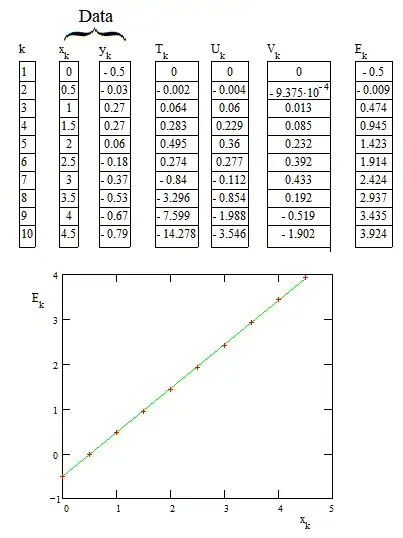
The differential equation can be transformed into an integral equation thanks to analytical integrations : $$y''+x^2y'+x=0$$ $$y'+x^2y-2\int xy\:dx+\frac12 x^2=c_1$$ $$y+\int x^2y\:dx-2\int\int xy\:(dx)^2+\frac16 x^3=c_1x+c_2$$ For numerical calculus $$y_k+T_k-2\,V_k+\frac16 x_k^3\simeq c_1x_k+c_2$$ $T_1=0\quad;\quad T_k=T_{k-1}+\frac12 (x_k^2y_k+x_{k-1}^2y_{k-1})(x_k-x_{k-1})\quad$ from $k=2$ to $k=n$.

$U_1=0\quad;\quad U_k=U_{k-1}+\frac12 (x_ky_k+x_{k-1}y_{k-1})(x_k-x_{k-1})\quad$ from $k=2$ to $k=n$.

$V_1=0\quad;\quad V_k=V_{k-1}+\frac12 (U_k+U_{k-1})(x_k-x_{k-1})\quad$ from $k=2$ to $k=n$.

We compute $\quad E_k=\big(y_k+T_k-2\,V_k+\frac16 x_k^3\big)\quad$ and check if the relationship with $x_k$ is linear. The statistical analysis of the errors according to some specified criteria of fitting allows to say if the data fits to a solution (not explicit) of the differential equation.

For more information about the method of fitting with integral equation : https://fr.scribd.com/doc/14674814/Regressions-et-equations-integrales

In addition, NUMERICAL EXAMPLE :
enter image description here

We observe that the $E_k(x_k)$ is quite linear as expected if the data approximately fits a solution of the differential equation. The linear regression gives $$E_k\simeq c_1\:x_k+c_2\quad\text{with } c_1=0.994\:;\: c_2=-0.517$$

After computing $c_1$ and $c_2$ it is possible to evaluate the initial conditions (at $x=x_1$) : $$y(x_1)=c_1x_1+c_2-\frac16 (x_1)^3\simeq y_1$$ $$y'(x_1)=c_1-(x_1)^2 y(x_1)-\frac12 (x_1)^2$$ For the above example the calculus was simplified because $x_1=0$ .

In fact, if the data was not approximate but exact and if the numerical integrations for $T_k,U_k,V_k$ were also exact, we should have found $c_1=1$ and $c_2=-0.5$

Of course all above doesn't gives the solution of the differential equation. Numerical methods and sofwares exist for solving the ODEs, given some conditions.

FOR INFORMATION :

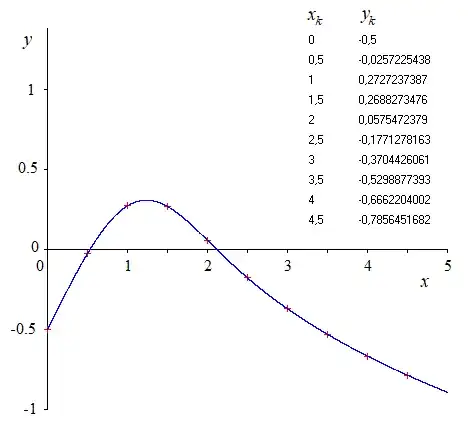
The data was coming from the numerical solving of $y''+x^2y'+x=0$ with conditions $y'(0)=1$ and $y(0)=-0.5$ for example. Then rounded $y_k$ were taken as data to be used for the above numerical example.
enter image description here

JJacquelin
  • 68,401
  • 4
  • 40
  • 91
1

We first need some way to estimate $k$:th derivative $d^ky/dx^k$ as Jacquelin mentions. There probably exist thousand ways to do this. Pick your favourite one.

Now we have data sets, for example $\{x,y,dy/dx,d^2y/dx^2\}$. We can create some arbitrary powerset of this. For simplicity just let $dy/dx$ be called $d$.

For example 2 degree polynomial: $$\{x,y,d,d^2,\\x^2,xy,xd,xd^2,\\yx,y^2,yd,yd^2,\\x^3,yx^2,x^2d,x^2d^2,\\xy^2,y^3,y^2d,y^2d^2\\x^2y,xy^2,xyd,xyd^2\}$$

You may see that the number of terms increase very fast.

This makes the use of some regularization more and more important the higher degree we use. Especially we want to be able to get sparse representation, for this a regularization norm of $<2$ or even $\leq 1$ is often desired. The last 10-15 years have seen growing popularity in $L_1$-norm regularizers. The solution is a vector of coefficients to the above data. The reason for the use of these norms in regularization is that we can get a sparse solution. This simplifies the model considerably. It is much nicer to have a model with say for example 3-4 terms (with non-zero coefficients) and some slightly larger error than a model with 24 terms and smaller error.

mathreadler
  • 26,534
  • Thanks for the expansion on the answer - I'm enjoying reading about these methods. – Raymond Hancock Sep 13 '19 at 10:31
  • 1
    Is this area a major field of research or is it just a small sub-area of statistics/calculus right now? – Raymond Hancock Sep 13 '19 at 12:24
  • Regularization is used everywhere in engineering and science where you try and solve "inverse" problems which could have millions of different solutions but where we want to find one or a few reasonably simple or well-behaved solutions. – mathreadler Sep 13 '19 at 12:32
  • @mathreadler. I up-vote your answer because it makes sense and it is presently an usual approach to this kind of problems. But I think that is not always the best way. – JJacquelin Sep 16 '19 at 18:32
  • All that you explain with ${x,y,dy/dx,d^2y/dx^2,...}$ can similarly done with ${x,y,\int ydx,\int(\int ydx)dx, ...}$. We can obtain sparse solutions as well. Of course they are integral equations instead of differential equations. The convenient differential equation is then derived from the convenient integral equation.

    The advantage is that the numerical evaluation of the integrals is generally much robust than the numerical evaluation of the differentials which requires some complicated methods of "regularization". I am a bit surprised that is not taken into consideration.

    – JJacquelin Sep 16 '19 at 18:33
  • I don't see why integral equations would help us any more than differential equations do. From my perspective avoiding regularization is not a strength, there is usually a trade-off where you lose generality in the solution in some sense when you do it. The strength lies in the number of freedoms you have available to define the regularizer. – mathreadler Sep 17 '19 at 09:23