10

Using the maximum modulus theorem in complex analysis, what is a good technique for finding the maximum of $|f(z)|$ on $|z|\le 1$, when $f(z)=z^2-3z+2$?

Got some really nice answers below, so I thought I'd share an image showing some contours of $|z^2-3z+2|$. Note that the magnitude does increase as we move "as far as possible" from the zeros (phrase used in answer below). And, at $z=-1$, note how the contour $|z^2-3z+2|=6$ is tangent to the circle $|z|=1$.
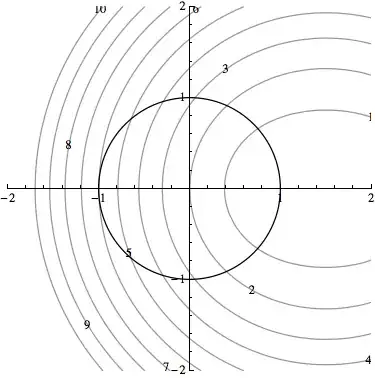
enter image description here

David
  • 2,322
  • Looks like I found one technique: http://math.stackexchange.com/questions/163543/maximum-value-of-the-modulus-of-a-holomorphic-function Are there any other suggestions? – David Mar 09 '13 at 19:57
  • 1
    What's wrong with simply setting $z = e^{i\theta}$ and setting the derivative w.r.t. $\theta$ equal to 0? – snar Mar 09 '13 at 20:45

1 Answers1

14

By the maximum modulus principle, the maximum is on the unit circle $|z| = 1$. Since $f$ has zeroes at $1$ and $2$, we would expect the maximum to be "as far as possible" away from those, i.e. at $x = -1$. Indeed, we have $f(-1) = 6$, and by the triangle inequality $$|f(z)| = |z^2-3z+2| \leq |z|^2+3|z|+2 = 6$$ on the unit circle. So $x=-1$ gives a maximum, but we still have to show that there are no other maxima.

Identifying $\mathbb C$ with $\mathbb R^2$, writing $z = x+yi$, the function becomes $$f(x,y) = (x^2-y^2-3x+2) + (2xy-3y)i$$ and we want to maximize $$|f(x,y)|^2 = (x^2-y^2-3x+2)^2 + (2xy-3y)^2$$ subject to the condition $x^2+y^2 = 1$. We can express $|f(x,y)|^2$ in terms of $x$ only, using $y^2=1-x^2$: \begin{align*}|f(x,y)|^2 &= (2x^2-3x+1)^2 + (2x-3)^2(1-x^2)\\ &= 8x^2-18x+10. \end{align*} The only maximum of this in $[-1,1]$ is at $x = -1$ .

marlu
  • 14,264
  • Really nice explanation. Little typo here: $$|f(x,y)|^2 = (x^2-y^2-3x+3)^2 + (2xy-3y)^2$$ – David Mar 09 '13 at 21:21
  • marlu, is that true in general that the point on the boundary at which $\vert f \vert$ is maximal is farthest away from the zeros? – The Substitute Feb 10 '15 at 11:56
  • I don't know. One might be able to prove something like that in general, but first one would have to say what exactly is meant by "farthest away from the zeroes". – marlu Feb 11 '15 at 14:33
  • @marlu sir, isn't by traingle inequality and by maximum modulus theorem it follows that maximum value of function $f(z)$ cannot exceed than $6$? and clearly it occurs when $z=-1$ Why need of rest of the calculation? Please sir help me... – Akash Patalwanshi Apr 27 '18 at 05:45
  • 2
    Yes, if you just want to know the maximum value (6) you don't need the rest of the calculation. You need it if you want to know where this value occurs (at $z=-1$ and no other point). – marlu Apr 28 '18 at 13:11