Beal's conjecture is a generalization of Fermat's last theorem. Fermat's last theorem states that there are no solutions to the equation $A^N+B^N=C^N$ where $A,B,C,N\in \Bbb{N}\space |\space N\ge 3$ In Beal's conjecture the exponents are allowed to vary independently, but there is an added restriction that the bases are coprime. So Beal's conjecture states that there are no solutions to the equation $A^X+B^Y=C^Z$ where $A,B,C,X,Y,Z\in\Bbb{N}\space |\space X,Y,Z \ge 3$ and $gcd(A,B)=gcd(B,C)=gcd(A,C)=1$
(As far as I'm aware this has not been proven or disproven yet.)
At one point Ramanujan looked into Fermat's last theorem he created generating functions which gave an infinite number of near miss solutions to Fermat's last theorem they are of the form $A^3+B^3=C^3\pm 1$ here are the generating functions and a few examples
My question: is there at least one near miss solution to Beal's conjecture? $$A^X+B^Y=C^Z\pm 1 \quad \text{{1}}$$ where $A,B,C,X,Y,Z\in\Bbb{N}\space |\space X,Y,Z \ge 3$ and $gcd(A,B)=gcd(B,C)=gcd(A,C)=1$
To be clear one near miss solution is sufficient. A generating function isn't necessary. (Although it would be extremely cool if someone finds one.)
Every equation which consists only of integer terms has an even number of odd terms. There can't be zero odd terms in {1} because $\pm 1$ is odd. There can't be two odd terms in {1} because that implies that there are two even terms and therefore one of the three gcd pairs isn't one. This leaves the only possibility that all terms in {1} are odd. Only odd bases can generate odd power numbers so $A$,$B$, and $C$ are all odd.
I have found two cases where all conditions are met except for coprime condition $3^3+15^4=37^3-1$ and $7^4+19^3=21^3-1$
I also found another case where the power numbers meet all conditions except for the $\pm 1$ and was only two off $31^3+63^3=23^4-3$
If there is a counter example one of the terms in {1} must be above $10^6$
Edit: I Realize that I should have stated this from the beginning. I want to avoid really trival counter examples so $A\neq 0, B\neq 0, C\neq 0, C\neq 1$. One of $A$ or $B$ can equal one but if this is the case the equation of the form $A^X+B^Y=C^Z+1$ cannot be used. If one of $A$ or $B$ is one then only the form $A^X+B^Y=C^Z-1$ is allowed. (If one of $A$ or $B$ is one then this would be equivalent to finding a pair of odd power numbers where both of the exponents are greater than two and the difference between the numbers in the pair is two. I don't think such a pair exists.)


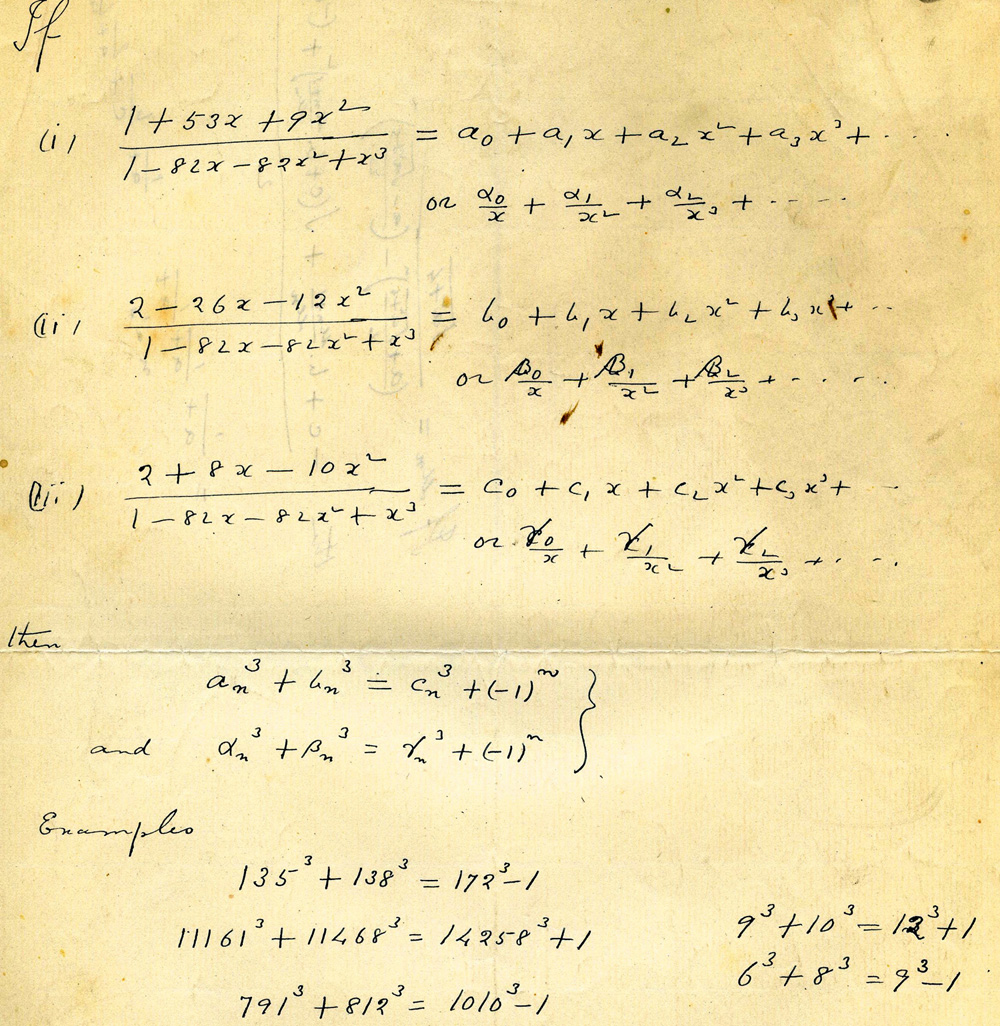
See: http://members.bex.net/jtcullen515/math10.htm
– vvg Oct 29 '20 at 09:44