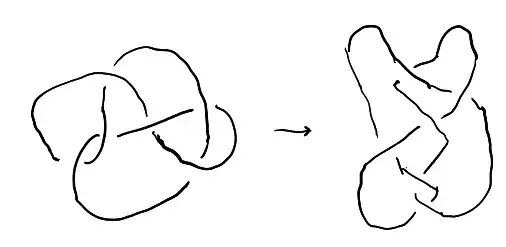
To make use of the idea that bridge number bounds the embeddability number, let's put $6_2$ into bridge position first:
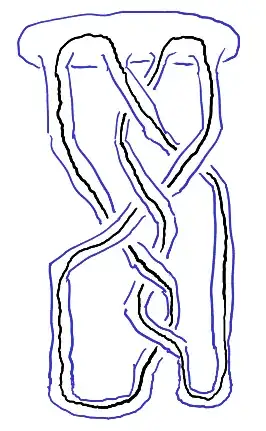
One way to get a surface for any knot is to make a tube that follows the entire knot, but the resulting torus isn't a "standardly embedded surface." A way to think of bridge position is that you are taking two unknotted $n$-tangles and gluing the boundaries together using some homeomorphism (the braid in the middle is a way to represent the homeomorphism, since there is a surjective homomorphism from the braid group $B_{2n}$ to the the mapping class group of the $2n$-punctured sphere), so by putting the "top" tangle on the $2n$-punctured sphere and the "bottom" tangle on $n$ tubes, the composite is a standardly embedded genus-$n$ surface.
Concretely, here is a genus $2$-surface for the bridge position above:
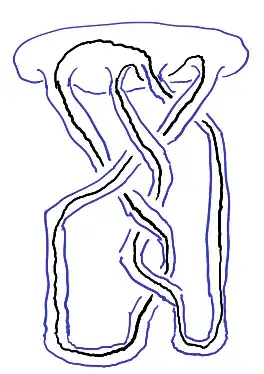
Why is this standardly embedded? Notice that the punctured sphere at the top can eat up the braid; the attached handles can freely move around, carrying the embedded knot with it. For example, here is one step of consuming the braid:
Fully consumed, the result is what one might call "a mess," but at least it's clear that the resulting genus-$2$ surface is standard:
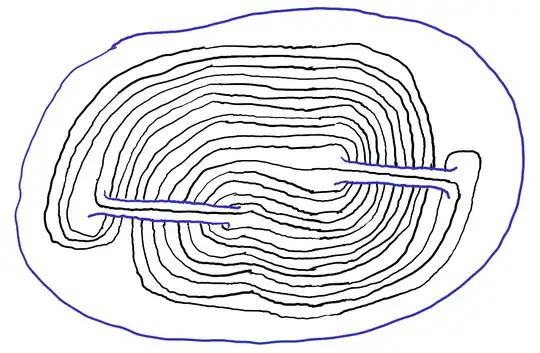
The blue is supposed to represent the surface, a sphere with two tubes glued into it.
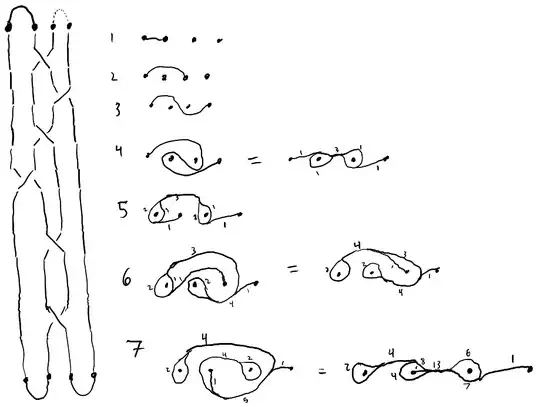
To calculate this, I made use of a structure called a traintrack on the punctured sphere to represent the two arcs between the punctures. As the braid acts on this pair of arcs, you can coalesce parallel segments into a single segment by allowing railroad switchers (or what I internally call splitters), then writing the weight on the segment to account for how many parallel tracks it is representing. An observation is that you only need to calculate what happens with one of the two arcs since there is only a single way, up to isotopy, to draw in the second arc. Hopefully this is enough information to make sense of the following computation, where each numbered step represents having consumed another braid generator:
A way of thinking about $n$-embeddability is that one wants a genus-$n$ Heegaard splitting of $S^3$ with the knot embedded in the splitting surface. This is related to the tunnel number $t(K)$ of the knot, but I'm not sure what the exact relation is.
One thing to notice about the surface obtained from the bridge position above is that each tube contains only a single strand, which seems potentially inefficient. This might give some intuition for why the bridge number is merely an upper bound for embeddability. However, it's known that $6_3$ is not a torus knot so the upper bound is sharp.


