We are going to show that $(a,b)$ belongs to one of the two lines with equations $b=\sqrt{a}$ and $b=\frac{1}{\sqrt{a}}$ as displayed on the following figure. It will give the answer, due to the symmetry of the system of equations with respect to the group of variables $(a,b)$ vs. $(c,d)$. Moreover, we will establish (see (*) at the bottom) that the last equation is superfluous.
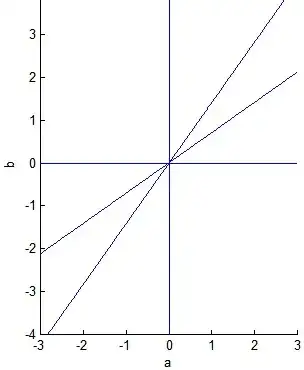
Here is the explanation :
Let :
$$S_1:=a+b, \ \ S_2:=c+d, \ \ P_1:=ab, \ \ P_2:=cd$$
The system constituted by the first three equations can be written, with these variables, using classical transformations :
$$\begin{cases}
(A) \ &S_1S_2&=&1& \ &\\
(B) \ &(S_1^2-2P_1)(S_2^2-2P_2)&=&9 & \ \implies \ & (C) \ 1-2(P_1S_2^2+P_2S_1^2)+4(P_1P_2)=9\\
(D) \ &(S_1^3-2P_1S_1)(S_2^3-2P_2S_2)&=&7 & \ \implies \ & (E) \ 1-3S_1S_2(P_1S_2^2+P_2S_1^2)+9(P_1P_2)=7.
\end{cases}$$
(equations (C) and (E) are obtained by expansion of (B) and (D) resp., using relationship (A)).
Setting
$$\alpha := P_1P_2 \ \text{and} \ \beta := P_1S_2^2+P_2S_1^2,$$
equations (C) and (E) become :
$$\begin{cases}
(C) & \ 2\alpha-\beta&=&4\\
(E) & \ 3\alpha-\beta&=&2
\end{cases} \ \ \implies \ \ \alpha=-2 \ \text{and} \ \beta=-8.$$
Using the fact that $S_1S_2=1$ and $\alpha=P_1P_2=-2$, equation $\beta=-8$ becomes :
$$P_1 \frac{1}{S_1^2} - \frac{2}{P_1}S_1^2 = -8$$
i.e.,
$$(F) \ \ \ \ P_1^2 + 8 P_1S_1^2 - 2 S_1^4 =0,$$
which can be considered as a quadratic equation in variable $P_1$ giving two solutions. Due to classical condition
$$(a+b)^2 \geq 2ab \ \iff \ S_1^2 \geq 2P_1,$$
only one of these solutions is eligible :
$$P_1=(-4+3\sqrt{2})S_1^2 \ \ \ \iff \ \ \ ab=(-4+3\sqrt{2})(a+b)^2 \ \ \ \iff \ \ \ (b-\sqrt{2}a)(b-\frac{\sqrt{2}}{2}a)=0$$
whence the result corresponding to the figure.
The parametric equations of the two lines are
$$(a,b)=(p,p \sqrt{2}) \ \ \text{and} \ \ (a,b)=(p,p \frac{\sqrt{2}}{2}), \ \ \text{for any} \ \ p \neq 0$$
Due to the symmetry of equations, we have as well, for any $q \neq 0$ :
$$(c,d)=(q,q \sqrt{2}) \ \ \text{and} \ \ (c,d)=(q,q \frac{\sqrt{2}}{2}).$$
A quick glance at any of the four equations show that necessarily $q=\frac{1}{p}$. We find back in this way all the solutions given by @Claude Leibovici and @A. Pongrácz .
(*) In fact, the fourth equation is a consequence of the first three. Here is why :
First of all, relationship (F) is equivalent to :
$$(G) \ \ \ \ S_1^4=\frac12P_1^2+4P_1S_1^2.$$
As the fourth equation can be written :
$$(H) \ \ \ \ (S_1^4+2P_1^2-4P_1S_1^2)(S_2^4+2P_2^2-4P_2S_2^2)=25,$$
using (G) in (H), we get :
$$\frac52P_1^2 \frac52P_2^2=25,$$
which is a tautology due to the fact that $\alpha=P_1P_2=-2.$


