Before I begin the question, it is meant to generalize to other theories, but I will focus on the natural numbers theory, with the following peano axioms:
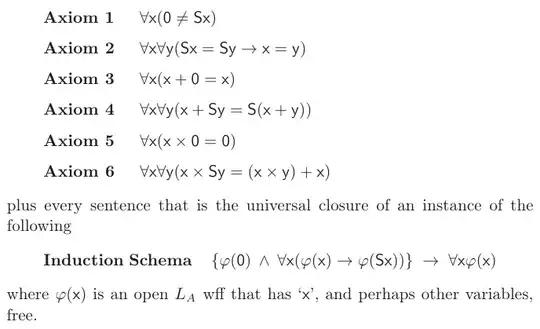
The question is, could the induction schema be proved instead of being an axiom schema by doing appropiate modifications to the logic and to the axiom list? I think that, intuitively, if one knows that all natural numbers are of the form $S...SS(0)$ and that $\varphi(0) \wedge \forall x(\varphi(x)\implies\varphi (Sx))$ then one should be able to deduce $\forall x \varphi(x)$. However, you can't prove that all natural numbers are of the form $S...SS(0)$ with axioms 1 to 6, so you could add that as an schema, where $n$ is a natural number: $$\text{No-cycles schema: } \lnot \exists x_1 \lnot \exists x_2 ... \lnot\exists x_n[S(x_1)=x_2 \wedge S(x_2)=x_3 \wedge ...\wedge S(x_n)=x_1]$$
If this schema is sufficient to capture the intuition of all natural numbers being of the form $S...S(0)$ (which I am not sure of), what could be added to the logical axioms/deduction rules/natural deduction system (without allowing for infinitely long proofs) to prove the induction schema?
Edit:
Thanks to helpful comments, I've realized that my question is twofold:
Can we create a theory where it's model doesn't have any deviant element? (it's fine if they have deviant properties). The closest formalization I can think of is that for every model of this theory has an order isomorphism ($x<y \iff S(x)=y$) with the standard model (under the same order).
If such a theory could be created and if we had it, would it imply induction? If not, what changes to the logical systems (avoiding infinite proofs) could be made to be able to prove induction?


