0

You're given the slopes $m_1, m_2, m_3$ of the equations of the sides of a triangle and you are requested to find if this triangle is a right triangle, an obtuse angled triangle, or an acute angled triangle, without calculating any of its internal ou external angles (trigonometric values of them).

Apart from the case of a right triangle, which is pretty obvious and readily assessed, what do you do?

MrDudulex
  • 728
  • Am I guaranteed to get them in order around the triangle? So for the triangle $(0,0),(3,0),(1,1)$ I would get $0,-\frac 12,1$ or some cyclic permutation and not $0,1,-\frac 12$? If so, think dot products of vectors along the slopes. – Ross Millikan Sep 13 '18 at 22:39
  • The order, in which the slopes of the equations of the sides are given, is irrelevant.It can be clockwise or anticlockwise – MrDudulex Sep 13 '18 at 22:44
  • There are no points given – MrDudulex Sep 13 '18 at 22:45
  • I was asking if we knew the order. I just gave points to specify a triangle so we could talk about the order of the slopes given. If we don't know if they are clockwise or counter I'll have to think some more. – Ross Millikan Sep 13 '18 at 22:51
  • Oh, excuse me, now I can understand what you've said. An order, as, for instance, $m_1>m_2>m_3$, is not given. – MrDudulex Sep 13 '18 at 22:53

1 Answers1

0

This explanation turned out longer than I thought but it's application in the example below is much shorter.

1/ Triangles with all negative or all positive gradients are obtuse triangles because a triangle with all angles less than $90$ degrees will have different signs for its gradients (perpendicular sides have negative reciprocal gradients). However, having gradients with different signs doesn't mean a triangle is necessarily acute.

2/ If two of the gradients are negative reciprocals of each other, then the triangle is a right triangle.

3/ For other triangles with different gradient signs, pick the single positive gradient or the lesser of the two positive gradients, say its line $1$ with gradient $m_1$ and determine its negative reciprocal. Now the gradients of the other $2$ sides $(2\ \text{and}\ 3)$ have to converge so there is only one way for their arrangement to work. Attaching these gradients to the ends and below line 1, the right end gradient has to be steeper than the left end gradient if both are negative. If the right hand end is steeper than the negative reciprocal of line $1$, then this is an obtuse triangle. If it isn't then the triangle is acute.

Where line $2$ and $3$ have different signs for their gradients, the positive gradient goes to the right end and the negative gradient to the left. If the left hand gradient is steeper than the negative reciprocal of line $1$, the triangle is obtuse.

If not, the last check is to determine if the angle between sides $2$ and $3$ is acute or obtuse. If the negative reciprocal of the left side is steeper than the right side, then the triangle is obtuse, if not the triangle is acute.

Example: for slopes $-1/5, 1/2\ \text{and}\ 3$

Picking the slope of $1/2$ as line $1$, it is pretty obvious that the left slope is $-1/5$ and the right slope is $3$ for the sides to converge. The negative reciprocal of $1/2$ is $-2$ whereby $-1/5$ is not steeper than $-2$ so both angles at the ends of line $1$ are acute.

Finally, the negative reciprocal of $-1/5$ is $5$ which is steeper than $3$ so the angle where sides $2$ and $3$ meet is obtuse so the triangle is obtuse.
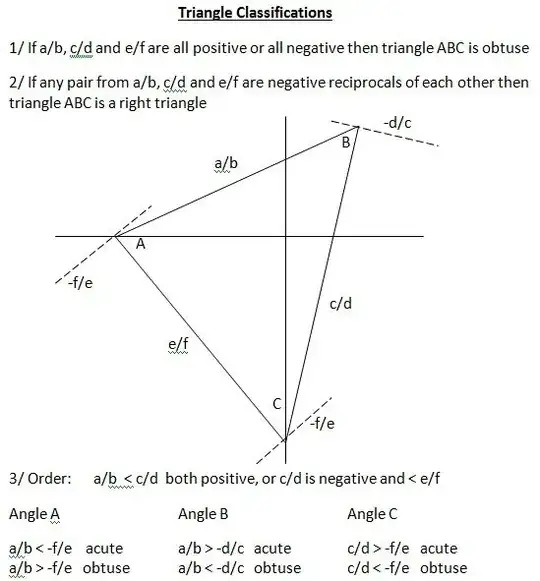
enter image description here

Phil H
  • 5,689
  • Interesting, albeit somewhat cumbersome. You seems to be in the right track to soon discover a very simple theorem (as simple as ignored by every precalculus textbook).Could you sum up your thoughts in a straightforward formula? – MrDudulex Sep 14 '18 at 02:18
  • Correcting: you seem to be in the right track... – MrDudulex Sep 14 '18 at 02:25
  • @MrDudulex I'll try to convert my explanation into a condensed set of mathematical steps. In short, (1) identify obvious obtuse and right triangles (2) determine order of slopes (3) determine obtuse and acute angles using negative reciprocals. It's late, I'll try and accomplish this tomorrow. – Phil H Sep 14 '18 at 03:02
  • Ok, I will wait your try.Good night. – MrDudulex Sep 14 '18 at 03:09
  • @MrDudulex Added a simplified version to my answer. I should add that there are several nuances addressed in my latest version which prevent even further simplification, ....by me that is. – Phil H Sep 14 '18 at 06:52
  • @Sorry for this late reply! I've decided to post the theorem which solves this kind of problem in a new question with the tag "proof verification". Soon you'll see it. – MrDudulex Sep 16 '18 at 18:02
  • I've just posted my theorem for proof verification: https://math.stackexchange.com/questions/2919798/a-theorem-for-classifying-triangles-when-given-only-the-slopes-of-the-equations – MrDudulex Sep 17 '18 at 04:29