Let us represent the Dirac delta by $\displaystyle\delta(x) = \lim_{\varepsilon\to 0^+} \eta_\varepsilon(x)$, where
$$
\eta_\varepsilon(x) = \frac{1}{\varepsilon}\text{rect}\left(\frac{x}{\varepsilon}\right) =
\left\lbrace
\begin{aligned}
&{1}/{\varepsilon}\, , & & {-\varepsilon}/{2} < x < {\varepsilon}/{2}\\
&0\, , & &\text{otherwise}
\end{aligned}
\right.
$$
is a rectangular function. We consider the Cauchy problem $u_t + u u_x = \eta_\varepsilon(x)$ with initial data $u(x,0) = 1$ for some $\varepsilon>0$.
For all abscissas $x_0$, the initial data is $u(x_0,0) = 1$. If $\varepsilon\to {+\infty}$, the (homogeneous) inviscid Burgers' equation is recovered. In this limit case, the characteristics are straight lines with slope 1 in the $x$-$t$ plane along which $u$ is constant. Now, we consider $\varepsilon<+\infty$. The first part of the method of characteristics gives ${\text d t}/{\text d s} = 1$. Letting $t(0)=0$, we know $t=s$. The other part reads
$$
\left\lbrace\begin{aligned}
\frac{\text d x}{\text d s} &= u(s)\\
\frac{\text d u}{\text d s} &= \frac{1}{\varepsilon}\text{rect}\left(\frac{x(s)}{\varepsilon}\right)
\end{aligned}\right.
$$
where $u(0)=1$ and $x(0)=x_0$. Several cases are examined:
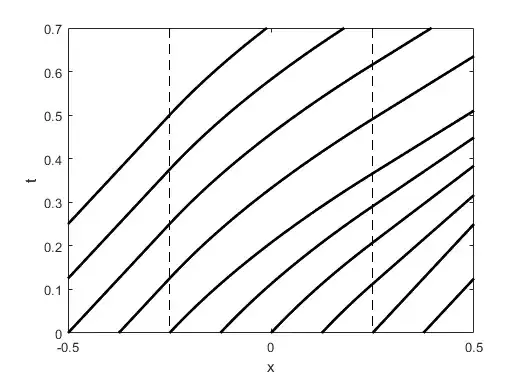
If $x_0\geq\varepsilon/2$, we start with $\text{rect}(x_0/{\varepsilon})=0$. Therefore, we know $u=1$ and $x=x_0+t$ for all $t$.
If $-\varepsilon/2<x_0<\varepsilon/2$, we start with $\text{rect}(x_0/{\varepsilon})=1/\varepsilon$. Therefore, we know $u=1+{t}/{\varepsilon}$ and $x=x_0+t+{t^2}/(2{\varepsilon})$ up to $t = t_1 = \varepsilon\left(\sqrt{2\left(1- x_0/\varepsilon\right)}-1\right)$, where $x=\varepsilon/2$. For $t > t_1$, we have again straight lines with equation $x = \varepsilon/2 + u_1\left(t - t_1\right)$, along which $u$ is constant and equal to $u_1 =\sqrt{2\left(1- x_0/\varepsilon\right)}$.
If $x_0\leq-\varepsilon/2$, we start with $\text{rect}(x_0/{\varepsilon})=0$. Therefore, we know $u=1$ and $x=x_0+t$ up to $t=t_1=-\varepsilon/2-x_0$, where $x=-\varepsilon/2$. From $t = t_1$, we have again $u=1+({t}-t_1)/{\varepsilon}$ and $x=-\varepsilon/2+t-t_1+{(t-t_1)^2}/(2{\varepsilon})$ up to $t = t_2 = t_1 + \left(\sqrt{3}-1\right)\varepsilon$, where $x=\varepsilon/2$. For $t > t_2$, we have again straight lines with equation $x = \varepsilon/2 + u_2\left(t - t_2\right)$, along which $u$ is constant and equal to $u_2 =\sqrt{3}$.
In the figure below, we represent the characteristics so-obtained for $\varepsilon = 1/2$:
The characteristic curve $x = \varepsilon/2 + t$ intersects a characteristic curve coming from $]-\varepsilon/2,\varepsilon/2[$ at $(x_b,t_b) = (\frac{3}{2}\varepsilon,\varepsilon)$. Hence, a shock wave is generated. On the right of the shock, the data is $u=1$. As long as the left data comes from $]-\varepsilon/2,\varepsilon/2[$, we have $t_1 = t - ({x_s-\varepsilon/2})/{u_1}$ and $t_1 = \varepsilon \left(u_1-1\right)$, which gives the data $u = u_1$. The abscissa $x_s$ of the shock satisfies the Rankine-Hugoniot condition $x'_s(t) = \frac{1}{2}\left(1 + u_1\right)$ with initial condition $x_s(\varepsilon) = \frac{3}{2}\varepsilon$, i.e.
\begin{aligned}
x'_s(t) &= \frac{1}{2}\left(1 + \frac{1+t/\varepsilon}{2}\left(1 + \sqrt{1 + 2\frac{\varepsilon-2x_s(t)}{1+t/\varepsilon}}\right) \right) \\
&\simeq 1+\frac{t}{2\varepsilon} + \frac{\varepsilon-2x_s(t)}{4}
\end{aligned}
which provides an approximation of $x_s(t)$.
To solve the full problem, one must consider also the case where the left data comes from $]-\infty,-\varepsilon/2[$, and then take the limit as $\varepsilon\to 0^+$.
The traffic flow problem with the ramp may be related to this post.


