added. Caution: it is not a single quadratic form that represents the primes you want, it is two quadratic forms. (Monday) Indeed, we can take the two forms to be $$ x^2 + 95 y^2 \; , \; \; \; 5 x^2 + 19 y^2 \; , $$
as these represent the same odd numbers as $x^2 + xy + 24 y^2$ and $5 x^2 + 5 xy + 6 y^2;$ for either of these latter forms to be odd, we need $x(x+y)$ odd, therefore $x$ must be odd and $y$ must be even, leading to $y=2t$ and forms $(x+t)^2 + 95 t^2$ and $5(x+t)^2 + 19 t^2 \; .$
ORIGINAL:Quite surprised how this worked out. There is a 1973 article by Estes and Pall that proves that, for binary forms, the spinor kernel is the fourth powers in the form class group. At the end I have put a list up to 2000 of the relevant primes; 5 and 19 are not there, this is a simple program that just counts distinct roots mod p.
Your form discriminant is $-95,$ positive binary forms.
The forms in the principal genus that are not fourth powers are the pair of "opposites" $\langle 4,1,6 \rangle$ and $\langle 4,-1,6 \rangle.$ These represent the same primes, for which your polynomial splits as two irreducible quadratics. Added: if you prefer, you may use $\langle 9,4,11 \rangle,$ or $9x^2 + 4xy + 11 y^2,$ as it represents a subset of the same numbers, exactly the same odd numbers, and the same primes. Let's see: while it is necessary to allow $xy$ both positive and negative in searching for values of $9x^2 + 4xy + 11 y^2,$ we still get bounds on $|x|,|y|$ since $9x^2 + 4xy + 11 y^2 \geq \frac{95}{11} x^2$ and $9x^2 + 4xy + 11 y^2 \geq \frac{95}{9} y^2.$ The first few such primes are
     11,     61,    101,    139,    149,    229,    271,    311,    359,    479,
    499,    541,    571,    619,    631,    691,    701,    719,    761,    769,
    881,   1031,   1049,   1061,   1069,   1259,   1279,   1301,   1489,   1499,
   1669,   1721,   1759,   1811,   1831,   1871,   1949,   1999,   2069,   2099,
   2221,   2239,   2251,   2381,   2441,   2531,   2671,   2851,   2969,   2999,
   3049,   3079,   3089,   3121,   3209,   3331,   3361,   3389,   3659,   3691,
   3779,   3881,   3911,   4001,   4051,   4111,   4159,   4229,   4241,   4339,
   4409,   4481,   4561,   4621,   4721,   4729,   4751,   4759,   4871,   5021,
   5039,   5051,   5059,   5099,   5261,   5419,   5441,   5519,   5591,   5641,
   5659,   5669,   5701,   5711,   5801,   5839,   5849,   5869,   5939,   6011,
   6029,   6199,   6271,   6389,   6469,   6571,   6581,   6599,   6619,   6689,
   6781,   6841,   6961,   6971,   7079,   7129,   7229,   7321,   7331,   7351,
   7459,   7549,   7639,   7649,   7829,   7901,   8101,   8111,   8209,   8219,
   8231,   8269,   8291,   8329,   8369,   8521,   8669,   8689,   8741,   8941,
   8969,   9041,   9049,   9091,   9181,   9221,   9239,   9371,   9391,   9421,
   9479,   9511,   9619,   9649,   9791,   9829,   9859,  10039,  10079,  10151,
  10271,  10391,  10531,  10651,  10789,  10891,  10979,
The principal form is $\langle 1,1,24 \rangle.$ With these primes, your polynomial splits as four distinct linear factors. Added: if you prefer, you may use $\langle 1,0,95 \rangle,$ or $x^2 + 95 y^2,$ as it represents a subset of the same numbers, exactly the same odd numbers, and the same primes.
    131,    239,    389,    419,    461,    821,    859,    919,   1051,   1109,
   1531,   1601,   1879,   1901,   2011,   2399,   2411,   2609,   2699,   2791,
   2971,   3011,   3041,   3469,   3541,   3559,   3671,   3709,   4139,   4219,
   4261,   4349,   4451,   4679,   4691,   4789,   4799,   4951,   5101,   5231,
   5279,   5479,   5821,   6089,   6229,   6521,   6959,   7151,   7559,   7699,
   7759,   7949,   7951,   8081,   8179,   8461,   8599,   8681,   8719,   9011,
   9029,   9311,   9319,   9349,   9431,   9631,   9661,   9811,   9839,   9941,
  10169,  10181,  10399,  10459,  10499,  10589,  10739,  10831,  11059,  11321,
  11701,  12071,  12101,  12641,  12791,  12829,  13171,  13259,  13399,  13469,
  13649,  13681,  13729,  13799,  13841,  14029,  14411,  14419,  14779,  14869,
  15091,  15361,  15439,  15739,  15881,  15889,  15971,  16061,  16091,  16189,
  16231,  16319,  16631,  16649,  17021,  17239,  17299,  17351,  17401,  17519,
  17579,  17581,  18061,  18149,  18169,  18251,  18401,  18701,  19009,  19139,
  19301,  19609,  19709,  20261,  20411,
The other fourth power is $\langle 5,5,6 \rangle.$ This represents $5$ and $19,$ for which the polynomial has repeat roots. Other primes represented also split your polynomial into distinct linear factors. Added: if you prefer, you may use $\langle 5,0,19 \rangle,$ or $5x^2 + 19 y^2,$ as it represents a subset of the same numbers, exactly the same odd numbers, and the same primes.
      5,     19,    191,    199,    251,    349,    491,    709,    739,    809,
    929,   1151,   1201,   1289,   1429,   1451,   1559,   1619,   1621,   2039,
   2129,   2281,   2341,   2551,   2591,   2741,   2819,   2861,   3019,   3329,
   3391,   3539,   3581,   3769,   3919,   3931,   4091,   4129,   4519,   4831,
   4861,   4889,   4909,   4919,   5179,   5381,   5431,   5521,   5749,   5861,
   6091,   6211,   6659,   6661,   6761,   7001,   7039,   7069,   7369,   7411,
   7529,   7541,   7681,   8171,   8699,   8779,   8821,   8839,   8861,   9241,
   9281,   9539,   9601,   9739,   9851,   9929,  10321,  10429,  10771,  10799,
  10949,  11069,  11119,  11329,  11549,  11789,  11971,  11981,  12119,  12281,
  12451,  12671,  12689,  12841,  12889,  13001,  13249,  13309,  13339,  13499,
  13691,  13781,  13931,  14159,  14221,  14551,  14561,  14731,  14741,  14831,
  15131,  15149,  15401,  15511,  15679,  15749,  15809,  16699,  16729,  16879,
  17011,  17231,  17599,  17789,  17791,  18059,  18089,  18289,  18379,  18439,
  18541,  18859,  18959,  18979,  19289,  19391,  19501,  19861,  20071,  20149,
  20201,  20341,  20479,  20759,  20771,  20879,
Here is the form class group for discriminant $-95$
jagy@phobeusjunior:~/old drive/home/jagy/Cplusplus$
jagy@phobeusjunior:~/old drive/home/jagy/Cplusplus$ ./classGroup
Absolute value of discriminant?
95
Discr  -95 = 5 * 19  class  number  8

 all
      95:  < 1, 1, 24>    Square        95:  < 1, 1, 24>
      95:  < 2, -1, 12>    Square        95:  < 4, -1, 6>
      95:  < 2, 1, 12>    Square        95:  < 4, 1, 6>
      95:  < 3, -1, 8>    Square        95:  < 4, -1, 6>
      95:  < 3, 1, 8>    Square        95:  < 4, 1, 6>
      95:  < 4, -1, 6>    Square        95:  < 5, 5, 6>
      95:  < 4, 1, 6>    Square        95:  < 5, 5, 6>
      95:  < 5, 5, 6>    Square        95:  < 1, 1, 24>

 squares
      95:  < 1, 1, 24>
      95:  < 4, -1, 6>
      95:  < 4, 1, 6>
      95:  < 5, 5, 6>

 fourths
      95:  < 1, 1, 24>
      95:  < 5, 5, 6>


Discriminant        -95     h :    8     Squares :    4     Fourths :    2
jagy@phobeusjunior:~/old drive/home/jagy/Cplusplus$
=====================================
These are the first few primes (NOT $5,19$ because they have repeated roots) for which the polynomial has four distinct roots.
jagy@phobeusjunior:~$  ./count_roots
131  count   1
191  count   2
199  count   3
239  count   4
251  count   5
349  count   6
389  count   7
419  count   8
461  count   9
491  count   10
709  count   11
739  count   12
809  count   13
821  count   14
859  count   15
919  count   16
929  count   17
1051  count   18
1109  count   19
1151  count   20
1201  count   21
1289  count   22
1429  count   23
1451  count   24
1531  count   25
1559  count   26
1601  count   27
1619  count   28
1621  count   29
1879  count   30
1901  count   31
2011  count   32
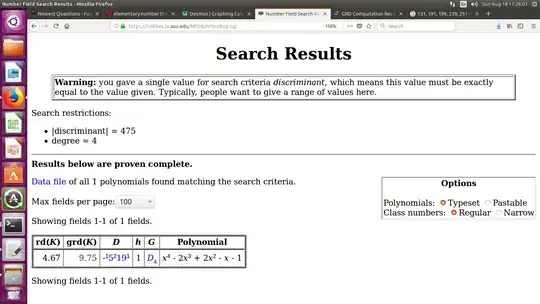
Note that the version of the polynomial used on the field website is something like $ -x^4 \cdot f\left(\frac{-1}{x}\right)$
Added Monday lunchtime: perhaps a little more attractive to say the primes giving four linear factors are represented by the two forms
$$ x^2 + 95 y^2 \; , \; \; \; 5 x^2 + 19 y^2 \; , $$
while the primes that give two irreducible quadratic are represented by
$$ 9 x^2 \pm 4xy + 11 y^2 $$


