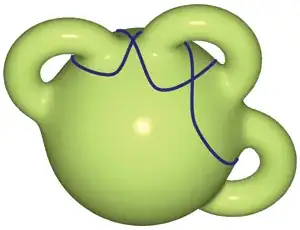
Let $(M^2,g)$ be a 2-dimensional complete Riemannian manifold (e.g. $(\mathbb{R}^2,\delta_{ij})$) and $p,q\in M$ two points with $p\neq q$. Let $\gamma:I\to M$ be a smooth embedded curve starting at $p$ and ending at $q$.
When does the curve shortening flow starting at $\gamma$ converge to a geodesic segment joining $p$ and $q$, i.e. the "shortest" curve joining the two points?
I am aware of Grayson's result that an embedded closed curve in a 2-manifold either shrinks to a round point or converges to a geodesic.
What results are known for curve shortening flow for line segments? Is the flow even well defined?