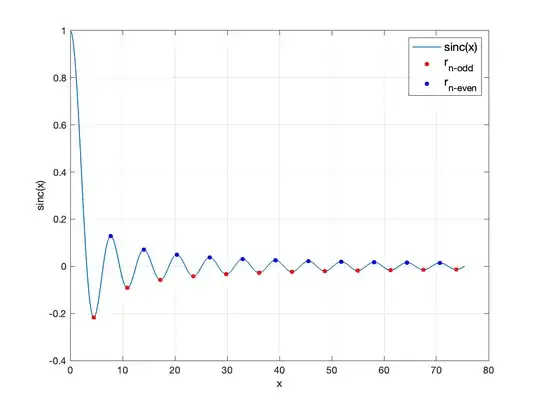
Here is a tested scheme for getting the maxima and minima of the sinc function. First of all, we all agree that we should set the derivative of the sinc function to zero. (Note that here I am taking $\text{sinc}(x)=\sin(x)/x$. You can always replace $x$ by $\pi x$). Now, the derivative of $\text{sinc}(x)$ is
$$\frac{d}{dx}\text{sinc}(x)=\frac{x\cos x-\sin x}{x^2}$$
and setting it to zero will lead to the condition
$$x-\tan x=0$$
This problem comes up in many areas of mathematics. The book, An Atlas of Functions, $2^{nd}$ Edition, by Oldham, Myland, and Spanier, Springer, 2009, shows that the the roots of the above equation, call them $r_n$, can be found efficiently by the equivalent relation
$$r_n=n\pi+\arctan(r_n)$$
where $(n-1/2)\pi<r_n<(n+1/2)\pi$. The beauty of this relation is that if always returns a value for $r_n$ that is less than the starting value. Hence, you can start an iteration at the upper limit of $r_n$ and proceed monotonically to the correct result. However, in my own program I simply used a root finder that I am already familiar with. Once you have the roots, you can get the values of the maxima/minima as $y_n=\text{sinc}(r_n)$.
Now, as for which roots are minima and maxima, well, odd-$n$ are minima and even-$n$ are maxima. These are shown as red and blue dots, respectively, in the figure below. Also by symmetry, we also have $y_n=\text{sinc}(-r_n)$ (not shown in the figure).