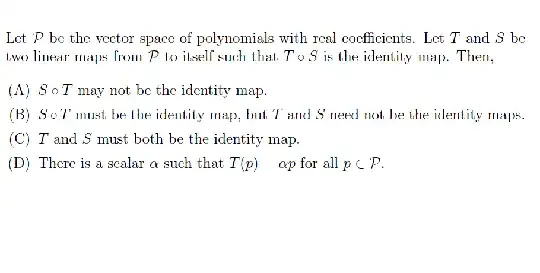
I came across the above problem and was trying to solve.Could someone point me in the right direction? Thanks everyone in advance for your time.
I came across the above problem and was trying to solve.Could someone point me in the right direction? Thanks everyone in advance for your time.

Hint: Try to think of operators $T,S$ satisfying the hypotheses. Think calculus.

Hint: Use what you know about a vector space (and the axioms satisfied) and what this means given that $P$ is a vector space.
Think of the linear maps $T, S$ as linear operators on $p \in P$: each mapping P \to P, and whose composition is the identity map $(T\circ S)(p) = T(S(p)) = p\in P$.
What do you know about two maps, when composed, being an identity map? Does anything change if you take $S(T(p)) = (S \circ T)p\;$?
Caveat
Be careful to distinguish the case of finite-dimensional vector spaces, from infinite dimensional vector spaces. What is true in finite-dimensional spaces, does not necessarily hold in infinite dimensional vector spaces, as is the case here.

With apologies to @amWhy and appreciation to @Gerry and @Christopher, I would like to offer an expanded answer to the question. The whole point of the problem posed was to make the reader aware of the distinction between finite-dimensional and infinite-dimensional vector spaces.
For self-maps, that is endomorphisms, of finite-dimensional spaces, a linear map is onto if and only if it’s one-to-one. This comes by dimension-counting, and one consequence is that if $S\circ T$ is identity, then so is $T\circ S$. For matrices, this means that if a square matrix $A$ has a left inverse $B$, then $B$ is also a right inverse of $A$.
The situation is quite different for infinite-dimensional spaces, and here just because $S\circ T$ is identity, there’s no justification in saying that $T\circ S$ also is identity. @Christopher’s hinted example of integration as your $T$, which sends $x^n$ to $x^{n+1}/(n+1)$, and differentiation as your $S$, which sends $x^n$ to $nx^{n-1}$, is apposite. Note that integration is one-to-one, two different functions have different antiderivatives, and differentiation is onto, every polynomial is the derivative of some polynomial. And in this case, $T\circ S$ sends any polynomial $f(x)$ to itself as long as $f$ has no constant term, but sends all constants to zero. So it certainly is neither one-to-one nor onto.
That’s why (A) was the correct answer, even though (B) would have been the correct answer for a finite-dimensional space.
I’d like to point out that the one-to-one map $T$ has inverses, but not uniquely in this case: since its image (“range” in the terminology of many) is not the whole of the space, there is considerable freedom in choosing a left inverse $S$ for it. For instance, we could have proclaimed that $S(f)=f'$ for polynomials without constant term, but $S(c)=c(17-3x^2)$ for constants $c$.

Let $S:P\to P$ be such that $(Sp)(x)=\int_0^xp(x)dx$ & $T:P\to P$ be such that $(Tp)(x)=\frac{d}{dx}p(x).$ It's a matter of verification that both of $S,~T$ are linear and $TS$ is the identity transformation where none of $S$ and $T$ are identity. So (C) is false. Note for $p(x)=x^2+5x+2,~(ST)p=S(2x+5)=\int_0^x(2x+5)dx=x^2+5x\neq p(x)\implies ST$ is not identity whence (A) is true and (B) is false. Again there's no $\alpha\in\mathbb R$ such that $x^2+5x+2\neq2x+5=T(x^2+5x+2)\implies$ (D) is false.
