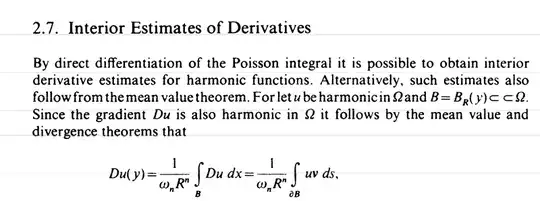
I am studying PDE from the book Elliptic Partial Differential Equations of Second Order by Gilbarg and Trudinger. Here I find difficulty to understand a concept. Here's this $:$
The author claims that if $u$ is harmonic on $B_R(0)$ then so is $Du$. But how is it possible? $Du$ is a vector-valued function and harmonic functions are all real valued functions. This problem in understanding leads to another problem which is the equality of integrals in the above picture i.e.
$$Du(y) = \frac {1} {\omega_n R^n} \int_B Du\ \mathrm {dx} = \frac {1} {\omega_n R^n} \int_{\partial B} u \nu\ \mathrm {ds}.$$
How can the above equality of integrals be obtained from the mean value and divergence theorem? I only know these two theorems for real valued function. I think mean value theorem can be extended for $Du$ here since $D_i u$ is harmonic on $B$ for $i=1,2, \cdots , n$ since $u$ is so. Thus we have the first equality of the above integrals. But I still find difficulty regarding the second equality of the integrals I.e. how do we find
$$\frac {1} {\omega_n R^n} \int_B Du\ \mathrm {dx} = \frac {1} {\omega_n R^n} \int_{\partial B} u \nu\ \mathrm {ds}.$$
Please help me in this regard.
Thank you in advance.

