2

I'm preparing for an exam in the signals and systems class I'm taking. One of the practice exams has a problem that requires you to take the Fourier transform of $\text{sinc}(4t)$.

From a table of Fourier transform pairs I found: $\dfrac{\omega_b}{\pi}\text{sinc}\left(\dfrac{\omega_b t}{\pi} \right)\Rightarrow \text{rect}(\omega/2\omega_b)$.

Using this I tried to match the given $\text{sinc}(4t)$ by rewriting it as $\dfrac14\dfrac{4\pi}{\pi}\text{sinc}\left(\dfrac{4\pi t}{\pi} \right)$. From this I get that $\omega_b = 4\pi$ and thus the Fourier transform should yield $\dfrac{1}{4}\text{rect}\left(\omega/8\pi \right)$.

But, in the exam solutions they show the Fourier transform to yield $\dfrac{\pi}{4}\text{rect}(\omega/8)$.

Any ideas where I'm going wrong?

Arturo Magidin
  • 417,286
  • 3
    You can't automatically use any table of Fourier transforms, since not everybody uses the same conventions (=definitions). Could you post the definition(s) you use in class and the ones that came with the table? – Gerben Mar 16 '11 at 21:47
  • What exactly do you mean be conventions. As far as the transform pair goes the one I posted in the question is what is listed in our book. – Ian Burris Mar 16 '11 at 22:03
  • 5
    There are two definitions of the sinc function in use; either $\sin x/x$ or $\sin \pi x/\pi x$. Could it be that the exam and the transform table differ in that regard? – Hans Lundmark Mar 16 '11 at 22:32
  • 2
    Also, there are two normalizations for the Fourier Transform; $\int_{\mathbb{R}}f(t)e^{-2\pi ixt}\mathrm{d}t$ and $\int_{\mathbb{R}}f(t)e^{-ixt}\mathrm{d}t$. – robjohn May 08 '12 at 21:35
  • related: https://math.stackexchange.com/q/25903/173147 – glS Aug 20 '24 at 16:48

1 Answers1

2

Because this is for signal analysis class, I will assume that $\newcommand{\Res}{\operatorname{Res}}\newcommand{\sgn}{\operatorname{sgn}}\newcommand{\sinc}{\operatorname{sinc}}\sinc(t)=\frac{\sin(\pi t)}{\pi t}$.

Since $\sinc(4t)$ is an even function, we have $$ \begin{align} \int_{-\infty}^\infty\frac{\sin(4\pi t)}{4\pi t}e^{-2\pi i\,xt}\,\mathrm{d}t &=\int_{-\infty}^\infty\frac{\sin(4\pi t)}{4\pi t}\cos(2\pi xt)\,\mathrm{d}t\\ &=\int_{-\infty}^\infty\frac{\sin(t(4\pi+2\pi x))+\sin(t(4\pi-2\pi x))}{8\pi t}\mathrm{d}t\tag{1} \end{align} $$ First note that $\int_{-\infty}^\infty\frac{\sin(k\pi t)}{\pi t}\mathrm{d}t$ is odd in $k$. For $k>0$, let's compute $$ \begin{align} \int_{-\infty}^\infty\frac{\sin(k\pi t)}{\pi t}\mathrm{d}t &=\int_{-\infty}^\infty\frac{e^{i\pi kt}-e^{-i\pi kt}}{2\pi it}\mathrm{d}t\\ &=\int_{\gamma^+}\frac{e^{i\pi kt}}{2\pi it}\mathrm{d}t-\int_{\gamma^-}\frac{e^{-i\pi kt}}{2\pi it}\mathrm{d}t\\ &=2\pi i\Res\left(\frac{e^{i\pi kt}}{2\pi it},0\right)-0\\ &=2\pi i\cdot\frac{1}{2\pi i}\\ &=1\tag{2} \end{align} $$ where both $\gamma^+$ and $\gamma^-$ go from $-R-i$ to $R-i$ and then $\gamma^+$ circles back counter-clockwise to $-R-i$ and $\gamma^-$ circles back clockwise to $-R-i$ and $R\to\infty$.

$\hspace{4cm}$enter image description here
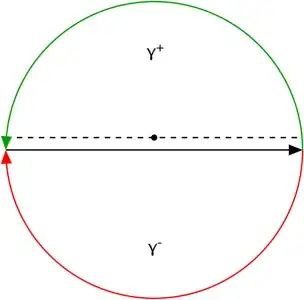
Equation $(2)$ and its oddness in $k$ says that $$ \int_{-\infty}^\infty\frac{\sin(k\pi t)}{\pi t}\mathrm{d}t=\sgn(k)\tag{3} $$ Combining $(1)$ and $(3)$ yields $$ \int_{-\infty}^\infty\frac{\sin(4\pi t)}{4\pi t}e^{-2\pi i\,xt}\,\mathrm{d}t=\frac{\sgn(4+2x)+\sgn(4-2x)}{8}\tag{4} $$ which is $\frac14$ for $x\in\left(-2,2\right)$, $\frac18$ for $x\in\left\{-2,2\right\}$, and $0$ elsewhere.

robjohn
  • 353,833