7

This answer cites a result which states the following

Theorem. Let $X$ be a topological space which is

  • countable,
  • metrizable,
  • has no isolated points.

Then $X$ is homeomorphic to $\Bbb Q$ with the usual order topology.

But how is this even possible? I made no effort to understand the proof $-$ yet. Mostly because until now it seems more "obvious" that this is false. How about the following "counterexamples":

  • Example 1. $\Bbb Q$ and $\Bbb Q^2$ are both countable, metrizable, have no isolated points and are connected. But removing a single point diconnects $\Bbb Q$ but not $\Bbb Q^2$.

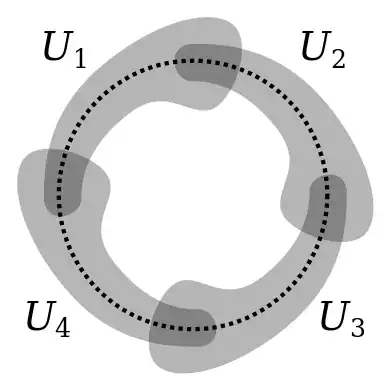
  • Example 2. What about $X=\Bbb Q^2\cap S^1$? It seems we can cover $X$ with connected open sets $U_i,i\in\Bbb Z_4$ so that $U_i\cap U_j=\varnothing$ if and only of $i-j=2$. Seems not possible for $\Bbb Q$.

$\qquad\qquad\qquad\qquad\qquad\qquad\qquad$

All my counterexamples use the term "connected". Are there some subtleties with this term which I am overlooking?

M. Winter
  • 30,828
  • 4
    $\mathbb{Q}$ and $\mathbb{Q}^2$ are totally disconnected. In fact, a connected metric space containing more than one point must have cardinality at least $2^{\aleph_0}$. – Daniel Fischer Nov 15 '17 at 14:36
  • 2
    Take your favourite irrational number $x$. Then consider the subsets of the real line $(-\infty,x)$ and $(x, \infty)$. In the subspace topology on $\mathbb{Q}$, these are disjoint open sets which cover $\mathbb{Q}$, and so $\mathbb{Q}$ is disconnected. Since $x$ was an arbitrary irrational, this might give some insight into why $\mathbb{Q}$ is "very" disconnected. – gj255 Nov 15 '17 at 14:58
  • I know there are proofs out there, but I agree with you. It ought to be false ;-) – user334639 Nov 15 '17 at 15:11
  • @gj255 This was insightful! Thank you. I was just blind for this more or less "obvious" fact :D If you put this comment as an answer to my false assumptions about $\Bbb Q$'s connectivity, then I can give a +1 (same goes for Daniel Fischer). – M. Winter Nov 15 '17 at 15:35
  • @DanielFischer Do you have some source or search term for this cadinality result? Sounds interesting. – M. Winter Nov 15 '17 at 17:08
  • 2
    For a fixed $p$ consider $x \mapsto d(x,p)$. Its image is a connected subset of $[0,+\infty)$. It contains $0$, and since $p$ isn't isolated, it contains some nonzero value. – Daniel Fischer Nov 15 '17 at 17:11
  • A quick comment on the Daniel Fischer's argument: suppose $a, b$ are in the image of that map - that is, there are $q, r$ with $d(p, q)=a$ and $d(p, r)=b$, and $a<c<b$. If $c$ is not in the image of the map, then think about the sets ${s: d(p, s)<c}$ and ${s: d(p, s)>c}$, and what that says about the connectedness of the space ... – Noah Schweber Nov 15 '17 at 22:47
  • At the same time, it's worth observing that if we replace "metric space" with "topological space" then connectedness is not enough to give us uncountability: e.g. the indiscrete topology on any set is always connected, trivially. – Noah Schweber Nov 15 '17 at 22:48

3 Answers3

8

You are incorrectly assuming that $\mathbb{Q}$ is connected. In particular, removing a single point from $\mathbb{Q}$ doesn't change it, even when viewed as a linear order (which gives more data than just the topology): any two countable dense linear orders without endpoints are isomorphic. This is due to Cantor, and is an example of a back-and-forth argument. It's a hard exercise to prove this from scratch, but I think it's a good one; and once you understand the proof (either by finding it yourself or by reading it) I think you'll have a good start on the intuition for why the various modifications of $\mathbb{Q}$ you're considering - $\mathbb{Q}^2$, "$S^1$-version" of $\mathbb{Q}$, etc. - don't actually yield different topological spaces.

Noah Schweber
  • 260,658
6

As a complement to Noah's answer: the error is the assumption that $\mathbb{Q}$ is connected, but why isn't it? Intuition might suggest that $\mathbb{Q}$ is connected because there aren't any large gaps in the space; for any rational, there are rationals to the left and to the right that are arbitrarily close by. This is not true of $\mathbb{Q}\backslash(0,1)$, for instance, which looks more obviously disconnected.

If we're inclined to think something like this, then we need to correct our intuition for connectedness! It is known that removing a single point from $\mathbb{R}$ results in a disconnected space, and this suggests that even 'tiny' gaps in a space can disconnect it. But there are plenty of tiny gaps in $\mathbb{Q}$ – in particular, it is missing all of the irrational numbers.

This suggests that the rationals are not just disconnected, but also in some sense 'very disconnected'; the irrational numbers – the gaps in our space – permeate the entire number line. Let's make this formal:

Theorem: the rational numbers are totally disconnected, in that every subset is either disconnected or contains at most one element.

Proof: suppose our subset $S$ contains elements $a,b$ with $a < b$. Between any two rational numbers there exists an irrational number $x$. Let us construct the following subsets of $\mathbb{R}$:

$$ A = (-\infty, x) \quad B = (x, \infty) \,.$$

Then in the subspace topology on $S$, $S \cap A$ and $S \cap B$ are disjoint open sets that cover $S$. So $S$ is disconnected.

gj255
  • 2,960
  • 22
  • 34
3

It is my opinion that looking at metric spaces clouds the essence of how to characterize $\mathbb Q$ as a topological space. So we throw that out at the start of this probe...


The question/answer

Showing $\mathbb{Q}$ is homeomorphic to $\mathbb{Q}^2$,

when seen for the first time has a bit of 'surprise element' to it; counter-intuitive or just weird, take your pick.

Applying the 'forgetful functor' to $\mathbb{Q}$, stripping away everything but the topology is a fun thing to think about. I've been on that journey the past few days; you might find this of interest:

Let $X$ be any countably infinite set with a well-ordering $X \equiv \mathbb N$,

$\quad s_0,s_1,s_2,s_3,\dots,s_n,\dots$

The element $s_0$ is in $X_0 = X$. We can certainly partition $X_0$ into two infinite disjoint sets $X_\text{00}$ (left) and $X_\text{01}$ (right) with $s_0 \in X_\text{00}$ and $s_1 \in X_\text{01}$. From this point on, we put the 'next element' to the 'left' or 'right' as we divide sets. So if $s_2 \in X_\text{00}$, divide $X_\text{00}$ into two disjoint infinite sets $X_\text{000}$ and $X_\text{001}$ with $s_2 \in X_\text{000}$ and $s_0 \in X_\text{001}$.

So, when you finish processing $s_n$, the set $X$ will be partitioned into $n+1$ infinite sets each containing exactly one $s_k$ with $k \le n$. It will be a finer partition than the preceding recursion performed on $s_{n-1}$.

Proposition 1: The sets $X_\tau$ form a countable basis of sets, defining a topology on $X$.
Proof: Easy exercise.

I haven't worked out all the details, but once I checked and saw the $3^{rd} \text{-method}$ in the
'3-proofs paper', this is worth some study:

Exercise: Show that $X$ is homeomorphic to $\mathbb Q$.

The set $X$ with this topology is, to my way of thinking, the purest point-set approach to describing the topology on $\mathbb Q$ - it is the 'canonical' set theoretic form. Knowing no theory, it will 'push you along' to discover interesting facts.
CopyPasteIt
  • 11,870