Proof
Lemma 1: For $x>1,\quad\left(\frac{-\ln x+2n}{2n-1+x}\right)^n < \left(\frac{-\left(1-\frac{1}{x}\right)+2n}{(2n-1+x)}\right)^n$
Proof, where the first step is proven here:
$$\begin{aligned}
\ln x &> 1-\frac1x;& x>1
\\
-\ln x+2n &< -\left(1-\frac{1}{x}\right)+2n
\\
\left(\frac{-\ln x+2n}{2n-1+x}\right)^n &< \left(\frac{-\left(1-\frac{1}{x}\right)+2n}{(2n-1+x)}\right)^n;& (2n-1+x)>0
\end{aligned}$$
Lemma 2: For $n>1,t>1,\quad{\frac{t}{t^n}+2nt-(t^n+t)}<2n-1$
Proof, where the first assumption can be proven by induction:
$$\begin{aligned}t^{n}&>t\left(\frac{1}{t^n}+(2n-1)\right)-(2n-1);& n>1, t>1
\\
t^{n}+t&>t\left(\frac{1}{t^n}+2n\right)-(2n-1)
\\
-t^{n}-t&<-t\left(\frac{1}{t^n}+2n\right)+(2n-1)
\\
{\frac{t}{t^n}+2nt-(t^n+t)}&<2n-1
\end{aligned}$$
Lemma 3: For $n>1,x>1,\quad\left(\frac{{-(1-\frac1x)+2n}}{2n-1+x}\right)^n<\frac{1}x$
Using lemma 2, with the substitution $x=t^n$,
$$\begin{aligned}
{\frac{x^{1/n}}{x}+2nx^{1/n}-(x+x^{1/n})}&<2n-1
\\
x^{1/n}\left({\frac1x+2n-1}\right)&<{2n-1+x}
\\
x\left({\frac1x+2n-1}\right)^n&<\left(2n-1+x\right)^n
\\
\frac{\left({\frac1x+2n-1}\right)^n}{\left(2n-1+x\right)^n}&<\frac{1}x;&{\left(2n-1+x\right)^n}>0
\\
\left(\frac{{-(1-\frac1x)+2n}}{2n-1+x}\right)^n&<\frac{1}x
\end{aligned}$$
Combining lemma 1 and lemma 3, we have $\left(\frac{-\ln x+2n}{2n-1+x}\right)^n<\left(\frac{{-(1-\frac1x)+2n}}{2n-1+x}\right)^n<\frac{1}x$, as desired.
Addendum
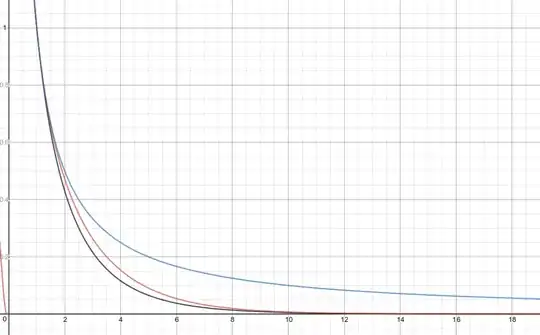
We can create the sharper bound, for sufficiently small $x>1$, $\left(\frac{-\ln x+2n}{2n-1+x}\right)^n < e^{(1-x^2)/(2x)}<\frac1x$. The reason $x$ must be small is because the inequality reverses for sufficiently large $x$. The inequality can be found by using the substitution $u=1-2n$ and observing:
$$\left(\frac{-\left(1-\frac{1}{x}\right)+2n}{(2n-1+x)}\right)^n=\underbrace{\left[\frac{\left(1-\frac{x}{u}\right)^u}{\left(1-\frac{1/x}{u}\right)^u}\right]^{1/2}}_a \underbrace{\left[\frac{1-\frac{x}{u}}{1-\frac{1/x}{u}}\right]^{-1/2}}_b$$
As $n\to +\infty$, $a$ approaches $\left(\frac{e^{-x}}{e^{-1/x}}\right)^{1/2}=e^{(1-x^2)/(2x)}$, while $b$ approaches $1$.
As shown in the figure below, the red curve, $e^{(1-x^2)/(2x)}$, forms a closer bound of the black curve, $\left(\frac{-\ln x+2n}{(2n-1+x)}\right)^n;\quad n=20$, than the blue curve, $\frac1x$. However, the inequality reverses around $x>14.3$.