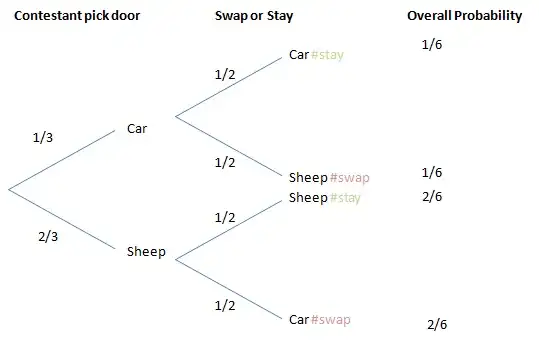
The key to the solution of the Monty Hall problem is that Monty Hall reveals one of the incorrect solutions after stage one. The problem ends up being exclusively about the door that you choose versus the one that is left.
This means that the probabilities are as follows:
We will assume Door 1 is the car and Door 2 and 3 are sheep.
Choose Door 1:
Monty can reveal door 2 or 3, so you have a choice between 1 and whichever of those is left, both being incorrect. Swapping will give you sheep in either case (each possibility with a 1/6th chance, for a 1/3rd chance total)
Choose door 2:
Monty reveals door 3 as incorrect. You WILL get the car if you swap for Door 1. (1/3rd chance).
Choose Door 3:
Monty reveals door 2 as incorrect. You WILL get the car if you swap for Door 1. (1/3rd chance)
If you choose to always stay, you will only have a 1/3rd chance of a car.
How is this related to your question?
If you look at all six probabilities for staying and swapping at once, you will get the answer you saw, and you will see a 1/2 chance of getting the car (2/6 if you do swap plus 1/6 chance if you don't swap). That doesn't show the impact of making a choice.
Using your chart, just compare the red "swap" probabilities to each other to see the impact of always swapping. If you ALWAYS choose to swap, you have a 2/3rd chance of being correct. If you ALWAYS choose to stay, you have a 1/3rd chance to be correct. The possible choices have to be examined independently to assess individual merit of a given choice.
Your question states as if you always choose to swap, but your examples show that you are accounting for both swapping and staying. Once you remove the chance of staying, you are only left with three possible results, not 6.