1

Given $P_k$, the truncated Prime $\zeta$ function, defined like $$ P_k(it):=\sum_{n=1}^k p_n^{it}, $$ where $p_n$ is the $n$th prime. What's the probability to find a value or range of $t$ less than $T$, where $|P_k(it)|<\epsilon$?

EDIT By that I mean, among all values of $t<T$, how large is the portion of values, where $|P_k(it)|<\epsilon$?

To give an example, I plotted $P_{500}(it)$, where $0<t<400$:

$\hskip0.7in$enter image description here
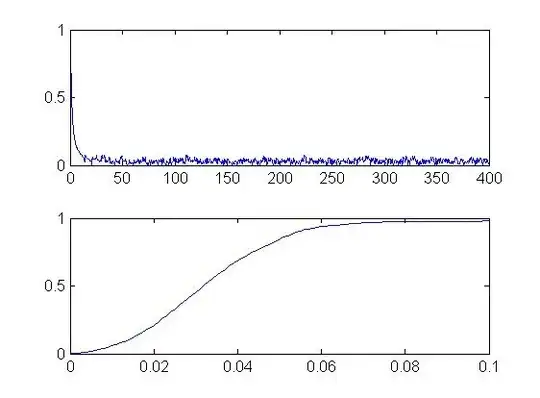
The lower plot shows the portion of values that lies below a certain threshold. Almost all values lie below $.1$. I interpret the lower plot as the sum over the distribution.

draks ...
  • 18,755
  • It's not clear what you mean by "the probability to find...". That might depend on how you are looking for it. – Robert Israel Nov 14 '12 at 23:14
  • There seems to be no probability at all in this question. – Did Nov 15 '12 at 07:29
  • @did, why not? The probability to find a value $|P_k(it)|\le k$ is $100%$ irrespective of $t$ and $T$... – draks ... Nov 15 '12 at 08:00
  • (Not independent of T.) The only probability space involved is [0,T] endowed with the normalized Lebesgue measure... Unless the proof involves some probabilistic techniques such as conditioning, change of measure, independence, whatever (and I see no reason to suspect it does), this is purely (deterministic) number theory. – Did Nov 15 '12 at 09:07
  • Ok, so what's the solution to this purely (deterministic) number theoretic problem? Sorry if I put it in the wrong box... – draks ... Nov 15 '12 at 09:49
  • No idea. And no idea whether this is known by the experts. – Did Nov 15 '12 at 13:19

1 Answers1

1

If $t$ is chosen randomly (uniformly) from a large enough interval, $p_n^{it}$ for different $n$ should be good approximations to independent random variables with uniform distribution on the unit circle. This distribution has mean $0$ and covariance matrix $\pmatrix{1/2 & 0\cr 0 & 1/2\cr}$. The sum, for large $k$, has approximately a bivariate normal distribution with mean $0$ and covariance $\pmatrix{k/2 & 0\cr 0 & k/2\cr}$. Its absolute value has PDF $f(r) = \dfrac{2 r}{k} e^{-r^2/k}$ for $r > 0$,
CDF $F(r) = 1 - e^{-r^2/k}$ for $r > 0$, mean $\sqrt{k\pi}/2$ and standard deviation $\sqrt{(1-\pi/4) k}$.

Are you sure your $P_k$ doesn't have a factor $1/k$?

Robert Israel
  • 470,583