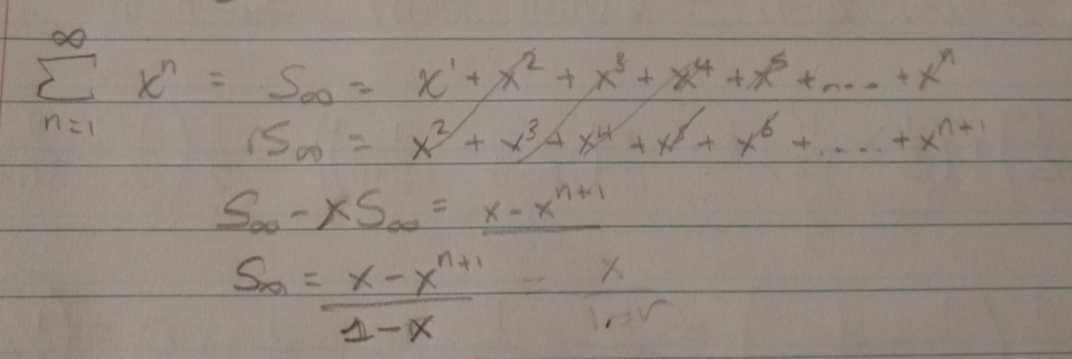
For what values of $x$ does this converge? Diverge? And show justification $$ \sum_{n=1}^\infty x^n $$ I know that it converges when $|x| < 1$ and diverges when $|x| \ge 1$
However I don't know how to justify this. I can explain it by writing and I did it so by saying this
If you raise a number greater or equal to 1 to a power and add each value, it would go to infinity. However if you take a fraction and raise it to a power, the denominator gets larger and faster, than the numerator, meaning the last term will be $0$ and there will be a final term, meaning there will be a number of finite terms, rather than a number of infinite terms meaning it converges.
I think this is correct, however I'm not so sure how to justify this with "math"