It depends somewhat upon your purpose.
If for example, you want to uniformly generate a collection of points on a unit sphere you could use the direction cosines $\alpha,\,\beta,\,\gamma$.
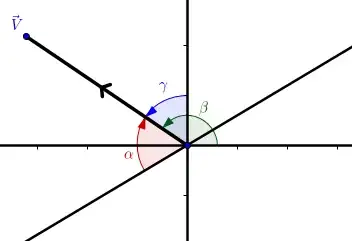
These are not independent, however, since
$$\cos^2\alpha+\cos^2\beta+\cos^2\gamma=1$$
So you could identify each unit vector $\vec{V}\in\mathbb{R}^3$ with a triplet $(\alpha,\beta,n)$ where $\alpha$ and $\beta$ are selected uniformly from $[0,\pi]$ and $n$ is selected uniformly from $\{-1,1\}$
so that
$$ \gamma= \frac{\pi}{2}+n\left(\frac{\pi}{2}-\cos^{-1}(1-\cos^2\alpha-\cos^2\beta)\right)$$
and resulting in a probability density function
$$f(\alpha,\beta,n)=\frac{1}{4\pi}$$
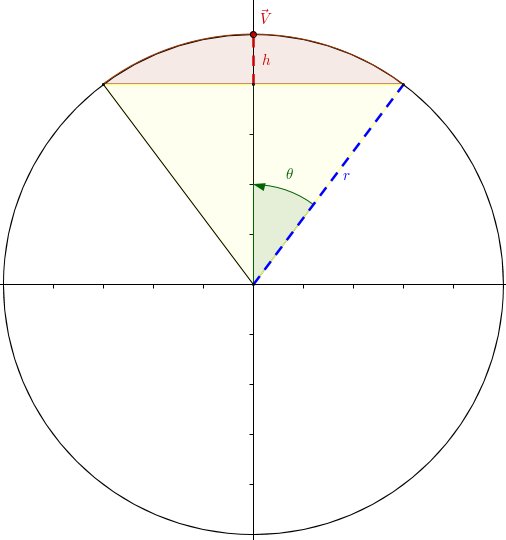
Another approach could be based upon the surface area of the cap of a central cone of a sphere.
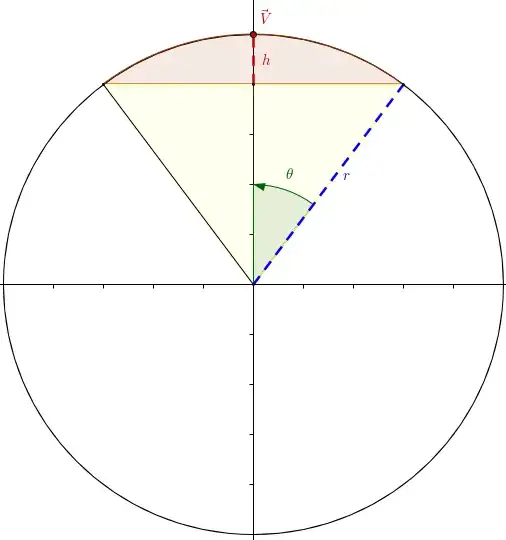
The surface area of a spherical cap on a sphere of radius $r$ and associated with a central cone with aperture $2\theta$ is given by
$$ A=2\pi rh $$
where $h=r-r\cos\theta$ thus
\begin{eqnarray}
A&=&2\pi r^2(1-\cos\theta\\
&=&4\pi r^2\left(\frac{1-\cos\theta}{2}\right)\\
&=&4\pi r^2\sin^2\left(\frac{\theta}{2}\right)
\end{eqnarray}
As a proportion of the entire surface area $4\pi r^2$ of the sphere we have the cumulative distribution function of the uniform distribution on the sphere
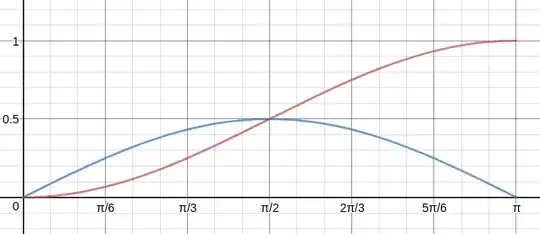
$$ F(\vec{V},\theta)=\sin^2\left(\frac{\theta}{2}\right) $$
and a probability density function of
$$ f(\vec{V},\theta)=\frac{1}{2}\sin\theta $$