Build-Up
One intuitive way to define/ characterize the dot and cross products is in terms of the projection and rejection operations.
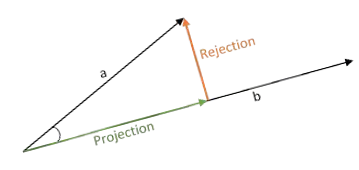
The dot product can be thought of as a way to measure the length of the projection of a vector $\mathbf u$ onto a vector $\mathbf v$. Specifically $$\mathbf u\cdot \mathbf v = \pm\|\mathbf v\|\|\operatorname{proj}_{\mathbf v}(\mathbf u)\|$$ where the sign is determined by whether the angle between the vectors is acute or obtuse. And of course, when the angle between the vectors is right, the projection $\operatorname{proj}_{\mathbf v}(\mathbf u)$ is just the zero vector $\mathbf 0$, and hence $\mathbf u\cdot \mathbf v = 0$.
The cross product, analogously, can be thought of as a way to measure the length of the rejection of a vector $\mathbf u$ from a vector $\mathbf v$. However, if you also want information on which direction the rejection points in (which is analogously given by the $\pm$ in the dot product), then it turns out that there's no way to do this consistently in a three dimensional space using a scalar. But we can describe the direction using a vector quantity -- though to make it a bit more symmetric (or technically anti-symmetric) in the arguments of the cross product, there are only two choices that we could make for the direction (they correspond to the usual right-hand rule and an alternate way of defining the cross product via a left-hand rule).
I won't go through the full process of motivating and constructing the cross product here as it's not necessarily a short argument and besides it's probably something that you'll learn better by working it out on your own. But here's the way we define/ characterize the cross product in $\Bbb R^3$ $$\mathbf u\times \mathbf v = \|\mathbf v\|\|\operatorname{rej}_{\mathbf v}(\mathbf u)\|\mathbf n$$ where $\mathbf n$ is the unique unit vector in our (three dimensional) space which is orthogonal to both $\mathbf u$ and $\mathbf v$ and where $(\mathbf u,\mathbf v, \mathbf n)$ forms a right-handed sequence -- i.e. the unit vector we obtain from the right-hand rule.
To further expand on the relationship between the definitions of the dot and cross products, notice that in the vector space $\Bbb R$, the only unit "vectors" are $1$ and $-1$. So if we defined $\mathbf n$ to be $1$ when the angle between $\mathbf u$ and $\mathbf v$ is acute and $-1$ otherwise, then we could write $$\mathbf u\cdot \mathbf v = \|\mathbf v\|\|\operatorname{proj}_{\mathbf v}(\mathbf u)\|\mathbf n$$
Answer
So the answer to your question is that the cross product of two parallel vectors is $\mathbf 0$ because the rejection of a vector from a parallel vector is $\mathbf 0$ and hence has length $0$.


