1

Two tangents are drawn from a point $P$ to the circle $x^2+y^2=1$. If the tangents make an intercept of $2$ on the line $x-1=0$, then what is the locus of $P$?

A) Parabola
B) Pair Of lines
C) Circle
D) Straight Line

What i did was to assume two tangents from point $P$ as $$y=mx \pm \sqrt{m^2+1}$$

and equate it with $x=1$. Sure it gives a value but how do i decide the ordinate then? Should I use symmetry or there is a better sophisticated method for this one?

Derek Allums
  • 3,197
  • You'l get value of m from given stuffs and then assume P(h,k) and then substitute ( h,k) in $x^2+y^2=1$ – Iti Shree Apr 24 '17 at 23:57
  • @ItiShree I can't seem to solve it. I'm getting $m^2=-1$ which makes no sense – The Dead Legend Apr 25 '17 at 00:08
  • Did you mean “Two tangents are drawn from a point $P$ to the circle.,..?” There’s only one tangent to a point on a circle. – amd Apr 25 '17 at 01:57
  • There is an external point $P$ from where we are drawing the tangent @amd – The Dead Legend Apr 25 '17 at 01:59
  • That’s not what you wrote, though. Now, please explain what you mean by “an intercept ot 2.” – amd Apr 25 '17 at 02:00
  • I wrote that only. @ amd. As far as "intercept of 2" is concerned. I think it's equivalent to the length intercepted by the tangents upon intersection with $x=1$. Although even I'm not sure about this part. – The Dead Legend Apr 25 '17 at 02:04
  • By speculative inspection, the locus of $P$ includes as limit points the points $(0,\pm2)$ and $(\pm \infty, 0),$, which eliminates all options but B) and would leave the pair of lines $y=\pm1$ as candidates. – dxiv Apr 25 '17 at 05:29
  • @dixv sorry to say but ans given is parabola. Do you have a better logic to support your option? – The Dead Legend Apr 25 '17 at 05:33
  • @TheDeadLegend If I had one fully worked out, I would have posted it as an answer ;-) I don't see a "nice" geometric solution offhand, and I am not all that tempted to carry out the analytic one. – dxiv Apr 25 '17 at 05:38

3 Answers3

2

This is not a solution. The following figure is just my guess on the meaning of the question.

enter image description here

Mick
  • 17,431
2

enter image description here

Let $A$ and $B$ be points on $x=1$ such that $|\overline{AB}| = 2$. With $R$ the point where $x=1$ meets the circle, define $\alpha := \angle ROA$ and $\beta := \angle ROB$. Let the "other" tangent from $A$ meet the circle at $S$; we see that $\angle ROS = 2\alpha$. Likewise, the "other" tangent from $B$ meets the circle at $T$ such that $\angle ROT = 2\beta$. Let these "other" tangents intersect at $P$, and note that $\overline{OP}$ bisects $\angle SOT$. Consequently, we can write $$\begin{align} P &= \sec(\alpha-\beta)\;\left( \cos(\alpha+\beta), \sin(\alpha+\beta) \right) \\ &= \left( \frac{\cos\alpha \cos\beta - \sin\alpha\sin\beta}{\cos\alpha\cos\beta + \sin\alpha \sin\beta}, \frac{\sin\alpha \cos\beta+\cos\alpha\sin\beta}{\cos\alpha\cos\beta + \sin\alpha \sin\beta} \right) \\ &=\left( \frac{1 - \tan\alpha\tan\beta}{1 + \tan\alpha \tan\beta}, \frac{\tan\alpha+\tan\beta}{1 + \tan\alpha \tan\beta} \right) \end{align}$$

We can get the equation for the locus by eliminating $a := \tan\alpha$ and $b := \tan\beta$ from the system $$x = \frac{1-a b}{1+ab} \qquad y = \frac{a+b}{1+ab}$$ subject to the "intercept condition" $$a - b = 2$$

Without too much trouble, we arrive at the relation

$$ 2( 1 + x ) = y^2$$

which describes a parabola. $\square$

Blue
  • 83,939
0

It is somewhat of a well known result that the equation of a pair of tangents to conic $S$ from a point $P(h, k)$ is obtainable using $S(h,k)S(x,y)=T(x,y)^2$. A proof for this might be found in the answers to this query on this site.
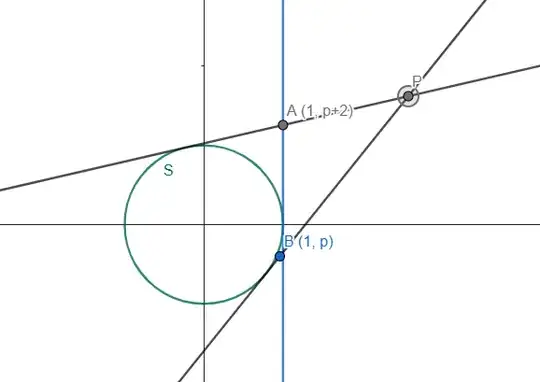
Diagram

Obtain the equation for pair of tangents in this case as: $$(x^2+y^2-1)(h^2+k^2-1) = (hx+ky-1)^2$$

This is satisfied by the points $A(1, p +2)$ and $B(1, p)$, for some $p$, lying on $x=1$ to conform to the given restrictions. Hence,

$$p^2(h^2+k^2-1) = (hx+kp-1)^2$$ $$(p+2)^2(h^2+k^2-1) = (hx+k(p+2)-1)^2$$

Once may eliminate $p$ from the above to equations to obtain a relation between $h$, and $k$. This comes out to be: $$h = \frac{1}{2}(k^2-2)$$

Rearranging, and replacing $h$ with $x$ and $k$ with $y$, we obtain the equation for a parabolic locus for $P$: $$y^2 = 2(x+2)$$


Comment: It is possible to obtain an answer without involving any of this by an analysis of the options themselves. This is by no means rigorous, or educative, but such heuristics are nonetheless pleasant. It is easy to establish that whatever the locus may come out to be, it must be symmetric about the x-axis. No single line symmetric about the x axis seems to satisfy our conditions. A pair of lines may also be eliminated with a bit of sketching. Curiously enough, a point at inifinity, subtending parallel tangents satisfies our criteria. This rules out the circle, and leads us to the parabola.