6

This construction removes the second quarter after each iteration. Picture from Wikipedia:
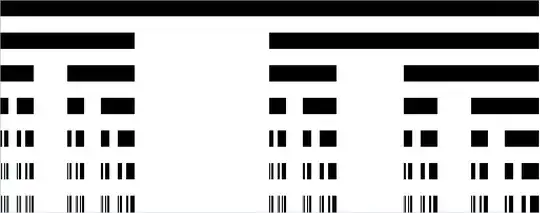
Asymmetric Cantor Set

Wikipedia gives the Hausdorff Dimension as $\log_2 \phi$ where $\phi$ is the Golden Ratio.

Intuitively, the dimension tells me that this set, scaled down by a factor of two, will "fit inside of itself" 1.618... times.

My intuition is leaning on the definition of the "self-similarity" dimension though, which I realize is not the same as the Hausdorff Dimension given by Wikipedia, but I also know that for simple fractal sets like this, the Hausdorff and self-similarity dimensions usually coincide.

In my analysis class last year, we talked briefly about the definition of the Hausdorff-measure and Hausdorff-dimension, but I've found it very difficult to locate examples of people actually showing how to calculate this dimension for any but the most basic objects.

Eric
  • 115

2 Answers2

4

I think you are right that calculating Hausdorff dimension directly is not commonly done, instead easier dimensions are calculated and then shown to bound the Hausdorff dimension tightly, or formulae are proved for classes of objects and then used in specific instances.

See chapter 9.2 in "Fractal Geometry: Mathematical Foundations and Applications (2nd ed)" by Kenneth Falconer, which proves a dimension formula for an iterated function system of similarities satisfying an open set condition.

For your fractal $F$ with similarity ratios $\frac{1}{4}$ and $\frac{1}{2}$, the open set can be taken as the open interval $(0,1)$, with $\dim_H(F) = \dim_{BOX}(F) = s$ satisfying the dimension formula:

$$ \left(\frac{1}{4}\right)^s + \left(\frac{1}{2}\right)^s = 1 $$

Multiplying throughout by $2^{2s}$ and rearranging gives $$\left(2^s\right)^2 - 2^s - 1 = 0$$ which can be solved with the quadratic formula giving $$2^s = \frac{1 \pm \sqrt{5}}{2}$$ Now $2^s > 0$ so take the positive branch, giving the desired $$s = \log_2 \frac{1 + \sqrt{5}}{2} = \log_2 \phi$$

Claude
  • 5,852
3

You may compute the similarity dimension as follows. The set is composed of two copies of itself - one scaled by the factor $1/2$ and the other scaled by the factor $1/4$. Thus, the similarity dimension is the unique, positive number $s$ satisfying $1/2^s + 1/4^s = 1$. Since $1/4=1/2^2$, this yields $$\frac{1}{2^s} + \left(\frac{1}{2^s}\right)^2 = 1.$$ This is a quadratic equation in the expression $1/2^s$, which can be solved to obtain $$\frac{1}{2^s} = \frac{-1+\sqrt{5}}{2} = \varphi.$$ Thus, $s=\log(\varphi)/\log(2).$

It's also possible to compute the dimension using a box counting technique as in this answer.

Mark McClure
  • 31,496