I am trying to figure out what my next step would be in this problem. What can I say about e in relation to m and n?
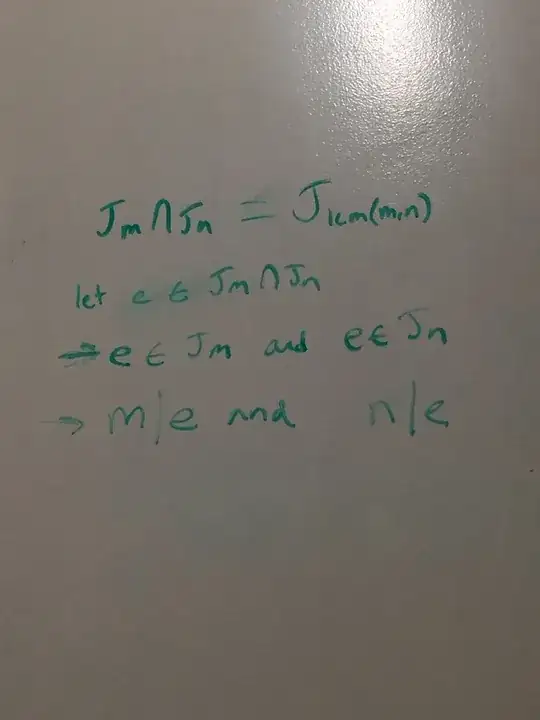
I am trying to figure out what my next step would be in this problem. What can I say about e in relation to m and n?

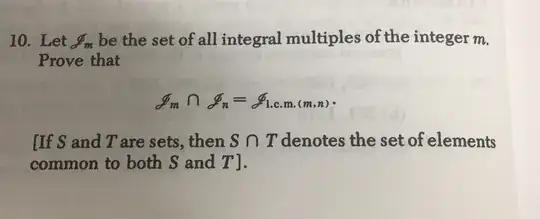
Hint $ $ By definition $\,\overbrace{J_a\cap J_b =\, J_{\ell}}^{\textstyle a\Bbb Z\cap b\Bbb Z = \ell \Bbb Z},\ \ell = {\rm lcm}(a,b),\,$ is equivalent to
Theorem $\,\ a,b\mid m\iff {\rm lcm}(a,b)\mid m\quad$ [Universal Property of LCM]
Proof $\ $ $(\Leftarrow)$ by definition of lcm and transitivity of divisibility: $\ a,b\mid {\rm lcm}(a,b)\mid m\,$ $\Rightarrow$ $\,a,b\mid m.$ $(\Rightarrow)$ may be conceptually proved by Euclidean descent as below.
The set $M$ of all positive common multiples of all $\,a,b\,$ is closed under positive subtraction, i.e. $\,m> n\in M$ $\Rightarrow$ $\,a,b\mid m,n\,\Rightarrow\, a,b\mid m\!-\!n\,\Rightarrow\,m\!-\!n\in M.\,$ Therefore, by induction, we deduce that $\,M\,$ is also closed under mod, i.e. remainder, since it arises by repeated subtraction, i.e. $\ m\ {\rm mod}\ n\, =\, m-qn = ((m-n)-n)-\cdots-n.\,$ Thus the least $\,\ell\in M\,$ divides every $\,m\in M,\,$ else $\ 0\ne m\ {\rm mod}\ \ell\ $ lies in $\,M\,$ and is smaller than $\,\ell,\,$ contra minimality of $\,\ell.$
Remark $ $ The above means lcm is a divisibility-least common multiple, i.e. it is least in the divisibility order $\, a\prec b\!\! \overset{\rm def}\iff\! a\mid b.\ $ This is the (universal) definition of lcm used in general rings (which generally - not being Euclidean (or PID) - lack that way to measure "least"). See here for more on the general viewpoint.

You have that $m | e$ and $n | e$. By definition of $\operatorname{lcm}$, we have that since $e$ is a multiple of $m$ and $n$, it is also a multiple of their lcm. Hence. $\operatorname{lcm}(m,n) | e$, so it follows that $e \in J_{\operatorname{lcm}(m,n) }$.
The other direction is obvious: If something is a multiple of $\operatorname{lcm(m,n)}$, then it is naturally a multiple of $m$ and $n$.
