6

The aim is to embed complete graphs on a torus in such a way that edges don't cross and the faces are homeomorphic to discs.

I found out that the complete graphs K6, K5 and K4 can be embedded on a torus. But what is with K3? I don't think so but how can this be proven properly?

There is a theorem that a graph can only be embedded on a surface when graph and surface have the same Euler characteristic. K3 has 2 and torus has 0. But K4 has also 2 and can nevertheless be embedded on a torus. What am I missing here?

milfor
  • 181
  • How do you define the Euler characteristic of a general graph? – EuYu Nov 24 '16 at 10:21
  • (number of vertices) - (number of edges) + (number of faces) – milfor Nov 24 '16 at 10:24
  • How exactly do you know how many faces it has without an a priori embedding? – EuYu Nov 24 '16 at 10:28
  • I know that K3 and K4 are planar graphs and that planar graphs always have Euler characteristic 2. – milfor Nov 24 '16 at 10:42
  • 3
    But $K_4$ is also embeddable in the torus, so why isn't the Euler characteristic 0? The point is that graphs don't have Euler characteristics, embeddings do. The embedding on the plane has 4 faces, so $V-E+F=2$. The embedding on the torus has 2 (non-cellular) faces, so $V-E+F=0$. Euler's formula holds in both cases, the fallacy is applying it to the graph instead of the embedding. You can define the maximum and minimum genus of a graph, but you can't define a unique genus. – EuYu Nov 24 '16 at 11:10
  • But in our lecture the graph itself has an Euler characteristic. So this is wrong? How would you prove then that K3 can't be embedded on a torus? – milfor Nov 24 '16 at 17:20
  • 3
    You've shown that $K_4$ has embedding onto two different surfaces with different genuses, so the notion of the genus of a graph it ambiguous. I suggest you ask your lecturer for clarification. Proving something is not embeddable is in general rather difficult. For $K_3$ on the torus however, we can do so by contradiction. Suppose $K_3$ had a $2$-cell embedding (all faces homeomorphic to a disk) onto the torus. Then Euler's formula applies and we must have $V-E+F = \chi = 0$. Since $V=E=3$, this implies we have $F=0$, which is clearly impossible. – EuYu Nov 24 '16 at 22:58
  • 1
    Fascinating! I have learned from you that a graph doesn't necessarily have the same F in all embeddings but F is nonetheless useful for contradictory purposes. Thank you! – milfor Nov 24 '16 at 23:28
  • @EuYu You should summarize all this as an answer. – Mike Pierce Nov 25 '16 at 23:03

1 Answers1

3

[This is answering an old question. Since no one wrote up the discussion in the comments, I do so, and then answer the main question of complete graphs in the torus.]

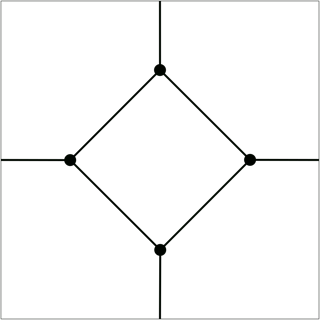
Informally, a graph $G$ can be embedded in a surface $\Sigma$, like the torus, if it can be drawn in $\Sigma$ such that the edges of $G$ do not cross, and such that edges intersect vertices only in their ends. We denote such a drawing/embedding by $\sigma(G)$. From this definition it is immediate that if $G$ can be embedded in $\Sigma$, then so can any subgraph $H$ of $G$; just restrict the embedding of $G$ to the part of it representing $H$, $\sigma(H) := \sigma|_H(G)$. A face of an embedding is a maximally arc-connected set of points in $\Sigma \backslash \sigma(G)$. Below is an embedding of $K_4$ in the torus, where opposite sides of the square are identified. As noted by EuYu, it has two faces, but an embedding of $K_4$ in the plane has four faces, so the number of faces of an embedding is not necessarily independent of the surface.

$\hspace{9 em}$ K_4 on Torus.
A graph $G$ embedded in a surface of Euler genus $g$ with $V$ vertices, $E$ edges, and $F$ faces satisfies the following inequality, known as Euler's formula.

$$ V-E+F\geq 2−g. $$ For connected plane graphs, this takes the form $V-E+F=2$. That this is an inequality here instead of an equality stems from the fact that in contrast with the faces of a connected plane graph, the faces of an embedding in other surfaces need not be homeomorphic to a disc. Equality holds if all faces are homeomorphic to a disc. For such embeddings, $V-E+F$ is thus an invariant, which we call the Euler characteristic $\chi(\Sigma)$.

Now, to answer which complete graphs can be embedded in the torus, we note that from Euler's formula, as $K_8$ has $V=8$, $E=28$, $F$ has to be at least $20$. But every face has at least three edges, and each edge is in two faces, implying that $K_8$ has at least $\frac{3}{2}\cdot 20=30$ edges, a contradiction. Thus $K_n$ for $n\geq 8$ does not embed in the torus. Finally, below is a drawing of $K_7$ in the torus. Hence, as embeddability is preserved under subgraphs, $K_n$ is embeddable in the torus if and only if $n\leq 7$.

$\hspace{9 em}$ K_7 on Torus.