2

I'm coming from a programming background so I apologies if this is blindingly simple or I misuse terms. I have an ellipse bounded by a square. For simplicity the centre of the square and ellipse is the origin (0,0) while the square is 2 width and 2 height.

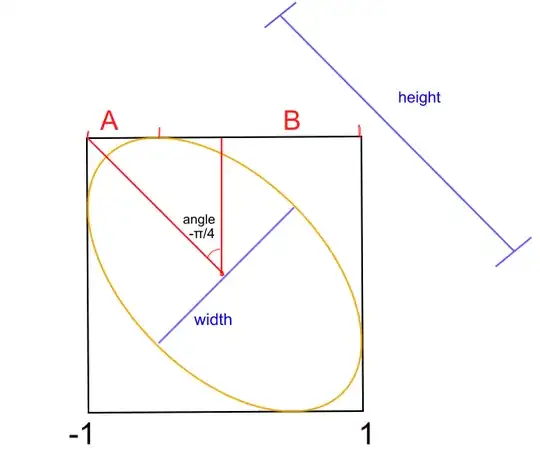
The ellipse is rotated -45° or +45° (angle in image) and I can easily work this out. The ellipse touches all sides of the square, and I also know the intersection points. In the image A is the distance between the corner and the intersection while B is the length of the long section (the other points are symmetric).

enter image description here

What is the width and height, as described in the image, of the ellipse?

Parcly Taxel
  • 105,904
AnnanFay
  • 510
  • Rotate it back and make it into a standard ellipse. For rotation, use the rotation matrix – Shailesh Nov 07 '16 at 13:04
  • 1
    There is an infinite number of such ellipses. You must give a supplementary constraint such as the coordinates of one of the contact points with the square. – Jean Marie Nov 07 '16 at 13:17
  • @JeanMarie Thanks, if that's the case it solves my problem. If you post an answer showing this I'll accept. – AnnanFay Nov 07 '16 at 13:39
  • @JeanMarie When you say contact points you mean A and B or something else? It's easy to see the ellipse contacts at (A-1,0), (1-A,0), (0,A-1) and (0,1-A). – AnnanFay Nov 07 '16 at 13:47
  • Correct that, the points would be (A-1,1), (1-A,-1), (1,A-1), (-1,1-A). – AnnanFay Nov 07 '16 at 13:53
  • Since the tag said "trigonometry", I had a trigonometric answer prepared... it's there for you. – Parcly Taxel Nov 07 '16 at 15:46

4 Answers4

2

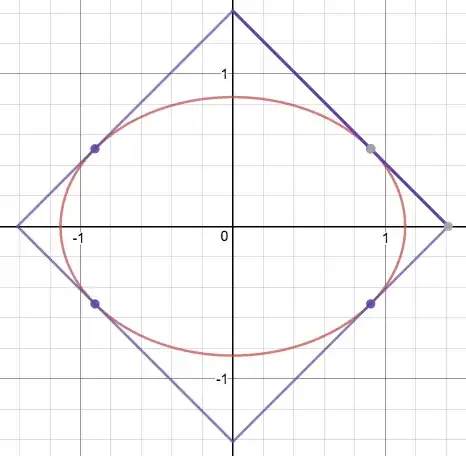
Start with an ellipse with semi-axes $a\geq b$ in standard position, and intersect it with a $45^\circ$-line $x+y=s>0$, such that the two points of intersection coalesce. This is the case if $s=\sqrt{a^2+b^2}$, and for the point of tangency $(x_*,y_*)$ one obtains $x_*={a^2\over s}$, so that $s-x_*={b^2\over s}$.

In the case at hand the length $s=\sqrt{2}$ is given, and $${A\over B}={s-x_*\over x_*}={b^2\over a^2}\ .$$ We therefore have to solve the system $$a^2+b^2=2,\qquad {b^2\over a^2}={A\over B}$$ for $a$ and $b$. Since $A+B=2$ the result simplifies to $$a=\sqrt{B},\quad b=\sqrt{A}\ .$$

2

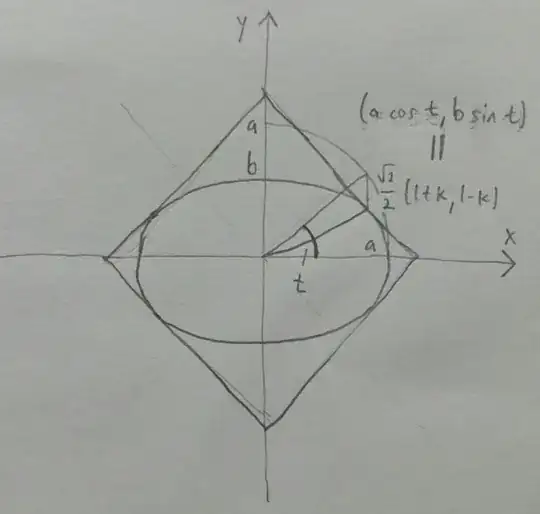
Suppose the ellipse's point of tangency $T$ with the square's top edge is $(k,1)$, where $-1\le k\le1$. ($k$ can be derived from $A$ or $B$ in the given diagram as $k=A-1=1-B$.) Now rotate the entire figure (square and ellipse) 45° clockwise about the origin; $T$'s new coordinates are $$\begin{bmatrix} \cos-45^\circ&-\sin-45^\circ\\ \sin-45^\circ&\cos-45^\circ\end{bmatrix}\begin{bmatrix}k\\1\end{bmatrix}=\frac{\sqrt2}2\begin{bmatrix}1&1\\-1&1\end{bmatrix}\begin{bmatrix}k\\1\end{bmatrix}=\frac{\sqrt2}2\begin{bmatrix}1+k\\1-k\end{bmatrix}$$

enter image description here

Given the ellipse's semi-axes $a$ and $b$ and a parameter $t$ as marked in the diagram above, the new $T$'s coordinates are also given by $(a\cos t,b\sin t)$. Equating the two representations of $T$ we have $$x=a\cos t=\frac{\sqrt2}2(1+k)$$ $$y=b\sin t=\frac{\sqrt2}2(1-k)$$ $$\frac ba\tan t=\frac{1-k}{1+k}\tag1$$ Taking derivatives with respect to $t$, we see that the tangent vector at $T$ is $(-a\sin t,b\cos t)$, so the slope at $T$ is $-\frac ba\cot t$, which is also $-1$ because it is parallel to the square's northeast face. Thus we find that $\tan t=\frac ba$, and substituting into $(1)$ we get $$\tan^2t=\frac{1-k}{1+k}$$ $\sin t$ and $\cos t$ can now be recovered: $$\cos t=\frac1{\sqrt{1+\tan^2t}}=\frac1{\sqrt{1+\frac{1-k}{1+k}}}=\frac1{\sqrt{\frac2{1+k}}}=\sqrt{\frac{1+k}2}$$ $$\sin t=\sqrt{1-\cos^2t}=\sqrt{1-\frac{1+k}2}=\sqrt{\frac{1-k}2}$$ Finally, the semi-axes $a$ and $b$ may be found as follows: $$a=\frac x{\cos t}=\frac{\frac{\sqrt2}2(1+k)}{\sqrt{\frac{1+k}2}}=\frac{\frac{\sqrt2}2(1+k)\sqrt2}{\sqrt{1+k}}=\sqrt{1+k}=\sqrt A=\sqrt{2-B}$$ $$b=\frac y{\sin t}=\frac{\frac{\sqrt2}2(1-k)}{\sqrt{\frac{1-k}2}}=\frac{\frac{\sqrt2}2(1-k)\sqrt2}{\sqrt{1-k}}=\sqrt{1-k}=\sqrt{2-A}=\sqrt B$$ The ellipse's width is $2a$ and its height is $2b$.

Parcly Taxel
  • 105,904
1

Consider an square formed by the sides of $\pm x\pm y=m$ (i.e. side length $m\sqrt2$).

Now find an ellipse which touches the square. Consider the top right quadrant. Edge of square is $$L: \quad x+y=m$$Assume point of tangency is $P(h,k)$.

Ellipse, $E$: $$\begin{align} \frac {x^2}{a^2}+\frac {y^2}{b^2}&=1\\ \frac {dy}{dx}&=-\frac {b^2x}{a^2y}=-\frac {b^2h}{a^2k}=-1\quad\text{at }P\\ \frac h{a^2}&=\frac k{b^2} \end{align}$$ $P$ lies on L, hence $h+k=m$, which gives $$\begin{align} h&=\left(\frac {m}{a^2+b^2}\right)a^2\\ k&=\left(\frac {m}{a^2+b^2}\right)b^2 \end{align}$$ $P$ lies on $E$, hence $$\begin{align} \left(\frac {m}{a^2+b^2}\right)^2\left[\frac {(a^2)^2}{a^2}+\frac {(b^2)^2}{b^2}\right]&=1\\ m&=\sqrt{a^2+b^2} \end{align}$$ This gives $$\begin{align} h&=\frac {a^2}m\\ k&=\frac {b^2}m\end{align}$$

$P$ divides edge of square into side lengths $$B=h\sqrt{2}=\frac {a^2\sqrt{2}}m\\ A=k\sqrt{2}=\frac {b^2\sqrt{2}}m$$ In the question posted, side length of square is $2$, hence $m=\sqrt{2}$, which gives $$A=b^2\\ B=a^2$$

"Height" (major axis) and "Width" (minor axis) of $E$ are given by

$$\text{Height (major axis)=}\color{red}{2a=2\sqrt{B}}\\ \text{Width (minor axis)=}\color{red}{2b=2\sqrt{A}}$$


Note

$\hspace{3cm}$enter image description here

From this solution to another recent MSE question, note that the ellipse

$$\frac{x^2}{u}+\frac {y^2}{1-u}=1$$ has a nice property in that its point of tangency with the line $L: x+y=1$ is $(u,1-u)$ which divides the line segment $V(0,1), H(1,0)$ on $L$ in the ratio $u:1-u$. Note that $0<u<1$. The line segment $VH$ has length $\sqrt2$. The semi-major and semi-minor axes of the ellipse are $\sqrt{u}, \sqrt{1-u}$ respectively.

0

I arrive at the general formula for these ellipses (with your parameter $A$):

$\tag{0}\dfrac{(x + y)^2}{A} + \dfrac{(x - y)^2}{2-A}= 2$

with height=$\sqrt{A}$ and width=$\sqrt{2-A}$.

in a still different manner compared with @Christian Blatter and Parcly Taxel.

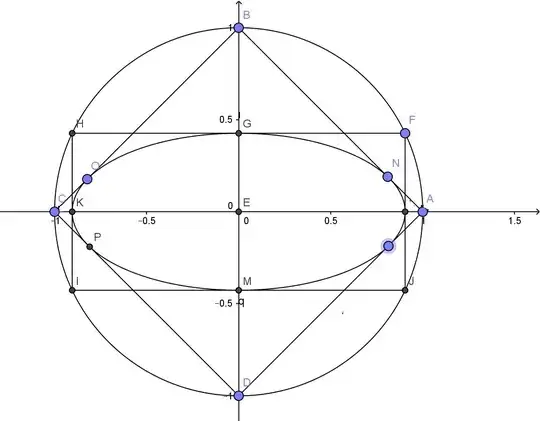
I first consider on the family $F$ of ellipses with axes $Ox$ and $Oy$ that are inscribed in the rotated square $C$ with vertices $(1,0), (0,1), (-1,0), (0,-1)$. (as Parcly Taxel does). It means that unit circle is their common "orthoptic circle": a theorem (established by Monge) says that the locus of points from which the 2 tangents that one can draw to the ellipse are orthogonal is a circle. See this. Remark : the name "orthoptic" comes from the fact that from any point of this circle, one "sees" the ellipse under a right angle.

Thus, using this property for a given ellipse $E \in F$, the rectangle $R$ with sides parallel to the axes which is circumscribed to E is inscribed in the unit circle. It should be observed that ratio length/width for $R$ is the same as the ratio of semi-axes of E. The coordinates of the vertices of $R$ are $(\pm \cos(t),\pm \sin(t))$, for a certain $t$. Thus, setting $a:=\cos(t)$, we have $\sqrt{1-a^2}=\sin(t)$ and the general ellipse $E \in F$ has equation:

$$\tag{1}\dfrac{X^2}{a^2}+\dfrac{Y^2}{1-a^2}=1$$

Now, by using a $\pi/4$ rotation of coordinates associated with a $\sqrt{2}$ enlargement (homothety), i.e. transformation $\cases{X=x+y\\Y=x-y}$ (in order that square C is transformed into the desired square), we obtain:

$$\tag{2}\dfrac{(x+y)^2}{a^2}+\dfrac{(x-y)^2}{1-a^2}=4$$

It remains to express (2) with parameter $A$ instead of parameter $A$. This is easily done by imposing, that (2) is verified for point $(x,y)=(A-1,1)$. This gives $a^2=\dfrac{A}{2}$. Plugging this expression into (2), one obtains equation (0).

The height and width are deduced from equation (0) by computing the coordinates of points $(x,x)$ and $(-x,x)$ of the ellipse.
enter image description here

Jean Marie
  • 88,997