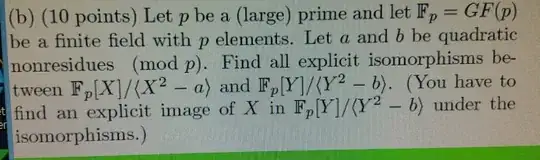
 I dont know how quadratic non residue is used to find isomorphism.
I know X^2-a and Y^2-b is irreducible polynomial in GF(p) and they are isomorphic. But how can i find explicit isomorphism?
I dont know how quadratic non residue is used to find isomorphism.
I know X^2-a and Y^2-b is irreducible polynomial in GF(p) and they are isomorphic. But how can i find explicit isomorphism?

You must map (the class of) $X$ to (the class of) a polynomial $f(Y)$ in $Y$ such that $f(Y)^2-a$ is a multiple of $Y^2 -b$. You may assume that $f$ is linear, so $X\mapsto cY+d$ with $c^2Y^2+2cdY+d^2-a$ a multiple of $Y^2-b$ ...

In this recent question you will find several arguments showing that as $a$ and $b$ are both quadratic non-residues, their product $ab$ is then a quadratic residue. So $ab=c^2$ for some $c\in\Bbb{F}_p$. Therefore, with $d=c/b$ we get that $a/b=d^2$.
With $d\in \Bbb{F}_p$ as above you can easily show that $X\mapsto dY$ will map everything in the ideal $\langle X^2-a\rangle$ into the ideal $\langle Y^2-b\rangle$, and this is one of the sought after isomorphisms. Another one is determined by $X\mapsto -dY$.
Once the method of constructing extension fields as quotient rings of the polynomial ring becomes second nature to you, you can think of (the coset of) $Y$ as a square root $\sqrt{b}$, and (the coset of) $X$ as $\sqrt a$. The isomorphisms above are then based on the calculation $$ \sqrt a= \sqrt{d^2b}=d\sqrt b $$ together with the usual sign ambguity with square roots.

