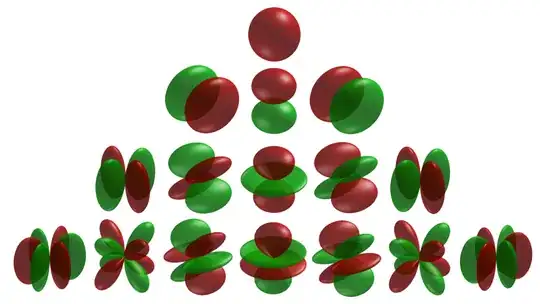
spherical harmonics (below image)
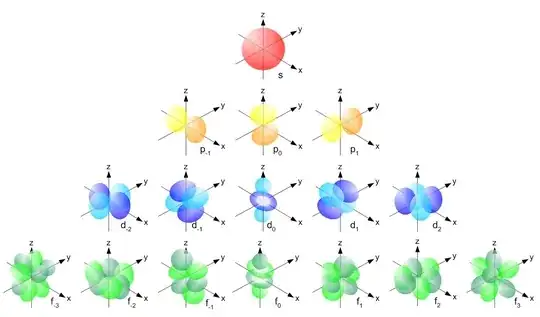
Schrödinger equation(below image)
What is the relationship between spherical harmonics and the schrodinger equation?
spherical harmonics (below image)
Schrödinger equation(below image)
What is the relationship between spherical harmonics and the schrodinger equation?

Quite the opposite: Spherical harmonics are found to be eigenfunctions for the angular momentum operator $L^2$, which all comes from the Schrödinger equation (SE). If you want to see how to get from SE to the spherical harmonics, I suggest you pick up an introductory text on Quantum Mechanics - it is far too big an endeavor to undertake here.
Edit to answer OPs edit:
SE (in the eigenbasis) is $$\hat{H}\psi=E\psi,$$ where $\hat{H}$ is the Hamiltonian. The Hamiltonian is an operator (which is not a number, but more like a matrix... that is the reason for the "hat") that basically specifies what system you're looking at. A lot of problems in QM goes like "write down $\hat{H}$ for the system at hand, then solve SE."
Now, $\hat{H}$ is special because the eigenvalues associated with it are the allowed energy states for the system, which determines how it behaves. As you may know, the energy of a system can be split up into the kinetic energy $\hat{T}$ and the potential energy $\hat{V}$. We can therefore write $\hat{H}=\hat{T}+\hat{V}$. Here's the connection with the spherical harmonics: Whenever $\hat{V}$ is spherically symmetric (and SE is separable), the eigenfunctions $\psi$ of $\hat{H}$ will have a polar part. This polar part is precisely the spherical harmonics. This is for instance the case in the famous example of the hydrogen atom.

The Schrödinger equation, and in particular the Schrödinger equation with $1/r$ electric potential function, is not something that you can "derive" from mathematics. Mathematically it would be perfectly consistent for photons to be massive (which would result in a Yukawa potential rather than $1/r$).
