11

If one wants to find the probability that a continuous random variable will fall within a range of $a \leq X \leq b$, based on a mean value $\mu$, and a deviation of $\sigma$, he would integrate the normal distribution function:

$$\int^b_a \frac{e^{-\frac{(x-\mu)^2}{2\sigma^2}}}{\sigma\sqrt{2\pi}}dx$$

Since this is for continuous probability, is there an alternative to normal distribution for discrete probability?


Suppose $\mu = 100$, and $\sigma = 50$. For discrete probability, I would try to use bounds close together to achieve a similar, but still not the completely desired outcome. However, the probability is very low:

$$\int^{99.95}_{100.05}p(x)dx = 0.0008$$

The probability seems too low for this to be true, which suggests that a different model for discrete probability should exist.

John K
  • 662
  • 1
    Not sure I fully understand what you are looking for, but the most obvious "discrete equivalent" of the Gaussian would be a Binomial. – Clement C. Aug 30 '16 at 18:02
  • @ClementC. This might be what I'm looking for. My goal is to find probability of X having some value instead of range of values, based on a mean and deviance. Binomial distribution might be what I am looking for – John K Aug 30 '16 at 18:15
  • 1
    The "standard" continuous approximation to $P(X=100)$ is $P(99.5 \leq Y \leq 100.5)$ where $Y$ is some appropriate continuous approximation to the distribution of $X$. – Ian Aug 31 '16 at 00:58

2 Answers2

9

Your ultimate goal is not clear. Perhaps I can flounder around and make some useful comments.

For appropriate choices of $n$ and $\theta,$ the distribution $Binom(n, \theta)$ is approximately normal, especially if $n$ is large and $\theta$ is not too far from 1/2. The mean is $\mu = n\theta$ and the variance is $\sigma^2 = n\theta(1-\theta).$

Also, for large enough $\lambda,$ the distribution $Pois(\lambda)$ is nearly normal. The mean and variance are $\mu = \lambda$ and $\sigma^2 = \lambda.$ However, the Poisson model may have less flexibility in matching what you want.

Of course, to find the probability that a random variable taking integer values lies in an interval $(a, b]$ you will add probabilities for integer values in that interval, rather than evaluating an integral.

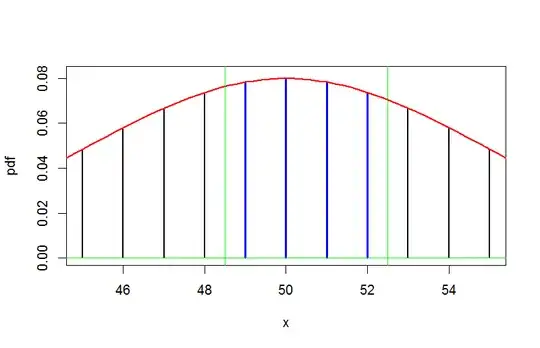
For example, if $X \sim Binom(n = 100, \theta = 1/2),$ you have $\mu = 50$ and $\sigma = 5.$ Perhaps you want

$$P(48 < X \le 52) = P(X = 49) + P(X = 50) + P(X = 51) + P(X = 52)\\ = P(X \le 52) -P(X \le 48) = F_X(52) - F_X(48) = 0.3091736,$$ where $F_X(\cdot)$ is the CDF of $X.$

If there are many integers in the desired interval, computation by hand can be tedious. In R statistical software dbinom denotes a binomial PDF and pbinom a binomial CDF.

The probability above could be evaluated in R as shown below. [The last value is a normal approximation (with continuity correction), which is often accurate to a couple of decimal places.]

 sum(dbinom(49:52, 100, .5))      # adding terms of the PDF
 ## 0.3091736
 diff(pbinom(c(48,52), 100, .5))  # subtracting two CDF values
 ## 0.3091736
 diff(pnorm(c(48.5,52.5), 50, 5)) # normal approximation
 ## 0.3093739

The figure below shows several values of the PDF of $Binom(100, .5),$ emphasizes the four probabilities required (heights of thick blue bars), and shows the approximating normal density curve. The normal approximation is the area beneath the curve between the vertical green lines.
enter image description here

BruceET
  • 52,418
5

You can construct a discrete distribution called the Skellam distribution (https://en.wikipedia.org/wiki/Skellam_distribution) from the difference of two Poisson distributions.

If $X \sim Pois(\lambda_1)$ and $Y \sim Pois(\lambda_2)$, then the distribution for $Z = X-Y$ fits the Skellam distribution with mean $\lambda_1-\lambda_2$ and variance $\lambda_1+\lambda_2$. The distribution is approximately normal with the PDF given by $Pr\{Z=n\} = e^{-(\lambda_1+\lambda_2)}\left(\sqrt{\frac{\lambda_1}{\lambda_2}}\right)^n I_n\left(2\sqrt{\lambda_1\lambda_2}\right)$.

Yinka L
  • 51