22

Let \begin{align} f(t,k,p)= \frac{ \int_0^\infty \cos(x t) e^{-x^k}dx}{\int_0^\infty \cos(x t) e^{-x^p}dx}, \end{align}

My question: How to find the following limit of the function $f(t,k,p)$ \begin{align} \lim_{t \to \infty} f(t,k,p), \end{align} for any $p>0$ and $k>0$.

What is known Some facts about the function

  1. Note that $\int_0^\infty \cos(x t) e^{-x^k}dx$ is a fourierier transform of $e^{-{|x|^k}}$.
  2. For $0<k \le 2$ we have that $\int_0^\infty \cos(x t) e^{-x^k}dx$ is non-negative function and has no zeros. See this question.
  3. For $k>2$ we know that $\int_0^\infty \cos(x t) e^{-x^k}dx$ has countable many zeros. See this questions.

A related question was asked here.

Because for the case of $p>2$ the denominator has countable many zeros I am not sure if $\lim_{t \to \infty} f(t,k,p)$ even exists. It would be nice to show if it exists or not. Other trivial case include $k=1,p=2$ and $k=2,p=1$ since inverse fourier transforms of $e^{-|x|}$ and $e^{-|x|^2}$ are know in closed form.

Clearly, the case of $k=p$ is trivial. So, we would like to analyze $k>p$ and $p<k$.

Numerical Simulations: Numerical simulations seem to suggest that \begin{align} \lim_{t \to \infty} f(t,k,p)&=-\infty, \ k>p, \\ \lim_{t \to \infty} f(t,k,p)&=\infty, \ k<p. \end{align}

Method of the Steepest Descent: (See the answer in progress via this method by @tired) It has been suggested by @tired that the method of steepest descent might be a possible approach for solving the limit. That is since \begin{align} \int_0^\infty \cos(x t) e^{-x^k}dx&= \mathsf{Re} \int_0^\infty e^{it} e^{-x^k}dx, \\ &= t^{\frac{1}{k-1}} \mathsf{Re} \int_0^\infty e^{ t^{\frac{k}{k-1}} (-u^k+iu)}du, \\ \end{align} where in the last step we have used substitution $x=u t^{\frac{1}{k-1}}$.

Note that this now take the form of $\int_I e^{ A S(u)}du$ which can be handle by method of steepest desend if $S(u)$ satisfies:

  1. $S(u)$ is holomorphic
  2. $\mathsf{Re}(S(u))$ has a single maximum: $\max_{ u \in I } \mathsf{Re}(S(u))=\mathsf{Re}(S(u_0))$ for execly one $u_0\in I$.
  3. $u_0$ is non-degenare saddle point. That is $S''(u_0)\neq 0$.

Adopting this to our case we have that the maximum of \begin{align} \max_{ u \in I } \mathsf{Re}(S(u))=\max_{ u \in [0,\infty) } \mathsf{Re}(-u^k+iu)=\max_{ u \in [0,\infty) } \mathsf{Re}(-u^k)= 0, \end{align} where $u_0=0$.

Note also that $S''(u)= k (k-1) u^{k-2}$ and therefore $S''(0)=0$ so the maximum is a degenaret saddle point. This violates the third conditon.

I really hoped that this method was going to work. Am I making any mistakes in the above?

Thank you for any help or suggestions you might have.

This the second bounty posted on this question.

Things that did not work:

Approach with expansion of $e^x$ \begin{align} f(t,k,p)&= \frac{ \int_0^\infty \cos(x t) e^{-x^k}dx}{\int_0^\infty \cos(x t) e^{-x^p}dx}\\ &=\frac{ \int_0^\infty \cos(u) e^{-(u/t)^k}du}{\int_0^\infty \cos(u) e^{-(u/t)^p}du}\\ &=\frac{ \int_0^\infty \cos(u) (1- (u/t)^k+O((u/t)^{2k})) du}{\int_0^\infty \cos(u) (1- (u/t)^p+O((u/t)^{2p}))du}, \end{align}

but the integrals, do not converge. Don't think this approach works.

Integration by parts approach: Note that by tntegration by parts \begin{align} \int_0^\infty \cos(x t) e^{-x^k}dx= \frac{k}{t^{k+1}} \int_0^\infty \sin(u) u^{k-1} e^{-(u/t)^k} du, \end{align}

using this we have that \begin{align} f(t,k,p)=\frac{k}{p} t^{k-p} \frac{ \int_0^\infty \sin(u) u^{k-1} e^{-(u/t)^k}du}{\int_0^\infty \sin(u) u^{p-1} e^{-(u/t)^p}du}. \end{align}

The question is how to proceed next? How do we know how the ratio of the two integrals behaves?

Boby
  • 6,381
  • Can't you do a rescaling $u=xt$ and expand the exponentials to first order in $1/t$ ? Can't you proceed by integration by part ? – Alexandre Krajenbrink Nov 25 '16 at 15:16
  • @AlexandreKrajenbrink I tried but didn't get far. – Boby Nov 25 '16 at 17:03
  • Why is integration by parts not being considered? In that case, both numerator and denominator have dominant terms $-i/t$ and thus the limit is one. – Ron Gordon Nov 27 '16 at 18:44
  • 1
    @RonGordon I added an approach with integration by parts. Can you suggest how I should proceed next with it? I am not sure what to do with the ratio of integrals. – Boby Nov 30 '16 at 14:07
  • 1
    What happens with a second integration by parts? – marty cohen Nov 30 '16 at 15:41
  • @martycohen well the antiderivative of $e^{-(x/t)^k}= \frac{t^{1/p}\Gamma(1/p; (x)^p)}{p}$. So, the term we will get is $ t^{1/p} \int_0^\infty \sin(x) \frac{\Gamma(1/p; (x/t)^p)}{p} ) dx$. Is this something that has a closed form? Where $\Gamma(1/p; x^p)$ is the incomplete gamma function. – Boby Nov 30 '16 at 15:47
  • 1
    Rewrite $\int_0^{\infty}e^{-x^m}\cos(nx)=\Re\int_0^{\infty}e^{-x^m+i n x}$. Now scale $x=y n^{\frac{1}{k-1}}$ to get $n^{\frac{1}{k-1}}\Re\int_0^{\infty}e^{-n^{\frac{k}{k-1}}(y^m+i y)}dy$ which is ready for the method of steepest decent – tired Nov 30 '16 at 16:15
  • @tire I never used this method. Can you fill in some details? – Boby Nov 30 '16 at 16:22
  • i'm quite busy these days but i might offer you this nice starting point: http://math.stackexchange.com/questions/1995855/higher-order-corrections-to-saddle-point-approximation/1995923#1995923 – tired Nov 30 '16 at 16:47
  • @tire is this the wiki link https://en.wikipedia.org/wiki/Method_of_steepest_descent for this method? – Boby Nov 30 '16 at 17:51
  • yes it it is... – tired Nov 30 '16 at 17:52
  • Dear @tired I tried to read a few things on the method of steepest_descent but I am afraid at this point it is beyond my skills. Perhaps when you have time you can share your solution? I would really appreciate that. – Boby Dec 01 '16 at 15:03
  • @Boby, i try my best but can't make any promises due to time constraints – tired Dec 01 '16 at 15:04
  • @tired sure. I understand. – Boby Dec 01 '16 at 15:10
  • @Boby furthermore i would like to encourage you to read the great answers to this question of mine: http://math.stackexchange.com/questions/1953633/asymptotic-evaluation-of-int-0-pi-4-cosx-t2-tan2tdt – tired Dec 01 '16 at 15:10
  • @tired thank you. I will go through it. – Boby Dec 01 '16 at 15:12
  • @tired I have a question when you did substitution $x=y n^{\frac{1}{k-1}}$ did you mean to you $x=y n^{\frac{1}{m-1}}$. Is that a typo? – Boby Dec 02 '16 at 20:25
  • 1
    @boby, yes sorry this was atypo – tired Dec 03 '16 at 00:40
  • @tired I was not able to apply the steepest descent method but I was able to do some numerical simulations. I added my conjecture to the answer. – Boby Dec 03 '16 at 19:12
  • Dear @tired I was wondering if how are you could spare some time to fill in some details on your method? – Boby Dec 05 '16 at 20:26
  • Dear @tired I started learning about the method of steepest descent by your examples. One of the requirements of this method is that for $f(y)=-y^m+iy$ the maximum of real part of $f(y)$ is non-degenerate saddle point that is second derivative of $f(y)$ is not zero at maximum $y_0$. But here the maximum of real part $f(y)$ occurs at $y=0$ right? and we also have that $f''(0)=0$ so the maximum is a degenare saddle point. Am I making a mistake here? – Boby Dec 06 '16 at 16:43
  • @sulty do you mean $t^{k-p}$ ? – Boby Dec 06 '16 at 22:14
  • @Boby I think I got confused, apologies, ignore me! – snulty Dec 06 '16 at 22:19
  • @snulty No worries. I have been tried to solve this for a few weeks now and made plenty of mistakes. – Boby Dec 06 '16 at 22:55
  • 1
    im working on it...as an intermediate result i might announce that if $k=3$ we have $- 6/n^4$ as leading order contribution. Your thoughts work well as long as $k$ is odd...i think for the even case a more sophisticated analysis is needed (we will see the next days) – tired Dec 07 '16 at 12:12
  • @tire great. Thank you – Boby Dec 07 '16 at 12:16
  • for $k$ odd the leading order asymptotics will be given by $i (-i)^k \frac{k!}{n^{k+1}}$ the idea is that you can deform into your path in a steepest descent contour with dominant contribution given by small piece of the positive imaginary near the origin (the saddlepoint contributions will decay exponentially but become more important as $k$ becomes bigger) – tired Dec 07 '16 at 12:25
  • @tired Thanks. I spend some time learning about this method and hopefully will be able to catch up with you. Looking forward to see some technical details. – Boby Dec 07 '16 at 13:29
  • @Boby First part: Done! – tired Dec 07 '16 at 14:48
  • @Boby please let me know what is unclear, thanks for the nice question btw – tired Dec 07 '16 at 15:10
  • 1
    @Boby more progress...but not finished. – tired Dec 09 '16 at 20:56
  • @Boby i finally finished the answer (hope i made no mistakes), i leave out some details in the end because a) i got a bit tired and b) the answer is already too long but you should be able to fill in the missing steps on your own with the knowledge i have provided. furthermore feel free to ask more questions! – tired Dec 12 '16 at 11:21

1 Answers1

19

Ok, this will be a long one...

Preliminaries

I only consider the constituting integrals, as soon as there asymptotics are known, the leading order behaviour of the corresponding quotients follows trivially.

To get started, rewrite

$$I(m,n)=\int_0^{\infty}e^{-x^m}\cos(nx)=\Re\int_0^{\infty}e^{-x^m+i n x}$$

We assume that $m\geq2$ and obviously that $n\rightarrow +\infty$

Now scale $x=y n^{\frac{1}{m-1}}={\alpha_{m,n}}y={\beta_{m,n}}y/n$ to get

$$I(m,n)={\alpha_{m,n}}\int_0^{\infty}e^{-\beta_{m,n}(y^m-i y)}dy$$

Next we want to find the saddle points of the complex valued function

$$ f(z)=e^{-\beta_{m,n}(\underbrace{z^m-i z}_{g(z)})} $$

That's simple: $g'(z)=0$ implies that $z_{k,m}=e^{\frac{i\pi+4 i k \pi}{2(m-1)}} \frac1m^{\frac1{m-1}}$ with $k\in(1,m-1)$and since $g''(z_k)\neq0$ none of them is degenerate which allows us to use the standard form of the method of steepest descent.

At this point it is useful to make a case analysis, depending on $m$ is odd or even. Let us start with the first case

$m$ is odd

To make the analysis a bit more transparent i will first focus on the simplest case $m=3$ and afterwards give a sketch how to proof the general result of this subsection.

Crucial example (1): $m=3$

In problems like this, it is always good to start with a nice picture

enter image description here

We see the extremal points (black Dots) at $z_{1,2}=(\pm\frac1{\sqrt{6}},\pm\frac i{\sqrt{6}})$ the corresponding curves of contstant phase $\color{\green}{C_1}$ (dashed green) and $\color{\orange}{C_2}$ (dashed orange). Furthermore the original contour of integration $\mathcal{O}$(black) and the curves with $\Im(z^3-i z)=0$, $\color{\red}{C_0}$ (red). Last but not least I higlighted the region with $\Re(z^3-i z)>0$ (blue).

To apply the method of steepest desecent we have to deform our original contour of integration $\mathcal{O}$ into a path of constant phase $\mathcal{C}$ (expect a phase jump at infinity) with converging constitutents. This means that since $\Im f(0)=0$ we have to follow initally the red contour $C_0$ into the converging blue region up to $e^{i\pi/3}\infty$. We call this piece $\mathcal{C}_{0}$. Now because we we are at complex infinity we can jump to a contour with different phase, which is the part of green dashed contour $C_1$ which connects $e^{i\pi/3}\infty\rightarrow \infty$ going through the saddle point at $z_1$. We call this piece $\mathcal{C}_{1}$. This means that $\mathcal{C}=\mathcal{C}_{0}+\mathcal{C}_{1}$

Now we have done the hardest part and can conclude by analyticity

$$ \int_{\mathcal{O}}f(z)dz=\underbrace{\int_{\mathcal{C}_0}f(z)dz}_{J_0}+\underbrace{\int_{\mathcal{C}_1}f(z)dz}_{J_1} $$

In a next step we need to determine which are the dominant contributions to the above integral?

By construction $J_1$ is dominated by the contributions of the saddle point. Because $\Re(z_1^3-i z_1)>0$ this part will decay exponentially with $\text{const} \times n^{3/2}$ exponent.

Due to the usual exponential decay of $f(z)$ in $J_0$ it is clear that this part will be dominated by it's contribution from around the origin (this argument DOESN'T WORK for the orginal contour $\mathcal{O}$ since $e^{-x^3}\sim \mathcal{O}(1)$ for many periods of $\cos(nx)$ so we can't only use the contributions around $x=0$ to determine the leading order behaviour of the integral).We might write

$$ J_0=\int_{\mathcal{C_0}}f(z)dz \sim i\int_{0}^{\infty}e^{i \beta_{3,n}y^3}e^{-\beta_{3,n} y}dy\sim i\int_{0}^{\infty}(1+i \beta_{3,n} y^3+\mathcal{O}(\beta_{3,n}^2 y^{6}))e^{-\beta_{3,n} y}dy=\\ \frac{i}{\beta_{3,n}}-\frac{3!}{\beta_{3,n}^3}+\mathcal{O}(\beta_{3,n}^{-5}) $$

Please ask, if you have questions at this point!

So we can conclude that for $n$ large enough $J_0 \gg J_1$, taking real parts and remembering the defintion of $\beta_{m,n}$ and $\alpha_{m,n}$

$$ I(3,n)\sim\alpha_{3,n}\Re(J_0)\sim-\alpha_{3,n}\frac{3!}{\beta^3_{3,n}}+\mathcal{O}(\alpha_{3,n}\beta_{3,n}^{-5})=\\-\frac{3!}{n^4}+\mathcal{O}(n^{-6})\quad \text{as} \,\, n\rightarrow+\infty $$

General result (1)

The above argument can easily repeated for arbitary odd $m$ since we have always the same type of contour:a phase zero part, dominated by the origin yielding a power law and a steepest desecent part through one saddlepoint which gives an exponetial decaying contribution which is subdominant (but get more important as $m$ increases since $\beta_{m,n}$ is a monotonically decreasing functions in $m$ with $\beta_{\infty,n}=n$ ). Following the steps as above we get

$$ I(m,n)\sim (-1)^{\nu(m)}\frac{m!}{n^{m+1}} \quad \text{as} \,\, n\rightarrow+\infty \,\,\text{and} \,\, m\,\,\text{is odd} $$

where $\nu(m)=1$ if $m = 4l-1$ and $\nu(m)=0$ if $m = 4l+1$ with $l\in \mathbb{N_{+}}$ (is there a nice name for this function?)

After this huge achivement let's pause for the moment, take a deep breath and then let us go on with the case that

$m$ is even

Also in this case we will focus first focus on the "simple" case $m=4$ and then see what we can learn from it to find a general result.

Crucial example (2): $m=4$

Let us start again with a picture (observe that i use parity to extend the range of integration to the whole real line)
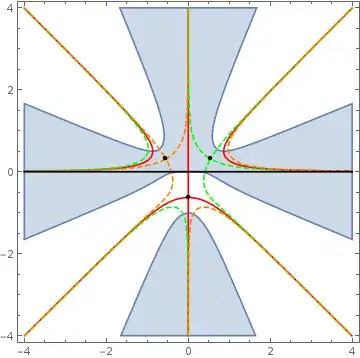
enter image description here

the coloring is as above, the only changes are that we now have three saddlepoints at $(\frac{\cos(\pi/6+k\pi/6)}{4^{1/3}},\frac{\sin(\pi/6+k\pi/6)}{4^{1/3}})$ with $k\in (0,1,2)$ and that $g(z)=z^4-i z$.

Now one might notice that there are two contours of steepest descent: $\Im(g(z))=0$ passing through $z_3$ called $\color{\red}{\mathcal{C}_0}$ and another one passing through $z_1$ via the part of $\color{\green}{C_1}$ connecting $\infty\rightarrow i \infty$ (again denoted by $\mathcal{C}_1$) and the part of $\color{\orange}{C_2}$ connecting $i \infty\rightarrow - \infty$, denoted $\mathcal{C_2}$. which one we should choose? Suppose we want to take $\mathcal{C}_0$, then to get a closed contour of constant phase we had to add pieces from non-convergent regions which is forbidden (the integral doesn't converge in this case). Furthermore the corresponding saddle point contribution is supressed since $\Re(g(z_3))>\Re(g(z_{1}))=\Re(g(z_{2}))$ so we can safley take $\mathcal{C}=\mathcal{C}_1+\mathcal{C}_2$. From the above relation we also see that both saddle points on this contour will equaly contribute so we have to take them both into account.

Again, by analyticity we can state

$$ \int_{\mathcal{O}} f(z)dz=\underbrace{\int_{\mathcal{C}_1} f(z)dz}_{J_1}+\underbrace{\int_{\mathcal{C}_2} f(z)dz}_{J_2} $$

Since the both, $J_1$ and $J_2$ are dominated by their respective saddlepoints we can linearize the contour of integration around both of them. For example we have at $z_1$ that $g(z)\sim g(z_1+e^{-i\pi/12}t)\sim g(z_1)+g''(z_1)e^{-i\pi/6}t^2/2$ where $t\in\mathbb{R}$. We get (as an exercise, proof this it is an application of the standard Laplace method)

$$ J_1\sim e^{-i\pi/12}e^{-\beta_{4,m}g(z_1)} \int_{-\infty}^{\infty}dte^{-\beta_{4,m}e^{-i\pi/6}g''(z_1)t^2/2}=e^{-i\pi/12}\frac{\sqrt{2\pi}}{\sqrt{\beta_{4,m}{e^{-i \pi/6}g''(z_1)}}}e^{-\beta_{4,m}g(z_1)} $$

and since $z_1=-z_2^*$ we can proof that

$$ J_2=J_1^* $$

from which it follows that

$$ \int_{\mathcal{O}}f(z)dz=2\Re(J_1) $$ or

$$ \int_{\mathcal{O}}f(z)dz\sim\frac{\sqrt{8 \pi}}{n^{2/3}\sqrt{|g''(z_1)|}}\cos(n^{4/3}\Im(g(z_1))-\frac{\pi}{6})e^{-n^{4/3}\Re(g(z_1))} $$

From which the original integral of interest can be deduced by dividing by two (note that our integral is already real) since we doubled the integration range in the beginning

$$ I(4,n)\sim\frac{\sqrt{2 \pi}}{n^{1/3}\sqrt{|g''(z_1)|}}\cos(n^{4/3}\Im(g(z_1))-\frac{\pi}{6})e^{-n^{4/3}\Re(g(z_1))} $$

which is totally different from the powerlaw behaviour we know from the case that $m$ is odd (why?).

General result (2)

The general case can be done along the same lines by showing that

$$ \Re(g(z_{k,m}))=-\underbrace{\left(\frac1m-1\right)}_{<0}\Im(z_{k,m}) $$

which shows that the extremal points with smallest imaginary real part will minimize the real part of $g(z_{k,m})$. Furthermore it is straightforward to prove that $\min(\Im(z_{k,m}))=\Im(z_{1,m})=\Im(z_{m/2-1,m})$ so we have always two saddles which contribute equally to the asymptotic expansion of the integral.

The rest of the argument goes through as in the case $m=4$ (expect that the contours of steepest descent have to be modified by a small amount, but i leave this part to you, the answer is already way too long) yielding

$$ I(m,n)\sim\frac{\sqrt{2 \pi}\alpha_{m,n}}{\sqrt{|g''(z_{1,m})|\beta_{m,n}}}\cos(\beta_{m,n}\Im(g(z_{1,m}))-\arg(z_{1,m}))e^{-\beta_{m,n}\Re(g(z_{1,m}))}\\ \quad \text{as} \,\, n\rightarrow+\infty \,\,\text{and} \,\, m\,\,\text{is even} $$

with corrections proportinal to $\frac{\text{expression above}}{\beta_{m,n}}$

tired
  • 12,588
  • 1
    I don't understand your $\nu(m)$ function. The two forms for $m$ in the two cases seem to be equivalent, since we can write $2l+3 = 2(l+1) + 1$. – John Barber Dec 07 '16 at 15:14
  • @JohnBarber: now it should be fine – tired Dec 07 '16 at 15:17
  • I have a few questions: 1) I thought that in the method of steepest descent we have the integral of the form $\int_I e^{t f(z) } dz$ and we have to find saddled points of $f(z)$. But here you are finding saddle point of $e^{t f(z) }$ instead of $f(z)$. Can you clarify this for me? 2) Can you explain: "By contradiction $J_1$ is dominated by the contribution of the saddle point." In particular, what is the contradiction? – Boby Dec 07 '16 at 21:57
  • 1
  • When you say that $J_1$ decays exponentially with the $c \cdot n^{4/3}$. How do you get this? Did you use and estimate $| \int_{C_1} e^{t S(z))} dz| \le \text{cosntant} e^{t M}$ where $M$ the maximum of $\text{Re}S(z)$ over $C_1$? I will write a few more question later. Wanted to understand this part for now. Thanks.
  • – Boby Dec 07 '16 at 22:03
  • 1
    1.) The saddlepoints of $e^{t f(z)}$ correspond to extreme values of $f(z)$ with $f''(z)>0$. 2.) I wrote "by construction....." does this makes things clearer? :) 3.) the decay is like $c n^{3/2}$ (see my update). this follows from the fact that $\int_{\mathcal{C}_1}....\sim e^{n^{3/2} f(z_1)}$ by standard laplace method – tired Dec 08 '16 at 10:55
  • @Boby regarding 1.) i messed up my notation a bit. now it should be clearer – tired Dec 08 '16 at 12:25
  • Thank you for the answers above. All those are clear to me know. A few more question and, I think, I understand this part. 1)Can explicit equations be given for curves $C_0$ and $C_1$. I want to understand them a little more. For example, the red curve (C_0) is of the type when $\text{Im}(z^3-z)=0$ but how do you get that the limit of $C_0$ is $e^{i \pi/3} \infty$? 2) What did you use to plot the figures they are very nice? – Boby Dec 08 '16 at 14:52
  • For $J_0$ can you give more detail how are you moving from $\int_{C_0} f(z) dz$ to $i \int_0^\infty e^{ i\beta (y^3-y)} dy$. I know that for $C_0$ we assume that $\text{Im} (z^3-z)=0$ but where do we get a factor of $i$ in front of the integral? Sorry, for all these questions but my complex analysis is very elementary.
  • – Boby Dec 08 '16 at 15:19
  • (+1) And I thought that I could get an asymptotic expansion by successively integrating by parts. – Mark Viola Dec 09 '16 at 04:56
  • @Dr.MV thanks a lot for the (+1). in some sense you can use i.b.p as it turns out it is just not the original function ...;) – tired Dec 09 '16 at 08:00
  • @Boby 1.) Yes you can do so, you plug in $z=x+i y$ into $f(z)$ and expand ot into real and imaginary part. The limits are then easily obtained by setting $x$ and/or $y$ very large. 2.) i use mathematica/wolfram cloud for the plots 3.) i set $z=iy$ which gives a factor of $i$ in front. this parametrization approximates $\Im(f(z))=0$ well at the origin where the dominant contributions to our integral come from. – tired Dec 09 '16 at 08:06
  • @Boby furthermore i want to apologize for the delay i'm very busy these days and this here turns out to be a much larger project then i first thought – tired Dec 09 '16 at 08:07
  • Thank you for your answer. Could you comment, very briefly, how the above results can be extended to $m\in \mahbb{R}^{+}$. – Boby Dec 12 '16 at 13:30
  • @Boby this generalization is non-trivial (we have to deal with branchcuts for example) but i think doable for at least $m\in Q$ . I will see what i can do. Btw. where did you encounter the orignal problem? probability theory maybe? – tired Dec 12 '16 at 14:36
  • I was interested in some deconvolution results, see this question http://math.stackexchange.com/questions/1877093/existence-of-additive-transformation-of-random-variables?noredirect=1&lq=1. I thought that this class of functions would be a nice example for students to show some imposibility results with deconvolution. But then it turned out to be very non-trivial. – Boby Dec 12 '16 at 14:58
  • @boby assume that $m=1/q$ where $q\in \mathbb{N}$ making a sub $x^m=t$ brings your integral into a from where you can apply much of the tools developed above so at least this special case should be doable – tired Dec 12 '16 at 15:01
  • For the even $m$ case, the direction of the steepest descent will be either $z_{k, m}$ or $i z_{k, m}$ for some $k$, giving either $\sin$ or $\cos$ in the formula for $I(m, n)$. The formula with $\cos$ won't work for $m = 6$ with any numbering of the roots. Also, $z_{1, 6}$ lies on the imaginary axis, thus it's not the root that we want in $I(m, n)$. Also a couple of minor corrections: for $m = 4$, the direction is $e^{-i \pi/6}$, not $e^{-i \pi/12}$; for $m = 3$, the contour goes in the direction $e^{i \pi/2}$ from zero and then approaches the direction $e^{2 i \pi/3}$, not $e^{i \pi/3}$. – Maxim Apr 27 '18 at 19:18
  • hey @Maxim,thanks for your input. I'll review this post the next days – tired Apr 30 '18 at 14:26