3

I am a Classics major trying to teach myself physics. I am on summer vacation at the moment, and I am going through a book called Classical Mechanics by J. Taylor. I am on the first chapter, and I need help with a question from the end of chapter 1.

Thank you, in advance. Please let me know if I should make any edits to the question.

Here is the question at hand.

enter image description here

I am having difficulty even showing that it is true for 2-D vectors. I would ask you to not provide an answer, but maybe some direction.

When trying to show for 2-D: $r \cdot s = (r_1^2 + r_2^2)^{1/2} \times (s_1^2 + s_2^2)^{1/2} \times \cos(\theta_{rs}) = r_1 \cdot s_1 + r_2\cdot s_2$

I tried squaring both sides. Which seems like it may be the right step forward. However, I had difficulty with trying to understand what to do with "$\cos(\theta_{rs})$." There is the suggestion to make our coordinate system such that vector-$r$ is aligned with the $x$-axis. Does that make $\cos(\theta_{rs})= {|s|\over s_1}$? It would seem like this would only be the case if $|s| > |r|$. Moreover, would this not make the component $r_2 = 0$, since the only component necessary to define vector-r in our coordinate system be $r_1$?

I feel like I may be overlooking something – maybe not so large. Some direction would be nice, but please, again, do not give me the answer!

Thank you very much for your patience and consideration.

Qwerty
  • 6,281
  • The proof uses the law of cosines. – JasonM Jul 07 '16 at 20:14
  • Is the law of cosines the only way to go about it? In other words, could one prove it if he or she was not aware of the law of cosines? – Rafael Vergnaud Jul 07 '16 at 20:34
  • If you are learning about physics and vectors, law of cosines is extremely easy. Look it up and learn it; it will help you a lot in developing math intuition and understanding. It is key in problem solving in physics. – Suganth Kannan Jul 07 '16 at 20:41
  • OK! Thank you. Appreciate your suggestion. – Rafael Vergnaud Jul 07 '16 at 20:42
  • @RafaelVergnaud Possibly, but the Law of Cosines is the most straightforward approach I can see. A $\cos(\theta)$ needs to be injected somehow. – JasonM Jul 07 '16 at 20:42
  • OK. I asked because the textbook introduces the law of cosines in the following question. So I assumed that the book expected the student not to known the law of cosines yet and wanted it to be proved another way (they gave the hint about manipulating the coordinate system). Thank you Jason. – Rafael Vergnaud Jul 07 '16 at 20:46

1 Answers1

1

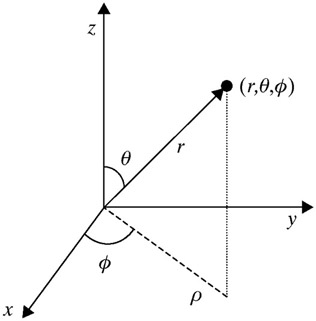
Let's tackle the 3D case. Let $\theta$ be the angle formed by vector $\vec s$ with the $z$-axis, and $\phi$ be the angle formed by the projection of $\vec s$ onto the $xy$-plane with the $x$-axis. Then geometry tells us that: $$ \vec s=(s\sin\theta\cos\phi, s\sin\theta\sin\phi, s\cos\theta), $$ where, as usual, we set $s=|\vec s|$.

Let's (nearly) follow your book suggestion: take $\vec r$ along the $z$-axis, so that $\vec r=(0,0,r)$. You immediately obtain: $$ r_xs_x+r_ys_y+r_zs_z=rs\cos\theta, $$ where $\theta$ is the angle between $\vec s$ and $z$-axis, which is the same as the angle between $\vec s$ and $\vec r$.

But of course this proof works only if you show that dot product defined by (1.7) is independent of the choice of axes.