40

It’s easy to divide an equilateral triangle into $n^2$, $2n^2$, $3n^2$ or $6n^2$ equal triangles.

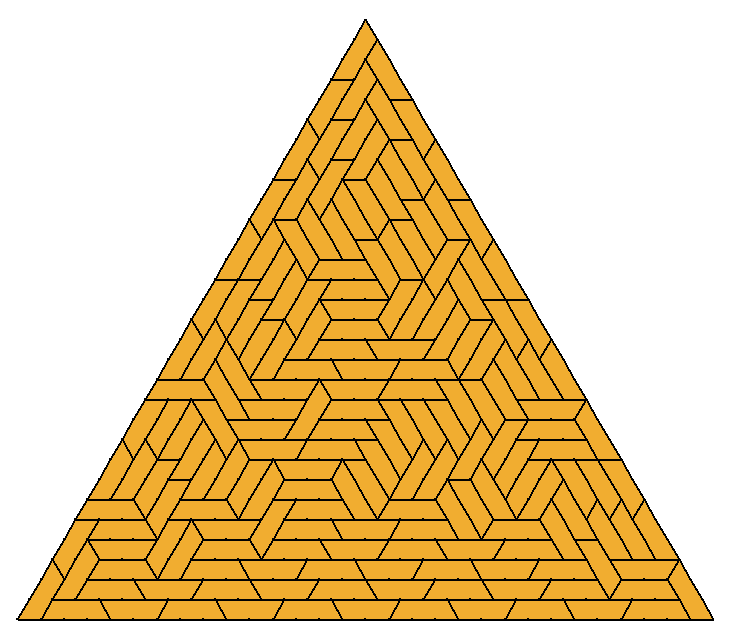
But can you divide an equilateral triangle into 5 congruent parts? Recently M. Patrakeev found an awesome way to do it — see the picture below (note that the parts are non-connected — but indeed are congruent, not merely having the same area). So an equilateral triangle can also be divided into $5n^2$ and $10n^2$ congruent parts.

Question. Are there any other ways to divide an equilateral triangle into congruent parts? (For example, can it be divided into 7 congruent parts?) Or in the opposite direction: can you prove that an equilateral triangle can’t be divided into $N$ congruent parts for some $N$?
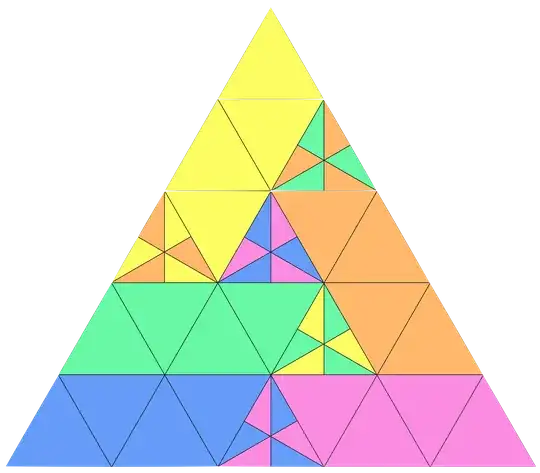
                                           

(Naturally, I’ve tried to find something in the spirit of the example above for some time — but to no avail. Maybe someone can find an example using computer search?..)

I’d prefer to use finite unions of polygons as ‘parts’ and different parts are allowed to have common boundary points. But if you have an example with more general ‘parts’ — that also would be interesting.

Grigory M
  • 18,082
  • maybe triangular numbers have some part to play? – vidyarthi Jun 24 '16 at 21:33
  • A reference for the information you provided would make it easier to understand and possibly answer your question – Yuriy S Jun 24 '16 at 22:29
  • Have you tried generalizing for odd $n$ based on the solution for $n=5$ that you've shown? – John Jun 24 '16 at 23:30
  • 2
    @John Of course I've tried! But more you look at the solution for $n=5$ more miraculous it seems: yellow, orange and green parts differ by a rotation, blue and pink differ by a reflection — and then these two groups magically fit together… After a couple of months I still have no idea how to generalise this — but maybe someone can find other examples using brute-force computer search, for example… – Grigory M Jun 26 '16 at 18:15
  • Fair enough; I was envisioning extending parts at the bottom somehow and laddering them up but yeah, the triangle on top can't be extended the same way. – John Jun 27 '16 at 16:36
  • A computer search appears prohibitive. For $n=7$, and without even including the 2-colored triangles, one needs to place $7$ sets of $7$ triangles in $49$ spots which gives about $10^{36}$ combinations. While this can certainly be reduced by considering various symmetries and obvious limits, the computation of whether a given set of triangles is congruent to another set, is not trivial. In fact, it is not obvious to me how to do this. An interesting problem, though. – Jens Jun 28 '16 at 20:34
  • Note that for a triangle with edge length $n$, there is $n^2$ miniature triangles in the triangle. This may not necessarily help, but it may do... – Xii Jun 29 '17 at 18:45
  • The five-part division was posted to https://math.stackexchange.com/questions/8288/splitting-equilateral-triangle-into-5-equal-parts – Gerry Myerson Sep 20 '18 at 10:13
  • 1
    How did you manage to split the triangle into $10n^2$ congruent parts? – Vosatorp Mar 02 '21 at 16:20
  • @Vosatorp n² equilateral triangles (easy) → 5n² parts (as in the picture) → 10n² parts (it's easy to split each part into two congruent figures) – Grigory M Mar 03 '21 at 07:24
  • @GrigoryM I understand that $5n^2$ is easy to get, but how can each of these parts be divided into two equal parts? After all, they are disjointed and unsymmetric. – Vosatorp Mar 03 '21 at 14:49
  • 1
    @Vosatorp it's not quite obvious, but it can be done: http://dev.mccme.ru/~merzon/visual/pic_triangle10.png – Grigory M Mar 03 '21 at 18:29
  • @GrigoryM Wow, got it, thanks – Vosatorp Mar 03 '21 at 21:11

4 Answers4

9

Recently Pavel Guzenko found a way to divide an equilateral triangle into 15 congruent parts (and also into 30 congruent parts).

dissection

Grigory M
  • 18,082
7

In a recent preprint https://arxiv.org/abs/1812.07014 M.Beeson shows how to divide an equilateral triangle into $15×3^6=10935$ equal triangles (with sides 3, 5, 7 and one angle equal to $2\pi/3$).

10935 triangles

Grigory M
  • 18,082
3

In this MathOverflow thread, there are dissections with $5n^2$ pieces for all $n\ge 6$ where the pieces are simply connected quadrilaterals. The smallest such is pictured here:

                                                    enter image description here

In the thread, it is mentioned that Michael Reid claims to have found a simply-connected dissection using $7n^2$ trapezoids for some $n$, but the result appears not to be published anywhere.

In the case where the tiles are triangles, the 1995 paper Tilings of Triangles by M. Laczkovich has many important results. In particular, it states that there is a dissection of an equilateral triangle into $2469600=2^5\cdot3^2\cdot5^2\cdot 7^3$ triangles with side lengths $7, 8,$ and $13$.

In general, Theorem 3.3 in the paper states

Let $x$ and $y$ be non-zero integers such that $x+2y\neq 0\neq y+2x$. Then there is a positive integer $k$ such that the equilateral triangle can be dissected into $n=|xy(x+2y)(y+2x)k^2|$ congruent triangles.

This yields dissections with a number of triangles whose squarefree part is any of $ 5, 6, 10, 13, 14, 15, 21, 30, 35, 39, 55, 65, 66, 70, 85, 95, 105, 119, 130,\ldots$

0

In a rather different vein, a properly sized spherical equilateral triangle can be divided into 14 congruent, connected parts.

Begin with the seven-way division of an equilateral triangle shown below.

enter image description here

The segments connecting the original vertices of $\triangle ABC$ with those of $\triangle A'B'C'$ are angle quadrisectors at the former vertices, omitting the bisectors.

In Euclidean geometry this division gives only those congruences admitted by the $D_3$ symmetry. But in spherical geometry $\triangle ABC$ can be sized to render its vertex angles $\psi=144°$. With this sizing all seven pieces become equal in area, and the equilateral $\triangle A'B'C'$ becomes congruent with its edge-sharing neighbors. The outer pieces lying along the edges of $\triangle ABC$ are not yet congruent with the others, but these are also isosceles. So all seven pieces are isosceles, and next we divide each of them in half by drawing the bisector of an apex angle.

This gives the claimed 14 congruent pieces on the sphere, all of them being spherical triangles with vertex angles measuring $36°,72°,90°$.

The existence of this 14-way division is connected with the fact that certain generalized regular polyhedra (Kepler-Poinsot polyhedra) will cover the sphere exactly seven times. See this question and in particular Dr. Richard Klitzing's answer.

Oscar Lanzi
  • 48,208