11

I'm doing 2 statistics exercises:

The 1st: An electrical firm manufactures light bulbs that have a length of life that is approximately normally distributed with a standard deviation of 40 hours. If a sample of 30 bulbs has an average life of 780 hours, find a 96% confidence interval for the population mean of all bulbs produced by this firm.

The 2nd: A random sample of 10 chocolate energy bars of a certain brand has, on average, 230 calories per bar, with a standard deviation of 15 calories. Construct a 99% confidence interval for the true mean calorie content of this brand of energy bar. Assume that the distribution of the calorie content is approximately normal.

I look at the solution my teacher provided. The 1st one use z-table and the 2nd use t-table. Could anyone tell me how to know (from questions) whether to use z or use t? And please show me the differences between 2 exercises here that make one use z-value and the other use t-value.

Thank you in advance for any help you can provide.

2 Answers2

17

Normally, you use the t-table when the sample size is small ($n<30$) and the population standard deviation $\sigma$ is unknown. Z-scores are based on your knowledge about the population’s standard deviation and mean. T-scores are used when the conversion is made without knowledge of the population standard deviation and mean.
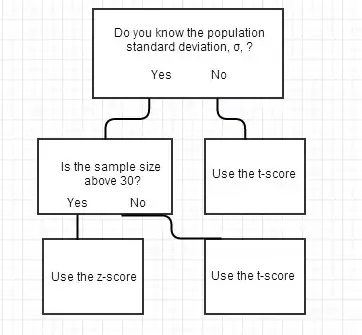
Here is a road map:
![enter image description here
In this case, both problems have known population mean and standard deviation. Thus you should only decide based upon whether the sample size is below $30$.
The 1st problem has $n=30$, so you should use z-table.
The 2nd problem only has $n=10$, so you should use t-table.

Image Source (possibly).

Angie
  • 309
  • in the case of the t-score: how can you generate a confidence/probability when you don't know the mean/standard-deviation? – Trevor Boyd Smith Apr 03 '20 at 18:44
  • Why are you required to know the population mean and standard deviation to use the z-score? According to the law of large numbers a sample's mean and variance approach that of the population as the sample size grows. Therefore, can't you logically use z-score for large values of n? – Gili Mar 08 '21 at 04:02
  • This is wrong. If the population is normal and you know the population standard deviation you should always use z-score, even if the sample size is less than 30. – Guillaume F. Jul 30 '23 at 04:30
1

In the first problem the population standard deviation is known. So one uses the normal distribution.

I would interpret the second problem as saying that $15$ is the sample standard deviation. So one uses the $t$-distribution, although for sample sizes say above $50$, the normal distribution, though technically wrong, is probably accurate enough.

André Nicolas
  • 514,336