Any set of two pairwise disjoint Fano planes is maximal; three or more Fano Planes must share at least one line. Henning's answer is streets ahead in terms of succinctness (and quite clever to boot), but frankly, I didn't do all of this work not to post an answer :)
But before I launch into a tedious case-by-case proof that there do not exist $3$ or more pairwise-disjoint Fano planes I would like to talk a bit about what I dream might yield a nicer approach for a someone with more insight than me (possibly my future self).
It is fairly well known that any pair of Fano planes share exactly $0, 1$ or $3$ lines (in fact, I found today that each Fano plane is disjoint from exactly $8$ others, shares a single line with exactly $14$ others, and shares $3$ lines with exactly $7$ others).
To quote a passage from Buckard Polsters article, YEA WHY TRY HER RAW WET HAT: A Tour of the Smallest Projective Space,
There is a unique partition of the $30$ labelled Fano planes
into $2$ sets $X$ and $Y$ of 15 each such that any $2$ Fano planes
in $1$ of the sets have exactly $1$ line in common.
You can take the $15$ single-intersection planes and make a nice picture of something called a generalized quadrangle from them (this one's "the doily", also from his article)
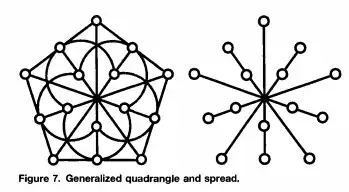
whose points are all labeled Fano planes and whose lines are Lines the planes share (there's a big picture in the pdf showing the planes). It's obviously silent on pairs of planes that are disjoint, but I'd like to believe there's some insight to be gained by considering how the two partitions interact with each other. As a sidenote, the article is both very informative and quite fun to read.
The usual definition is that two Fano planes are considered equivalent if they have the same set of lines. Under this definition, there are $30$ non-equivalent Fano planes that we'll arbitrarily separate into one of two categories:
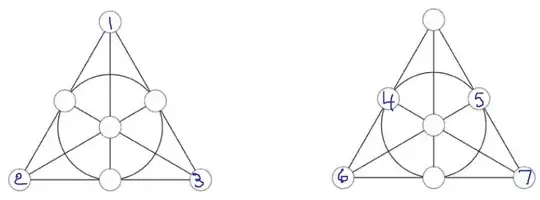
The first do not contain the line $\{1,2,3\}$ and there are $4! = 24$ of these. The second do contain the line $\{1,2,3\}$ and there are $3! = 6$ of these.
Let us now find pairwise disjoint (those sharing no lines) Fano planes. We'll search in the first category of planes, those not containing the line $\{1,2,3\}$. I find it more convenient to use the set $\{1,2,3,x,y,z,w\}$ instead of $\{1,2,3,4,5,6,7\}$ as point labels.
Without loss of generality, we will start with the plane
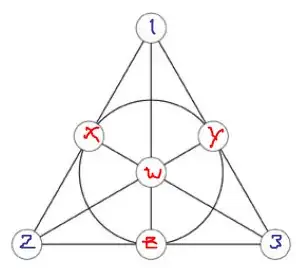
whose lines are
\begin{array}{ccc}
12x & 13y & 23z\\
1zw & 2yw & 3xw\\
&xyz&
\end{array}
and attempt to find a disjoint plane by permuting $\{x, y, z, w\}$. Such a permutation must have no fixed points: if $x$ did not move, the line $12x$ would be preserved (and similarly for $y$ and $z$), while if $w$ were fixed, the line $xyz$ would be preserved.
Thus our permutation is either a $4$-cycle ($a \mapsto b \mapsto c \mapsto d \mapsto a$), or a product of disjoint $2$-cycles, as these are the only permutations of $4$ letters with no fixed points.
The list of products of disjoint $2$-cycles is rather small
\begin{align*}x \leftrightarrow y &\text{ and } z \leftrightarrow w \\
x \leftrightarrow z &\text{ and } y \leftrightarrow w \\
x \leftrightarrow w &\text{ and } y \leftrightarrow z
\end{align*}
and for each, one of the lines containing $w$ is preserved (e.g., for $x \leftrightarrow y \text{ and } z \leftrightarrow w$, the line $1zw$). Thus we must use some $4$-cycle to permute the letters, and without loss of generality, we may choose $x \mapsto y \mapsto z \mapsto w \mapsto x$, yielding the plane
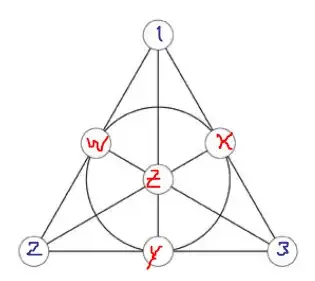
with lines
\begin{array}{ccc}
12w & 13x & 23y\\
1yz & 2xz & 3zw\\
&xyw&
\end{array}
which is easily seen to be disjoint from our starting plane.
Now we attempt to add a third plane, one that still avoids the line $\{1,2,3\}$. We have enough lines to avoid that it's best to keep them in mind, and attempt to place $x, y, z, w$ around the restrictions:
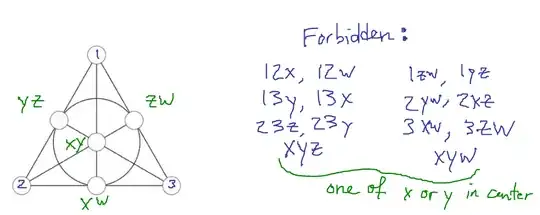
In the picture, the green letters are the only possible values for a certain spot (we can't have $x$ in the line with $1$ and $2$, since we've already used the line $12x$, and so on, for the straight lines). The fact that the two circles have been lines $xyz$ and $xyw$ means that we can't use both $x$ and $y$ in the circular line. Thus, each point has two possibilities. By making a single choice, the rest of the points are completely determined.
Alas, neither choice has a happy ending:
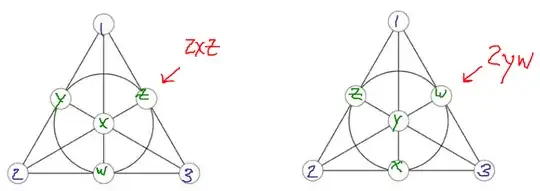
So to recap, we've only managed to find a pitiful pair of disjoint Fano planes from the $24$ that avoid the line $\{1,2,3\}$. But maybe we can find a plane containing $\{1,2,3\}$ that's disjoint from ours (spoiler alert: We cannot).
Using the template above (but $x, y, z, w$ instead of $4, 5, 6, 7$) for a plane containing $\{1,2,3\}$, we write possibilities for the three to-be-labeled points in green. We also have the same Forbidden lines from our two disjoint planes.

Using each of the Forbidden lines with two letters (e.g., $2$ can't go at the top because the line $2yw$ has already been used), we are able to narrow down the possibilities.
But, to our shared dismay, $2$ is needed in two places, and we cannot find another Fano plane, disjoint from our two. As we have been working in full generality, no set of two disjoint Fano planes can be expanded to a set of three or more pairwise disjoint Fano planes.


