Antoine's necklace is a pathological embedding of the Cantor set into $\Bbb R^3$. The second iteration looks like this:
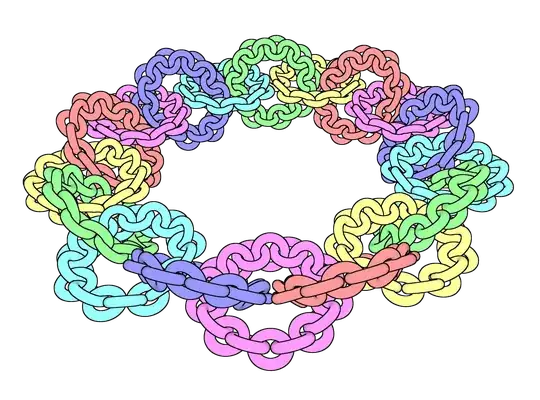
Interestingly, the complement $\Bbb R^3\setminus\rm A$ is not simply connected. This property is preserved by ambient isotopies. (Thanks, @MikeMiller!) Anything with an ambient isotopy to what's defined in the article, then, should be considered to be an Antoine's necklace.
What happens when you project the necklace onto a plane? That is, if $\pi:\Bbb R^3\to\Bbb R^2$ is a projection, what is $\pi({\rm A})$? I'm sure you don't get another Cantor set. In fact, it seems like it would always be connected. My guess is that it must be homeomorphic to the Sierpiński carpet. Is it?


