For convenience, $$x''+\omega^2x=0.$$
Solution 1:
Multiply by $2x'$, to get
$$2x'x''+2\omega^2xx'=0=(x'^2+\omega^2x^2)'.$$
After integration we get a separable equation
$$x'^2+\omega^2x^2=C^2,$$ or
$$\frac{x'}{\sqrt{A^2-x^2}}=\omega.$$
Integrating,
$$\arcsin\left(\frac x{A}\right)=\omega t+\phi.$$
Solution 2:
Let $D$ denote the differentiation operator. We can rewrite the equation as
$$(D^2+\omega^2)x=0$$ and factor
$$(D-i\omega)(D+i\omega)x=0.$$
Indeed, $(D-i\omega)(D+i\omega)x=(D-i\omega)(x'+i\omega x)=x''+i\omega x'-i\omega(x'+i\omega x)=x''+\omega^2x$.
If we define $y=(D+i\omega)x$, we need to solve
$$(D-i\omega)y=0,$$ i.e.
$$\frac{y'}y=i\omega.$$
The solution is easily found to be
$$y=Ce^{i\omega t}.$$
Now we need to solve
$$(D+i\omega)x=y=Ce^{i\omega t}.$$
The solution is found by combining the general solution of the homogenous equation, $C'e^{-i\omega t}$, found similarly, and a particular solution of the non-homogeneous equation.
When trying $y=C''e^{i\omega t}$, we have
$$C''i\omega e^{i\omega t}+C''i\omega e^{i\omega t}=Ce^{i\omega t}$$ which is a valid solution.
Then
$$x=C'e^{-i\omega t}+C''e^{i\omega t}.$$
As the solution must be real, it can be rewritten as
$$x=C'\cos(\omega t)+C''\sin(\omega t)=A\sin(\omega t +\phi).$$
Solution 3:
We recall that $(\sin(t))''=-\sin(t)$ and $(\cos(t))''=-\cos(t)$.
Then scaling with the coefficient $\omega$, $(\sin(\omega t))''=-\omega^2\sin(\omega t)$ and $(\cos(\omega t))''=-\omega^2\cos(\omega t)$.
These are two independent solutions of the differential equation, and as the equation is of the second order, the linear combination of these two functions is the general solution
$$x=C\cos(\omega t)+S\sin(\omega t).$$
Solution 4:
The characteristic equation is $\lambda^2+\omega^2=0$ and has the solutions $\lambda=\pm i\omega$. Hence the general solution
$$C_+e^{i\omega t}+C_-e^{-i\omega t}.$$
As we want a real solution, after expansion and cancelling of the imaginary part,
$$x=C\cos\omega t+S\sin\omega t.$$
Solution 5:
The equation is autonomous (no explicit appearance of time).
Let $v:=x'$. We have $x''=\dfrac{dv}{dt}=\dfrac{dv}{dx}\dfrac{dx}{dt}=v\dfrac{dv}{dx}$. The equation turns to
$$v\frac{dv}{dx}+\omega^2 x=0$$ or $$v^2+\omega^2 x^2=C$$ and we join the solution 1.
Solution 6:
Let us try the entire series $\displaystyle\sum_{n=0}^\infty a_nt^n$.
We get
$$\sum_{n=2}^\infty (n(n-1)a_nt^{n-2}+\omega^2a_nt^n)=0,$$
giving the recurrence
$$a_{n+2}=-\frac{\omega^2a_n}{(n+1)(n+2)}$$ and $a_0,a_1$ are free.
Hence,
$$x=a_0\sum_{n=0}^\infty(-\omega^2)^n\frac{t^{2n}}{(2n)!}+a_1\sum_{n=0}^\infty(-\omega^2)^n\frac{t^{2n+1}}{(2n+1)!}.$$
We recognize $a_0\cos(\omega t)+\dfrac{a_1}\omega\sin(\omega t)$.
Solution 7:
Let us try and find the Taylor development of $x$ around $t=0$. We have no information on $x_0:=x(0)$ nor $x'_0=x'(0)$, which are free parameters. Then
$$x''(0)=-\omega^2x(0)=-\omega^2x_0,\\
x'''(0)=-\omega^2x'(0)=-\omega^2x'_0,\\
x''''(0)=-\omega^2x''(0)=\omega^4x_0,\\
x'''''(0)=-\omega^2x'''(0)=\omega^4x'_0,\\
\cdots$$
Hence by induction,
$$x^{(2n)}(0)=(-\omega^2)^nx_0,\\x^{(2n+1)}(0)=(-\omega^2)^nx'_0.$$
Finally, in a way similar to solution 6, $x(t)=x_0\cos(\omega t)+\dfrac{x'_0}\omega\sin(\omega t)$.
Solution 8:
Let us rewrite the second order ODE as a system of the first order,
$$\begin{cases}x'=y,\\y'=-\omega^2x,\end{cases}.$$
In matrix form
$$\begin{pmatrix}x'\\y'\end{pmatrix}=\begin{bmatrix}0&1\\-\omega^2&0\end{bmatrix}\begin{pmatrix}x\\y\end{pmatrix}.$$
We know that the solution of such a system is obtained from the exponential of the matrix, itself a function of its Eigenvalues. The Eigenvalues are $\pm i\omega$ and the solution will be of the form
$$\begin{pmatrix}x\\y\end{pmatrix}=\begin{bmatrix}e^{i\omega}&0\\0&e^{-i\omega}\end{bmatrix}\begin{pmatrix}a\\b\end{pmatrix}.$$
For a real solution, we must have $b=a^*$.
Alternatively, we can compute the powers of the matrix, let $M$. We observe that
$$M^2=\begin{bmatrix}0&1\\-\omega^2&0\end{bmatrix}\begin{bmatrix}0&1\\-\omega^2&0\end{bmatrix}=\begin{bmatrix}-\omega^2&0\\0&-\omega^2\end{bmatrix}=-\omega^2I.$$
Hence the powers are alternatively $(-\omega^2)^{2n}I$ and $(-\omega^2)^{2n}M$, and we obtain the exponential as
$$\sum_{n=0}^\infty M^n\begin{pmatrix}x_0\\y_0\end{pmatrix}\frac{t^k}{k!}=\left(I\cos(\omega t)+M\frac{\sin(\omega t)}{\omega}\right)\begin{pmatrix}x_0\\y_0\end{pmatrix}.$$
Solution 9:
By Laplace,
$$\mathcal L(x''+\omega x)=s^2\mathcal Lx-sx_0-x'_0+\omega^2\mathcal Lx=0$$
and
$$\mathcal Lx=\frac{sx_0+x'_0}{s^2+\omega^2}.$$
Reverting to the original by means of a table,
$$x(t)=x_0\cos(\omega t)+\frac{x'_0}{\omega}\sin(\omega t).$$
The resolution by the Fourier transform is uneasy as it requires the use of distributions.
Solution 10:
We can integrate the equation numerically, for instance with a Runge-Kutta solver. But we have a dependency on three parameters, namely $\omega$ and the initial conditions $x(0),x'(0)$.
We can remove the first dependency by rescaling time, let $\tau:=\omega t$, giving
$$\ddot x+x=0.$$
Accordingly, we update the initial condition $\dot x(0)=\dfrac{x'(0)}{\omega}$. To remove the dependency on the initial conditions, we observe that the equation is (luckily) linear and it suffices to solve for the two canonical cases $x(0)=1,\dot x(0)=0$ and $x(0)=0,\dot x(0)=1$.
Here is a plot of the results of integration:
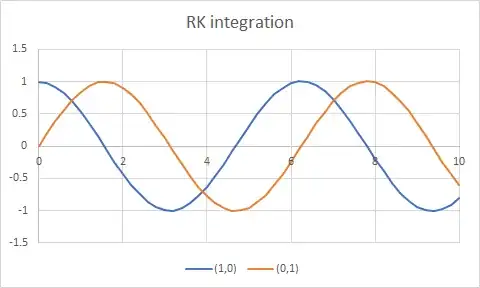
Now the general solution is a linear combination of these two canonical functions, that can be tabulated once for all.
Solution 11:
By Picard's method, we start with a linear solution that satisfies the initial conditions
$$z_0(t)=x'_0t+x_0.$$
Then we integrate $x''=-\omega^2x$ twice and still fulfilling the initial conditions, get
$$z_1(t)=x'_0t+x_0-\omega^2\int_0^t\int_0^t(x'_0t+x_0)dt=x'_0t+x_0-\omega^2\frac{t^3}{3!}x'_0-\omega^2\frac{t^2}2.$$
The next step yields
$$z_2(t)=x'_0t+x_0-\omega^2\frac{t^3}{3!}x'_0-\omega^2\frac{t^2}2+\omega^4\frac{t^5}{5!}x'_0-\omega^4\frac{t^4}{4!}$$
and one recognizes the pattern for the sine and cosine developments.


