You rescaled equation is incorrect, derivatives with respect to $x$ must also be transformed into derivative with respect to $X$. The easiest way to do this is with the chain rule,
$$ \frac{dy}{dx}=\frac{dy}{dX}\frac{dX}{dx}=\epsilon^{-\alpha}\frac{dy}{dX}. $$
So your rescaled equation is
$$\epsilon^{1-2\alpha}\frac{d^2Y}{dX^2}+(1+x_0+\epsilon^{\alpha}X)\epsilon^{-\alpha}\frac{dY}{dX}+Y=0, $$
or, separating powers of $\epsilon$,
$$\epsilon^{1-2\alpha}\frac{d^2Y}{dX^2}+(1+x_0)\epsilon^{-\alpha}\frac{dY}{dX}+X\frac{dY}{dX}+Y=0. $$
Now, the $XY'(X)$ and $Y$ terms will be smaller than the $\epsilon^{1-2\alpha}$ and $\epsilon^{-\alpha}$ terms, so we need to balance $-\alpha$ and $1-2\alpha$, which means $\alpha=1$, and our leading order equation is
$$ \frac{d^2Y}{dX^2}+(1+x_0)\frac{dY}{dX}=0. $$
The solution is $$Y=A\exp(-(1+x_0)X)+B$$ (this is the inner solution, or boundary layer solution). Now the inner solution should cannot grow exponentially out of a boundary layer, as if it did, you couldn't match it to the outer solution. This means you need the argument of $\exp$ ($-(1+x_0)X$) to be negative as $X$ goes out of the layer. If the layer is internal, you need $-(1+x_0)X=0$ as $|X|\rightarrow\infty$, if the layer is at the left end, you need $-(1+x_0)X<0$ as $X\rightarrow\infty$ and if the layer is at the right end of the interval, you need $-(1+x_0)X<0$ as $X\rightarrow-\infty$. Since $1+x_0\geq1$ we can only have a layer at the left end $x=0$.
The outer solution is what you get for $\epsilon=0$ in the unscaled equation,
$$(1+x)\frac{dy}{dx}+y=\frac{d}{dx}\left((1+x)y\right)=0,$$
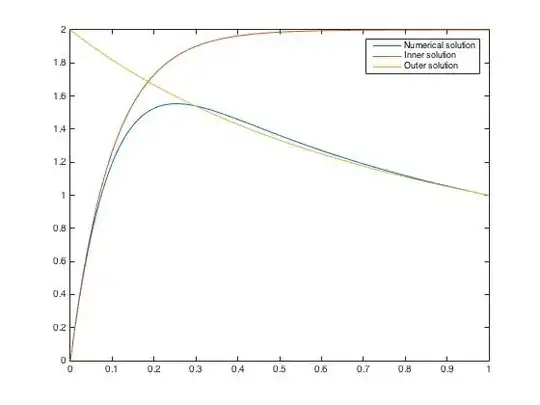
so $y=C/(x+1)$. If the boundary layer is at $x=0$ then the outer boundary condition is $y(1)=1$ so $C=2$.
To close the system you have to use matching conditions,
$$\lim_{X\rightarrow\infty}Y(X)=\lim_{x\rightarrow0}y(x) $$
which gives
$$\lim_{X\rightarrow\infty} A\left(e^{-X}-1\right)=2 $$
so $A=-2$ and $Y(X)=-2(e^{-X}+1)$. (Think about what would happen if we had $e^X$ instead of $e^{-X}$, this is why the layer had to be at $x=0$.)
And because they are always cool, here's the picture you get, for $\epsilon=0.1$, just to make sure.