There are two relevant geometric observations. Consider the following drawing of a quadrilateral with $\theta_1, \theta_2 \geq \frac{\pi}{2}$:
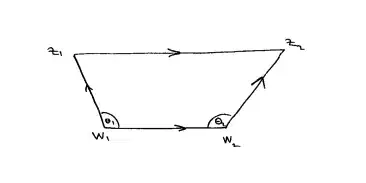
Then $|w_2 - w_1| \leq |z_2 - z_1|$. In order to prove it algebraically, we have
$$ \left< w_2 - w_1, w_2 - w_1 \right> = \left< (z_1 - w_1) + (z_2 - z_1) + (w_2 - z_2), w_2 - w_1 \right> = \\ \left< z_1 - w_1, w_2 - w_1 \right> + \left< z_2 - z_1, w_2 - w_1 \right> + \left< w_2 - z_2, w_2 - w_1 \right>.$$
Since $\theta_1 \geq \frac{\pi}{2}$, we have $\left< z_1 - w_1, w_2 - w_2 \right> \leq 0$. Similarly, since $\theta_2 \geq \frac{\pi}{2}$ we have
$$ \left< z_2 - w_2, w_1 - w_2 \right> = \left< w_2 - z_2, w_2 - w_1 \right> \leq 0. $$
Combining the inequalities and using the Cauchy-Schwarz inequality, we see that
$$ |w_2 - w_1|^2 = \left< w_2 - w_1, w_2 - w_1 \right> \leq \left< z_2 - z_1, w_2 - w_1 \right> \leq |z_2 - z_1||w_2 - w_1| $$
showing that $|w_2 - w_1| \leq |z_2 - z_1|$.
Now, to prove that the projection is distance-decreasing, consider the following drawing:
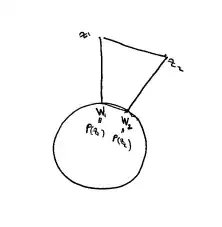
Recall that the projection $P$ satisfies $\left< z - P(z), x - P(z) \right> \leq 0$ for all $x \in C$. This means that the angle between $z - P(z)$ and $x - P(z)$ is greater than or equal to $\frac{\pi}{2}$. Geometrically, $z - P(z)$ lies on one half of the separating half-space at $P(z)$ while $x - P(z)$ lies on the other half. Applying this observation to $z = z_1, x = P(z_2)$ and $z = z_2, x = P(z_1)$, we see that we are in the situation described in the beginning of the answer and so the result follows.


