0

If a coin is flipped 1000 times, 600 are heads, would you say it's fair?

My first thought was to calculate the p-value. Assume it's fair, the probability of getting 600 or more heads will be

.5^1000 * (c(1000;600) + c(1000; 601) + ... c(1000, 1000))

but then it will be too hard to calculate. How to solve that other ways? Thanks!

tick
  • 1
  • 1
    The probability of getting exactly $600$ heads out of $1000$ flips of a fair coin is $\frac{\binom{1000}{600}}{2^{1000}}$ if that's what you're trying to ask. – barak manos Oct 22 '15 at 17:39
  • Here is another approximation: https://mathoverflow.net/questions/261428/approximation-of-sum-of-the-first-binomial-coefficients-for-fixed-n – NotMe Dec 31 '21 at 17:16

4 Answers4

2

If the coin were fair, then the standard deviation for $1000$ flips is ${1\over2}\sqrt{1000}\approx16$, so a result with $600$ heads is roughly $6$ standard deviations from the mean. If you're familiar with Six Sigma, you'll have grounds for suspecting the coin is not fair.

Barry Cipra
  • 81,321
1

You can bound the $p$ value as $$ \sum_{i=600}^{1000}\binom {1000}{i}2^{-1000}\le401\binom {1000}{600}2^{-1000}=1.9\times10^{-8} $$ which is very small. So I wouldn't say it is fair. There are more precise ways but since $600$ so far off the expected value, this rough method is sufficient.

DirkGently
  • 1,638
1

Just to add to Barry's Cipra answer: Your question follows The Binomial Distribution, hence:

$\mu=np={1\over2}*1000=500 $

and $\sigma=\sqrt{np*(1-p)}=\sqrt{1000*0.5*(1-0.5)}=15.8$

600 heads means you're looking at over 6 sigma! So to put it in perspective, with +3 sigma you're in the 99.7th percentile. Conclusion: coin is unfair.

enter image description here

adhg
  • 571
0

If the sample size $n$ is "large" and neither the success probability $p$ nor the failure probability $q=1-p$ is "too small", the binomial distribution is well approximated by the normal distribution with mean $\mu = n p$ and standard deviation $\sigma = \sqrt{n p q}$. To be more specific: If the three conditions $n\ge 50$, $n p \ge 10$, and $n q \ge 10$ are satisfied, the approx. is great. This can be checked by plotting the probability density functions, which I did for our example with $n=1000$, and $p=1/2$ in the region of interest:

enter image description here

In order to "resolve" the difference of the two probability densities here an other plot:
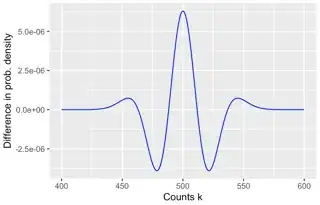
enter image description here

In order to keep it simple, I didn't add any "continuous correction" -- which exists for the approximation. Looking at the plots, we see that the approximation is great. Hence, we are allowed to use the normal approximation to estimate the probability. This was done by the others so I do not repeat it here.

NotMe
  • 559