This question was asked here some time ago. I answered it yesterday and a kind user told to not link notes, so I take a chance to put some math here.
As you can see the formula involves the cardinalities of sets, so it is quite natural to ask if you can bring $G$ to the other side and find an explicit isomorphism.
Let's agree on some notation:
$X$ is a $G$-set, it means that is a set with an implicit action of $G$ on it.
$O_x$ is the orbit of $x \in X$.
$G(x, y) = \{g \in G\, .\, y = g x\}$ is the "path space" between $x$ and $y$, so you think to them as "connections" between the two elements.
$G(x) := G(x, x)$ is then the stabilizer of $x$.
$X^g = \{x \in X\, .\, g x = x\}$ is the set of elements of $X$ fixed by $g$.
$X_G$ is the set of orbits, so it is the quotient of $X$ by the equivalence relation induced by the action.
What we want to prove now is that $\displaystyle X_G \times G \cong \sum_{g \in G} X^g$.
As you can find in most algebra textbooks(as Rotman) there is a relation between the fixed points and the stabilizers:
$\displaystyle \sum_{g \in G} X^g = \{(g, x)\, .\, g x = x\} = \sum_{x \in X} G(x)$
So our problem is equivalent to $\displaystyle X_G \times G \cong \sum_{x \in X} G(x)$, but this is just a "global" version of the orbit stabilizer theorem!
Here is a list of (almost) straightforward things I leave you to prove(I have no time right now, if some of them are not clear just ask, or search in the link I put on the other question):
If $y \in O_x$ then $G(x, x) \cong G(x, y)$.
$G(x, y) \cong G(y, x)$.
If $x_1 \sim x_2$ and $y_1 \sim y_2$ then $G(x_1, y_1) \cong G(x_2, y_2)$, in particular if $x \sim y$ then $G(x) \cong G(y)$.
Using all that and a bit of tricks on the sums, prove the orbit-stabilizer theorem: $O_x \times G(x) \cong G$.
Using all that and a bit of tricks on the sums, prove the global orbit-stabilizer theorem: $\displaystyle \sum_{x \in X} G(x) \cong X_G \times G$.
Addendum:
So, what you can do is to consider $X$ and for each point put an arrow from the point to himself for each element of his stabilizer. Here is an example of what can happen with a group of order $6$ acting on a set of order $11$:
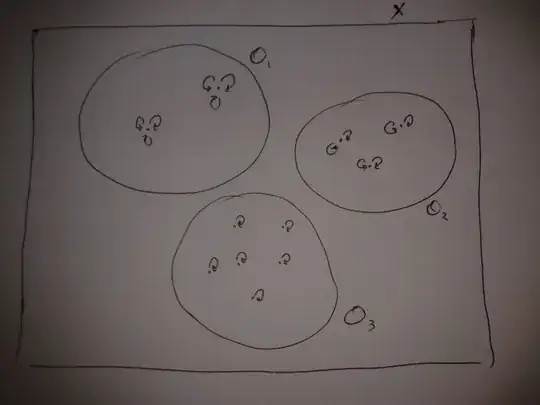
The elements of $X$ are grouped in their classes of equivalence. By (3.) you have a bijection between the sets of arrows of points in the same orbit, and using the orbit-stabilizer theorem you have a bijection between the arrows in one orbit and $G$, so in total you have a bijection between all the arrows of points in $X$ and the product of the orbit space and $G$.


