2

For the flow $A = \frac{c}{r}$ with $r=\sqrt{x^2+y^2+z^2}$ I wanted to calculate the velocity field with $\nabla A$ As a result I get $(-\frac{c}{r^2},0,0)$. So far so good. When I tried converting it to cartesian coordinates I'm stuck. I would have inserted the given $r$ in my solution however wolfram alpha & the solution suggest the solution in cartesian coordinates is: enter image description here
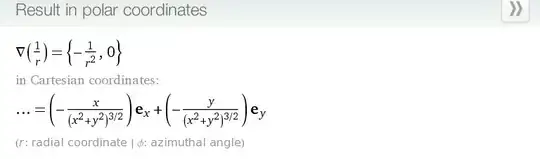
Converting with $x=\sqrt{x^2+y^2+z^2} \cos(0)$ does not really work. I'm sure I'm currently having a major blackout in seeing something elemental missing here.

idkfa
  • 145
  • 1
    See here: http://math.stackexchange.com/questions/586848/how-to-obtain-the-gradient-in-polar-coordinates – KittyL Aug 06 '15 at 14:04

1 Answers1

1

You cannot simply convert your expression for polar coordinates to cartesian because the operator is different in the systems. But the cartesian calcuation is easy (using $c=1$): $$\nabla A = \left(\frac{\partial}{\partial x}A, \frac{\partial}{\partial y}A\right) = \left(\frac{\partial}{\partial x}\frac{1}{\sqrt{x^2+y^2}}, \frac{\partial}{\partial y}\frac{1}{\sqrt{x^2+y^2}}\right) = \left(\frac{-x}{(x^2+y^2)^{3/2}}, \frac{-y}{(x^2+y^2)^{3/2}}\right) $$

gammatester
  • 19,147
  • Thanks! I know that using cartesian coordinates is not really a hassle however doing it in polar coordinates is easier. I thought since wolfram alpha showed the conversion that there is a way to convert the solutions. The flow stays the same anyway, I just use a different system to describe it, thus I should be able to describe my velocity field in both systems as well. Or would I have to convert beforehand as you did to get both results? I thought the operator is different to cover for the differences in the systems. – idkfa Aug 07 '15 at 07:12