10

Let $\displaystyle f(x)= \lim_{\epsilon \to 0} \frac{1}{\sqrt{\epsilon}}\int_0^x ze^{-(\epsilon)^{-1}\tan^2z}dz$ for $x\in[0,\infty)$.

Evaluate $f(x)$ in closed form for all $x\in[0,\infty)$ and sketch a graph of this function.

Hints, as well as solutions are welcome for this question :-)

Edit: So far, I have, from substituting $\sqrt{\epsilon}u$ = z,

$\displaystyle f(x)= \lim_{\epsilon \to 0} \int_0^{\sqrt{\epsilon}u} \sqrt{\epsilon}ue^{-(\epsilon)^{-1}\tan^2\sqrt{\epsilon}u}du$

But we can split the integral into two terms, with the first integral equal to zero, by dominated convergence theorem. I think we only need to look at:

$\displaystyle f(x)= \lim_{\epsilon \to 0} \int_0^{a} \sqrt{\epsilon}ue^{-(\epsilon)^{-1}\tan^2\sqrt{\epsilon}u}du$ + $\displaystyle \lim_{\epsilon \to 0} \int_a^{\sqrt{\epsilon}u} \sqrt{\epsilon}ue^{-(\epsilon)^{-1}\tan^2\sqrt{\epsilon}u}du$

= $$0+\displaystyle \lim_{\epsilon \to 0} \int_a^{\sqrt{\epsilon}u} \sqrt{\epsilon}ue^{-(\epsilon)^{-1}\tan^2\sqrt{\epsilon}u}du$$

(I'm not sure if integrating away from the origin helps much, to be honest.)

3 Answers3

6

Consider what happens on an interval $[n\pi-\frac\pi2,n\pi+\frac\pi2]$. Let $x=\tan(z)$ and $u=x/\sqrt{\epsilon}$, then $$ \begin{align} \lim_{\epsilon\to0}\frac1{\sqrt{\epsilon}}\int_{n\pi-\frac\pi2}^{n\pi+\frac\pi2}e^{-\tan^2(z)/\epsilon}\,\mathrm{d}z &=\lim_{\epsilon\to0}\frac1{\sqrt{\epsilon}}\int_{-\infty}^\infty e^{-x^2/\epsilon}\frac{\mathrm{d}x}{1+x^2}\\ &=\lim_{\epsilon\to0}\int_{-\infty}^\infty e^{-u^2}\frac{\mathrm{d}u}{1+\epsilon u^2}\\ &=\int_{-\infty}^\infty e^{-u^2}\,\mathrm{d}u\\[6pt] &=\sqrt\pi\tag{1} \end{align} $$ For all $\epsilon\gt0$, we have $$ \frac1{\sqrt\epsilon}e^{-\tan^2(z)/\epsilon}\le\frac{|\cot(z)|}{\sqrt{2e}}\tag{2} $$ Thus, for any $\lambda\gt0$, Dominated Convergence says $$ \lim_{\epsilon\to0}\frac1{\sqrt{\epsilon}}\int_{n\pi-\frac\pi2}^{n\pi+\frac\pi2}\big[|z-n\pi|\ge\lambda\big]e^{-\tan^2(z)/\epsilon}\,\mathrm{d}z=0\tag{3} $$ where $[\cdot]$ are Iverson Brackets. Combining $(1)$ and $(3)$ gives $$ \lim_{\epsilon\to0}\frac1{\sqrt{\epsilon}}\int_{n\pi-\frac\pi2}^{n\pi+\frac\pi2}\big[|z-n\pi|\lt\lambda\big]e^{-\tan^2(z)/\epsilon}\,\mathrm{d}z=\sqrt\pi\tag{4} $$ Limits $(3)$ and $(4)$ tell us that $\frac1{\sqrt\epsilon}e^{-\tan^2(z)/\epsilon}$ is an approximation of $$ \sqrt\pi\sum_{n\in\mathbb{Z}}\delta(z-n\pi)\tag{5} $$ where $\delta(z)$ is the Dirac delta function.

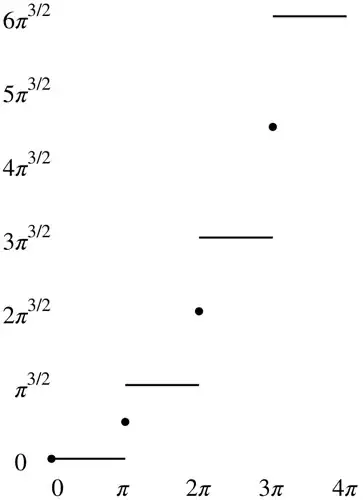
Thus, $$ \bbox[5px,border:2px solid #C0A000]{\lim_{\epsilon\to0}\frac1{\sqrt{\epsilon}}\int_0^xz\,e^{-\tan^2(z)/\epsilon}\,\mathrm{d}z =\left\{\begin{array}{} \displaystyle\pi^{3/2}\,\frac{\lfloor x/\pi\rfloor^2+\lfloor x/\pi\rfloor}2&\text{if }x\not\in\pi\mathbb{Z}\\ \displaystyle\pi^{-1/2}\,\frac{x^2}2&\text{if }x\in\pi\mathbb{Z} \end{array}\right.}\tag{6} $$ The plot would look something like

enter image description here

robjohn
  • 353,833
  • Mathematica concurs using f[x_,e_]:=1/Sqrt[e]NIntegrate[z Exp[-Tan[z]^2/e],{z,0,x},WorkingPrecision->20] – robjohn Jul 08 '15 at 10:01
  • @Dr.MV: The proof above shows that on $[n\pi-\frac\pi2,n\pi+\frac\pi2]$, $$\lim_{\epsilon\to0}\frac1{\sqrt\epsilon} e^{-\tan^2(z)/\epsilon} =\sqrt\pi\delta(z-n\pi)$$ so that on the whole real line $$\lim_{\epsilon\to0}\frac1{\sqrt\epsilon} e^{-\tan^2(z)/\epsilon} =\sqrt\pi \sum_{n\in\mathbb{Z}}\delta(z-n\pi)$$ which is given in line $(5)$. Thus, integrating against $z$ we get the sum of $\sqrt\pi,n\pi$ for each point $z=n\pi$ in the domain of integration. If the domain of integration ends at $n\pi$, then due to symmetry, we get half the value normally contributed at that point. – robjohn Jul 08 '15 at 14:25
  • Hi @robjohn, I've been studying your solution all day today and finally have some meaningful questions to ask: 1) we know the integrand goes to zero, if $tan^2$ is positive, since then the exponential factor of the integrand goes to zero exponentially fast - the 1/$\sqrt{\epsilon}$ does no harm. But wherever $tan^2$ is equal to zero, then the integrand blows up - since there is only a z/$\epsilon$ term in the integrand. But you showed that it is at the point of blow-ups of the integrand, namely when $sin^{2}$ is zero, which occurs at integer multiples of $\pi$, – User001 Jul 09 '15 at 01:29
  • that there is a nonzero contribution from the integration - $\sqrt{\pi}$ – User001 Jul 09 '15 at 01:30
  • do I have the right idea? so whichever x we are fixing as our upper limit, we are just counting the number of n$\pi$'s in our integration domain, and then multiplying $\sqrt{\pi}$ with consecutive integers (integration against z, as you called it), z = 1,2,3,... – User001 Jul 09 '15 at 01:35
  • and you showed that any z that is a positive distance away from n$\pi$ -- so, z not of the form n$\pi$-- gives a zero integral, by dominated convergence theorem. – User001 Jul 09 '15 at 01:37
  • I don't understand the piecewise defined function -- is it just the consecutive integers formula? – User001 Jul 09 '15 at 01:41
  • So, I'm just trying to make sense of it all. Thank you so much for posting this solution, @robjohn!! :-) – User001 Jul 09 '15 at 01:44
  • 1
    @LebronJames: I am out getting dinner. I will address your questions as soon as I can. – robjohn Jul 09 '15 at 01:54
  • Ok, enjoy!! Very exciting solution. I think I almost understand it all - you are indeed using the sum of consecutive integers formula, taking into account that x may not be an integer, so you're using the floor function to account for this case. :-) – User001 Jul 09 '15 at 01:56
  • @robjohn How did you arrive at inequality $(2)$ for all positive $\epsilon$? Take $\epsilon=4$ (yes, I know that we let $\epsilon \to 0$, but the bound states for all $\epsilon>0$), $z=\pi/3$ and we have $\frac{1}{\sqrt{\epsilon}}e^{-\tan^2z/\epsilon}=\frac12e^{-3/4}\approx. 0.236183$, while $\frac{1}{e\tan^z}=\frac{1}{3e}\approx. 0.122626$. So, the inequality seems to fail. Just curious ... how did you arrive at it? – Mark Viola Jul 09 '15 at 02:48
  • Hi @robjohn, I just have one question remaining for this problem: was the motivation to consider the interval you suggested coming from the fact that $tan^2$ is $\pi$ - periodic, so that perhaps ...if we knew the contribution of the integration over one period of the function, we pretty much know the integration over the whole real line? (I think the exponential function, composed with $tan^2$, is still periodic with the same minimum period, $\pi$.) Thanks, – User001 Jul 09 '15 at 03:44
  • 1
    @LebronJames: on $\big[-\frac\pi2,\frac\pi2\big]$, $\frac1{\sqrt\epsilon}e^{-\tan^2(x)/\epsilon}$ is a family of approximations to $\sqrt\pi$ times the Dirac delta function. Since $\tan^2(x)$ has a period of $\pi$, on $\mathbb{R}$, $\frac1{\sqrt\epsilon}e^{-\tan^2(x)/\epsilon}$ is an approximation to $\sqrt\pi$ times the sum of Dirac delta functions translated to $x=n\pi$. Thus, on an interval containing a neighborhood of $n\pi$, the integral of $\frac1{\sqrt\epsilon}f(x)e^{-\tan^2(x)/\epsilon}$ tends to $\sqrt\pi,f(n\pi)$. – robjohn Jul 09 '15 at 04:58
  • 1
    @LebronJames: on an interval ending at $n\pi$, the integral of $\frac1{\sqrt\epsilon}f(x)e^{-\tan^2(x)/\epsilon}$ tends to $\frac{\sqrt\pi}2,f(n\pi)$. In the case at hand, $f(x)=x$. – robjohn Jul 09 '15 at 05:01
  • @Dr.MV: Note that $\frac{\mathrm{d}}{\mathrm{d}\alpha}\alpha e^{-\alpha \tan^2(x)}=e^{-\alpha\tan^2(x)}(1-\alpha\tan^2(x))$. Thus, the maximum occurs when $\alpha=\frac1{\tan^2(x)}$; that is, when $\alpha e^{-\alpha\tan^2(x)}=\frac1{e\tan^2(x)}$. – robjohn Jul 09 '15 at 05:12
  • But that isn't the right-hand side. It is $\sqrt{\alpha}e^{-\alpha \tan^2(x)}$. So, it appears that this is the source of error. – Mark Viola Jul 09 '15 at 05:32
  • 1
    @robjohn It doesn't change the thrust of your development, but the bound you want to establish dominated convergence is $$\frac{1}{\sqrt{\epsilon}}e^{-\tan^2x/\epsilon}\le \frac{1}{\sqrt{2e\tan^2x}}$$However, doesn't the DC theorem require the dominating function be integrable? Neither $\cot^2x$ nor $|\cot x|$ are integrable on any interval containing a singularity. So, does that not invalidate the reasoning here? – Mark Viola Jul 09 '15 at 06:21
  • 1
    @Dr.MV: Oops... that is the bound, but that works as well. All we are trying to show with dominated convergence is $(3)$ and for that $|x|\ge\lambda$. Since $\frac1{\sqrt\epsilon}e^{-\tan^2(x)/\epsilon}\le\frac{\cot(\lambda)}{\sqrt{2e}}$, the integrands are bounded by $\frac{\cot(\lambda)}{\sqrt{2e}}$ on $|x|\ge\lambda$ and $|x|\lt\frac\pi2$ so the dominating function is integrable (bounded on a bounded set). – robjohn Jul 09 '15 at 08:58
  • 1
    I don't want to nit pick, but you need an absolute value sign on the cotangent for the bound. – Mark Viola Jul 09 '15 at 12:33
  • 1
    Indeed. Fixed in the answer. – robjohn Jul 09 '15 at 13:23
  • What would a sketch of the graph look like? I have a set of dots that are monotone increasing. In between these dots, I have a line going through the real axis (to show zero contribution away from n$\pi$...and then near n$\pi$ I connect the line on the real axis with the dot - to show a sharp spike upwards, and then sharply downwards back to the real axis (f(x) = 0). Then repeat for the other (higher) dots (point masses). So, this sketch would also be in line with what you described, @robjohn - I am just essentially sketching out a family of Dirac delta functions on $[0,\infty)$ – User001 Jul 09 '15 at 22:51
  • 1
    @LebronJames: between each pair of consecutive integers, the limit is constant. At each integer, the limit is exactly half way between the values in the neighboring intervals. So the graph is horizontal lines between the integers and points half way between at the integers. – robjohn Jul 09 '15 at 23:24
  • Ok, got it. Thanks so much @robjohn :-) – User001 Jul 10 '15 at 00:03
2

NOTE:

I wanted to give a special thanks to @robjon for his insightful comments.


We first observe that $\lim_{\epsilon\to 0}e^{-\tan z/\epsilon}=0$ unless $z=\ell \pi$, $\ell$ an integer. Therefore, all of the "action" of the integration will take place over intervals around $\ell \pi$. So, let's first see what is happening for $0<x<\pi/2$.


In the spirit of Laplace's Method, we have for $0<z<\pi/2$, $\tan^z =z^2+O(z^4)$ and thus for $0<x<\pi/2$

$$\begin{align} \epsilon^{-1/2}\int_0^xze^{-\tan^2z/\epsilon}dz&\sim\epsilon^{-1/2}\int_0^xze^{-z^2/\epsilon}dz\\\\ &=\epsilon^{-1/2}\left.\left(-\epsilon^{-z^2/\epsilon}\right)\right|_{z=0}^{z=x}\\\\ &=\epsilon^{1/2}\left(1-e^{-x^2/\epsilon}\right) \end{align}$$

which clearly goes to zero as $\epsilon\to 0$.


Next, we observe that the integration around singularities of the tangent function pose no challenge. Thus, for a general $(L-1)\pi<x<L\pi$, and $\delta >0$ we can write

$$\begin{align} \epsilon^{-1/2}\int_0^x ze^{-\tan^2z/\epsilon}dz&=\epsilon^{-1/2}\sum_{\ell=0}^{L-2}\left(\int_{\ell \pi+\delta}^{(\ell+1)\pi-\delta}ze^{-\tan^2z/\epsilon}dz+\int_{(\ell+1)\pi-\delta}^{(\ell+1)\pi+\delta}ze^{-\tan^2z/\epsilon}dz\right)\\\\ &+\epsilon^{-1/2}\int_{(L-1)\pi+\delta}^{x}ze^{-\tan^2z/\epsilon}dz \tag 1\\\\ \end{align}$$

We observe that in $(1)$ the only integrals that will contribute in the limit as $\epsilon \to 0$ are those around integer multiples of $\pi$. Thus, we have for $(L-1)\pi<x<L\pi$ and $\delta>0$

$$\begin{align} \lim_{\epsilon \to 0}\epsilon^{-1/2}\int_0^x ze^{-\tan^2z/\epsilon}dz&=\lim_{\epsilon \to 0} \epsilon^{-1/2}\sum_{\ell=0}^{L-2}\left(\int_{(\ell+1)\pi-\delta}^{(\ell+1)\pi+\delta}ze^{-\tan^2z/\epsilon}dz\right) \tag 2\\\\ \end{align}$$

We proceed to evaluate the integrals in $(2)$. To that end we have

$$\begin{align} \epsilon^{-1/2}\int_{(\ell+1)\pi-\delta}^{(\ell+1)\pi+\delta}ze^{-\tan^2z/\epsilon}dz &=\epsilon^{-1/2}\left(\int_{-\delta}^{\delta}ze^{-\tan^2z/\epsilon}dz+(\ell +1)\pi\int_{-\delta}^{\delta}e^{-\tan^2z/\epsilon}dz\right)\\\\ &=(\ell +1)\pi\epsilon^{-1/2}\int_{-\delta}^{\delta}e^{-\tan^2z/\epsilon}dz\\\\ &\sim (\ell +1)\pi\epsilon^{-1/2}\int_{-\delta}^{\delta}e^{-z^2/\epsilon}dz\\\\ &= (\ell +1)\pi\int_{-\delta/\epsilon^{1/2}}^{\delta/\epsilon^{1/2}}e^{-z^2}dz\\\\ &\to (\ell +1)\pi^{3/2} \end{align}$$

Summing over $\ell$ we find for $(L-1)\pi<x<L\pi$

$$\lim_{\epsilon \to 0}\epsilon^{-1/2}\int_0^xze^{-\tan^2z/\epsilon}dz=\frac{L(L-1)\pi^{3/2}}{2}$$

One final note concerns the case in which $x=L\pi$. For that case, we see that we need to add one more integral, namely

$$\begin{align} \lim_{\epsilon\to 0}\epsilon^{-1/2}\int_{L\pi-\delta}^{L\pi}ze^{-\tan^z/\epsilon}&=L\pi\int_{-\infty}^0e^{-z^2}dz\\\\ &=\frac12 L\pi^{3/2} \end{align}$$

Thus, for $x=L\pi$ we have

$$\lim_{\epsilon \to 0}\epsilon^{-1/2}\int_0^xze^{-\tan^2z/\epsilon}dz=\frac{L^2\pi^{3/2}}{2}$$

Putting it all together we have

$$\lim_{\epsilon \to 0}\epsilon^{-1/2}\int_0^xze^{-\tan^2z/\epsilon}dz= \begin{cases} \frac{L(L-1)\pi^{3/2}}{2},&(L-1)\pi<x<L\pi\\\\ \frac{L^2\pi^{3/2}}{2},&x=L\pi \end{cases} $$

Mark Viola
  • 184,670
  • Really cool solution, @Dr.MV. Can I ask a follow-up question? How'd you get the -2z^2? – User001 Jul 08 '15 at 05:37
  • Such a cool solution, @Dr.Mv. I was convinced that the answer couldn't possibly be zero, since that'd be trivial. I'm going to sleep and re-do this problem in the morning. Thanks so much!! Have a great night :-) – User001 Jul 08 '15 at 05:57
  • Hi @Dr.MV, actually, do we have to worry about the blow-ups from the tan function? +infinity is fine, but if it's -infinity, we get $e^{\infty}$ . Or is tan^2 always non-negative? – User001 Jul 08 '15 at 06:14
  • Yes, it's non-negative - the integrand doesn't blow up. Sorry, I'm just in a state of shock that the answer is equal to zero, I guess. – User001 Jul 08 '15 at 06:16
  • Ok, got it - I will redo this problem along with the version with $\epsilon^{-1}$ to see what I integrate and come up with. Thanks, @Dr.MV! Good night! – User001 Jul 08 '15 at 06:18
  • 1
    This only works for $x\lt\pi$. The interesting part comes when $x\ge\pi$. – robjohn Jul 08 '15 at 09:23
  • 1
    The part of your answer where you get $2z^2+O(z^6)$ is garbled. Are you claiming that $\tan^2(z)=2z^2+O(z^6)$? If so, that seems to be problematic as $\tan^2(z)=z^2+O(z^4)$. – robjohn Jul 08 '15 at 10:43
  • In the final answer, you need to have $(L-1)\pi\le x\lt L\pi$; otherwise, there may be multiple choices for $L$ given a particular $x$. – robjohn Jul 08 '15 at 18:19
  • @robjohn Yes, of course. I'll edit again. – Mark Viola Jul 08 '15 at 18:20
  • 1
    You note that $\lim\limits_{\epsilon\to0} e^{-\tan^2(x)/\epsilon}=0$. However, what is needed is $\lim\limits_{\epsilon\to0} \frac1{\sqrt\epsilon}e^{-\tan^2(x)/\epsilon}=0$ for $x\ne0$, and that $\frac1{\sqrt\epsilon}e^{-\tan^2(x)/\epsilon}$ is uniformly bounded in $\epsilon$ for $x$ away from $0$ (the last is so that we can use Dominated Convergence). – robjohn Jul 09 '15 at 00:35
  • 1
    @robjon I did note that and for purpose of gaining an understanding of where the "action" is in the integral. I don't see that this note is inappropriate. – Mark Viola Jul 09 '15 at 00:52
  • Hi @Dr.MV, thanks so much for this!! I think I finally understand this problem now :-) – User001 Jul 09 '15 at 02:46
  • 1
    @LebronJames You're quite welcome. And special thanks goes to Robjon for showing the way forward! – Mark Viola Jul 09 '15 at 02:50
1

For small $\epsilon$, $\tan^2(\sqrt{\epsilon} u ) \approx \epsilon u^2$, so the integral is of approximately $\sqrt{\epsilon}u e^{-u^2}$ which can be integrated.

marty cohen
  • 110,450