4

I've just taken Probability and Statistics exam and here is the question that becomes a hot debate among my friends in the classroom:

What is the median of a random variable that follows a Poisson distribution with parameter $\lambda=5$?

$(\text{A})\,\,\,4\quad\quad(\text{B})\,\,\,5\quad\quad(\text{C})\,\,\,6\quad\quad(\text{D})\,\,\,7\quad\quad(\text{E})\,\,\,8$

Here is my attempt:

Let $X$ be a random variable that follows a Poisson distribution with parameter $\lambda=5$, then we have $P(X\le4)\approx0.440493$ and $P(X\le5)\approx0.615961$. So, it's clearly the median $(x_{50})$ of $X$ is between $4$ and $5$, more precisely $x_{50}\approx4.32937026824559119408$ obtained by a computer program. Unfortunately, we are only allowed to use a simple scientific calculator so basically it's difficult to obtain that precise value using a simple scientific calculator by trial and error or Newton method due to time limit. I managed to obtain $x_{50}\approx4.33$ by trial and error method, so I answered $4$ because I rounded to the nearest integer. But some of friends argued and they answered $5$ because they used the nearest rank method, $x_{50}=\lceil4.33\rceil=5$.

What exactly is the answer? Please explain. Thanks.

Venus
  • 10,041

1 Answers1

5

A median is any value of $m$ for which it is true that $P(X \le m) \ge 0.5$ and $P(X \ge m) \ge 0.5$. Your calculations clearly show that this is satisfied for $m = 5$, and only $m = 5$, not any other real value. The Poisson is a discrete distribution defined on integers, so there can never be a single non-integer value which is THE median. The median for a distribution defined on integers must be either be a single integer as in this case, or a range of real values as would be the case for the binomial distribution for odd n which is symmetric about a non-integer. The range can include integers too if they have 0 probability. It makes no sense for you to be attempting to compute something to a large number of decimal places. If 4.1 doesn't satisfy the definition of median, then clearly 4.9 can't either since both have the same probability mass to the left and right. Less than 50% lies to the left, so more than 50% lies to the right. When we get to 5, more than 50% is less than or equal to 5, and so more than 50% will be greater than or equal to 5 too since this doesn't change. The mass on 5 gets included in both ranges.

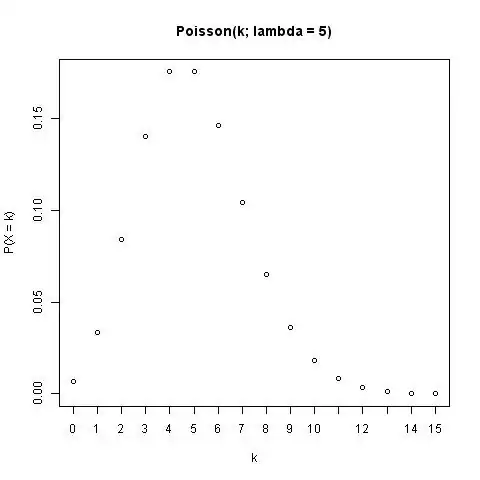
See the graph below of the Poisson pmf with $\lambda = 5$ for k from 0 to 15. If you look at the peak between k = 4 and k = 5, there is a slight asymmetry with more probability mass to the right than to the left since the distribution is skewed, so that represents more than 50% probability for $k \ge 5$ and less than 50% for $k \le 4$. But if we include the point at 5 and look at $k \le 5$, then that will easily be more than 50%.

Poisson(5)

BruceZ
  • 1,217