Quote of the Question to Make it Easier to Reference in the Answer
I am proving $(x^n)'=nx^{n-1}$ by the definition of the derivative:
$$ \begin{align}
(x^n)'&=\lim_{h \to 0} {(x+h)^n-x^n\over h}\\
&=\lim_{h \to 0} {x^n+nx^{n-1}h+{n(n-1)\over 2}x^{n-2}h^2+\cdots+h^n-x^n\over h} \\
&=\lim_{h \to 0} \left[ nx^{n-1}+{n(n-1)\over 2}x^{n-2}h+\cdots+h^{n-1} \right]
\end{align}
$$
Because polynomial is continuous for every $x$, we can conclude that $\lim_{x_0\to 0}(x_0)^n=0$. Therefore
$$\lim_{h \to 0} \left[ nx^{n-1}+{n(n-1)\over 2}x^{n-2}h+\dots+h^{n-1} \right]= nx^{n-1}$$
Is this proof valid?
Steps Towards the Answer
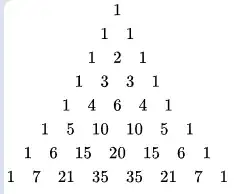
By application of the Binomial Theorem for example for $(x+y)^4$:
 The coefficient a in the term of $ax^by^c$ is known as the binomial coefficient
${\displaystyle {\tbinom {n}{b}}}$ or
${\displaystyle {\tbinom {n}{c}}}$ (the two have the same value). These coefficients for varying n and b can be arranged to form Pascal's triangle.
The coefficient a in the term of $ax^by^c$ is known as the binomial coefficient
${\displaystyle {\tbinom {n}{b}}}$ or
${\displaystyle {\tbinom {n}{c}}}$ (the two have the same value). These coefficients for varying n and b can be arranged to form Pascal's triangle.
The derivative of a constant $C$ $\left(n=0\right)$ is zero since $\displaystyle \lim_{h \to 0}\frac{C-C}{h}=\displaystyle \lim_{h \to 0}\frac{0}{h}=0$. Now when $\displaystyle \lim_{h\to 0}$ then for the case $n=1$:
$$x^{'}=\lim_{h \to 0}\frac{x+h-x}{h}=\lim_{h \to 0} \frac{h}{h}=1$$
Now consider $n \ge 2$ so that:
$$\lim_{h \to 0}\frac{(x+h)^n-x^n}{h}=
\lim_{h \to 0}\frac{
{\tbinom {n}{n}} \,x^n + h \, {\tbinom {n}{n-1}} \,x^{n-1}+
{\tbinom {n}{n-2}}\,x^{n-2}*h^2 + \, ...\text{Higher Order Terms of $h$}
-x^n}{h}
$$
Since the binomial coefficient ${\tbinom {n}{n}}=1$ and the binomial coefficient ${\tbinom {n}{n-1}}=n$ and $x^2-x^2=0$, then:
$$
\lim_{h \to 0}\frac{(x+h)^n-x^n}{h}=
\lim_{h \to 0}\frac{
n \, h \, x^{n-1}+
{\tbinom {n}{n-2}}\,x^{n-2}*h^2 + \, ...\text{Higher Order Terms of $h$}
}{h}
$$
Taking the limit $\displaystyle \lim_{h \to 0}$ where $\displaystyle \lim_{h \to 0} h=0 $ and Higher Order Terms of h $\displaystyle \lim_{h \to 0} \, \text{and (Higher Order Terms of h) } \to 0 \, \text{ so: }$
$$
\begin{align}
\lim_{h \to 0}\frac{(x+h)^n-x^n}{h}&=
\lim_{h \to 0}\frac{
n \, h \, x^{n-1}+
{\tbinom {n}{n-2}}\,x^{n-2}*h^2 + \, ...\text{Higher Order Terms of $h$}
}{h} \\
&=\lim_{h \to 0}
n \, x^{n-1}+
{\tbinom {n}{n-2}}\,x^{n-2}*h + \, ...\text{Higher Order Terms of $h$} \\
&=\lim_{h \to 0} n \, x^{n-1}=n \, x^{n-1}
\end{align}
$$
So,
$$\boxed{
\left(x^n\right)^{'}=\lim_{h \to 0}\frac{(x+h)^n-x^n}{h}=n \, x^{n-1}
}$$
And the proof is complete. Aside from a few formalities and additional details, these were basically the same steps as summarized with the question's proof. So the summary proof in the question is complete and correct.


