It is not true in general that a bounded holomorphic function on the unit disk extends continuously to the boundary. This answer by Jonas Meyer explains how to construct such a function explicitly using Blaschke products.
However, if you believe the Riemann mapping theorem, there is a quick geometric way to construct a counterexample. Consider the following closed subset of the plane:
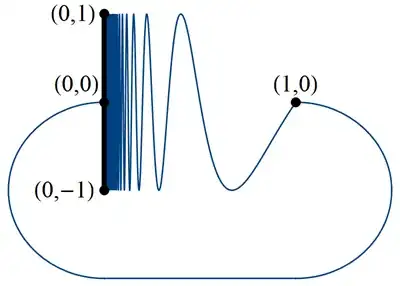
This is a variant of the famous topologist's since curve, and consists of the graph of $y = \sin(\pi/x)$ for $0<x<1$ together with the line segment from $(0,-1)$ to $(0,1)$ and a curve from the point $(0,0)$ to the point $(1,0)$.
Let $U$ be the interior region, i.e. bounded component of the complement of this closed set. Then $U$ is open and simply connected, so there exists a Riemann map $f\colon\mathbb{D} \to U$, where $\mathbb{D}$ is the open unit disk. The function $f$ is holomorphic and bounded, but $f$ cannot extend continuously to the boundary of the disk, since the boundary of $U$ isn't a continuous image of a circle.


