6

I am actually not familiar with topology, but since we had a short outlook on these things in our differential geometry lecture today, I would appreciate some general remarks:

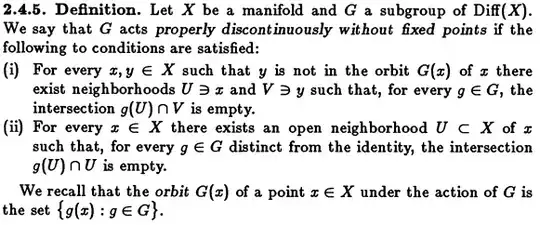
Let $M$ be a smooth manifold and $\Gamma$ a group of diffeomorphisms on $M$, then

$\Gamma$ is called properly discontinuous, if 1.) and 2.) hold.

$1.) \forall p \in M \exists p\in U$ (open nbh.)$ \forall \phi \in \Gamma \backslash\{id\}: \phi(U) \cap U = \emptyset. $

This seems to tell me that there is basically no fixed point under such a non-trivial diffeomorphism (even more, we get that we can separate the image by an open nbh.)

$2.) \forall p,q \in M,$where $q$ is not in the orbit of $p$ there are open nbhs $U(p),U(q)$ such that $\phi(U(p)) \cap U(q) = \emptyset$ for all $\phi \in \Gamma.$

First question: I feel that the second property is often skipped in textbooks, but don't know why?! To me, it seems to be similar to a Hausdorff property in $M/\Gamma.$

Now, we showed that such a group $\Gamma$ implies that $M/\Gamma$ is again a manifold and the projection $\pi: M \rightarrow M/\Gamma$ is a covering map. In this sense $\Gamma$ can be regarded as the group of deck transformations. If $M$ is simply connected, then this group can be also considered as the fundamental group of $M / \Gamma.$

Second question: If I understand this correctly, then the converse also holds. $M/\Gamma$ is a manifold, only if $\Gamma$ acts properly discontinuous on $M$?

Third question: In this thread Lee Mosher argues that properly discontinuous is not sufficient to conclude that $M \rightarrow M/\Gamma$ is a covering map (see his comments). Is this also true for my definition? Actually I don't understand why free action is not a corollary of my first part of the definition, cause it just means that the only group element that is allowed to have fixed points is the identity?

Jimmy
  • 1,585
wewasss
  • 787
  • 1
    Did you check out this math.OF thread? I believe property 1 corresponds to Type D there. – Alp Uzman Jun 10 '15 at 18:13
  • 1
    See my answer to this question. – Jack Lee Jun 10 '15 at 19:08
  • @JackLee thanks that clarifies it, I bet you also know the answer to question 2.) – wewasss Jun 10 '15 at 19:19
  • @JackLee could you please give me also a hint regarding the second question? – wewasss Jun 11 '15 at 07:22
  • 1
    The answer to your second question, as you posed it, is no. For example, the action of $\mathbb R$ on $\mathbb R^2$ by vertical translations has a quotient diffeomorphic to $\mathbb R$, but it's not properly discontinuous. But if you assume it's a covering space action (meaning that it satisfies your condition 1), then the quotient is a manifold iff the action satisfies condition 2. – Jack Lee Jun 11 '15 at 14:36

2 Answers2

2

Exactly the same group action (but named little differently) is in the book "Differential Geometry"on page 68 written by Marcel Berger and Bernard Gostiaux. enter image description here

Additonaly on the page 70 there is theorem of yours. It is done well with details. enter image description here

Back to your questions.

  1. You are perfectly right. In the proof of this theorem condition 2) starts to work, when we want to show that $M/\Gamma$ is Hausdorff.
  2. Hard question.
  3. Here we come back to the definition. Your group actually acts "properly discontinuously without fixed points (freely)." This additional condition makes the difference. (see the proof in the book I've mentioned)
Fallen Apart
  • 3,995
  • 2
  • 28
  • 42
  • I have troubles understand your point 3.) Why is the acts freely part not included in the first assumption of the definition? I don't see how 2.) is related to the acts freely? – wewasss Jun 10 '15 at 18:26
  • It is not included in the discussion you have linked. They mean something different than you when speak of proper discontinuous action. But you are right. Your definition truncated to this part is exactly the proper discontinuous action. – Fallen Apart Jun 10 '15 at 18:29
0

Let me address some issues raised in your question which are not addressed in the accepted answer.

First of all, when you see the expression "properly discontinuous" you should not assume that it is meant in the same sense you (whoever you might be) have in mind. I counted 6 inequivalent definitions of proper discontinuity used in the literature (and I probably missed some). Let me refer to the definition 1 in OP as PD1 and to 1 & 2 as PD2.

The definition that Lee Mosher had in mind in his comment in the linked answer is PD3 which different from PD1 and PD2! His definition PD3 allows for fixed points and can be written as:

For every compact subset $K$ of $M$, the subset $$ \{\gamma\in \Gamma: \gamma K\cap K\ne \emptyset\} $$ is finite. This definition allows non-free group actions (i.e. a non-identity element can have a fixed point). By my count, this is actually the most common definition. It is not hard to see that PD2$\Rightarrow$PD3 and, clearly, PD2$\Rightarrow$PD1.

Now, to your question 2:

Suppose that $\Gamma$ is a group of homeomorphisms of $M$ such that $M/\Gamma$ is a manifold. Does it follow that $\Gamma$ acts properly discontinuously on $M$?

As Jack Lee noted in his comment: regardless of what definition of proper discontinuity you use, the answer is negative. For instance, we can take $M={\mathbb R}^n$ and $\Gamma\cong {\mathbb R}^m$, $0<m\le n$, a group of translations acting on $M$ (and preserving a splitting of ${\mathbb R}^n$ as ${\mathbb R}^n={\mathbb R}^m \oplus {\mathbb R}^{n-m}$). Then the quotient $M/\Gamma$ is homeomorphic to ${\mathbb R}^{n-m}$ but the action is not properly discontinuous in any sense.

Let's modify this question and, assume additionally, that the quotient $M/\Gamma$ has the same dimension $n$ as $M$. Then the answer is still negative if one were to use PD1:

Take $M={\mathbb R}^2$ and the group $\Gamma$ of order 2 generated by the involution $(x,y)\mapsto (-x,-y)$. Then the action is not free (hence, fails PD1) but $M/\Gamma$ is homeomorphic to ${\mathbb R}^2$.

It is easy to see, however (and it was already observed in the OP) that if $M/\Gamma$ is Hausdorff, then Property 2 in the OP holds. This leaves us with two questions, which, I think, are open problems:

Question 1. Suppose that $M/\Gamma$ is a manifold of the same dimension as $M$. Does $\Gamma$ satisfy PD3?

Question 2. Suppose that $M/\Gamma$ is a manifold of the same dimension as $M$ and the action of $\Gamma$ on $M$ is free. Does $\Gamma$ satisfy PD1? (Which then would imply PD2.)

Moishe Kohan
  • 111,854