5

I am trying to prove the following using complex analysis:

$$\sum_{n=-\infty}^{\infty}\frac{(-1)^{n}}{a^{2}+n^{2}}=\frac{\pi}{a\sinh(a\pi)}$$

I am told to use the following function:

$$f(z)=\frac{1}{(a^{2}+z^{2})\sin(\pi z)}$$

So we note that $f(z)$ has singularities at $z = \{\pm i a, n\}$, where $n \in \mathbb{Z}$. We can use the following contour (which I will call $\Gamma$):
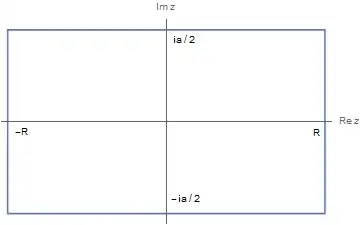
                                    Contour

By Cauchy's Residue Theorem, we have:

$$\lim_{R \to \infty}\oint_{\Gamma}f(z)\:\mathrm{d}z=2\pi i \sum_{n=-\infty}^{\infty}\operatorname{Res}(n,f(z))$$

We can compute the residue at each point:

$$\operatorname{Res}(n,f(z))=\frac{(-1)^n}{\pi(a^{2}+n^{2})}$$

So we have:

$$\lim_{R\to \infty}\oint_{\Gamma}f(z)\:\mathrm{d}z = 2\pi i \sum_{n=-\infty}^{\infty}\frac{(-1)^{n}}{a^{2}+n^{2}}$$

But we have that:

$$\begin{align*}\lim_{R\to\infty}\oint_{\Gamma}f(z)\:\mathrm{d}z = \lim_{R\to\infty}\Bigg(I &+ \int_{-\frac{a}{2}}^{\frac{a}{2}}\frac{\mathrm{d}y}{(a^{2} + (R + iy)^{2}\sin(\pi(R + iy))} \\ &+ \int_{R}^{-R}\frac{\mathrm{d}x}{(a^{2} + (x + ia/2)^{2})\sin(\pi(x+ia/2))} \\ &+ \int_{\frac{a}{2}}^{-\frac{a}{2}}\frac{\mathrm{d}y}{(a^{2} + (iy - R)^{2})\sin(\pi(iy - R))}\Bigg)\end{align*}$$

However, I'm not not sure how to proceed? I'd be grateful for any hints!

Mark Viola
  • 184,670
  • what is $I$ ? Furthermore the trick here is to convert the sum of the infinite set of residues into the sum over the two additional ones at $z=\pm ia$ – tired Jun 07 '15 at 17:41
  • Despite of the nice answer below, there is a way to do it with your contour. so if you are interested, please let me know! – tired Jun 07 '15 at 17:45
  • @tired I think the OP would benefit from seeing alternative approaches. So, ... definitely – Mark Viola Jun 07 '15 at 17:49
  • @tired it would be great to see an alternative approach! I'm new to complex analysis so the more the better! – Thomas Russell Jun 07 '15 at 17:54
  • Done, hope you enjoy it. Ask if there are any questions! – tired Jun 07 '15 at 18:09

2 Answers2

4

Change the contour to a square box $C_{R}$ of sides $2R$ and centered at the origin. The residues are from singularities at $z=\pm i$ and $z=n$ for all integers $|n|<R$ .

The residues at $z=\pm i$ are both equal to

$$\frac{1}{2ia\sin(\pi ia)}=-\frac{1}{2a \sinh(\pi a)}$$

The residues at $n$ are given by

$$\frac{(-1)^n}{\pi(a^2+n^2)}$$

It is easy to show that

$$\lim_{R\to \infty }\oint_{C_{R}}\frac{1}{(a^2+z^2)\sin(\pi z)}dz=0$$

since $\sin (\pi z) = \sin (\pi x)\cosh (\pi y)+i\cos(\pi x) \sinh (\pi y)$ grows exponentially on each side of the box.

Thus,

$$\lim_{R\to \infty}\oint_{C_{box}}\frac{1}{(a^2+z^2)\sin(\pi z)}dz=2\pi i\left(\sum_{n=-\infty}^{\infty}\frac{(-1)^n}{\pi(a^2+n^2)}-\frac{1}{a\sinh(\pi a)}\right) =0$$

implies that the sum of the residues is zero. This gives

$$\sum_{n=-\infty}^{\infty}\frac{(-1)^n}{a^2+n^2}=\frac{\pi}{a\sinh(\pi a)}$$

as was to be shown!

Mark Viola
  • 184,670
3

Ok i will give an answer using the original contour:

As the questioner correctly mentioned, by looking into the $\textbf{INTERIOR}$ of the contour we get (Limit $R\rightarrow \infty$ is implicit) $$ \oint_{\Gamma}f(z)=2 \pi i\sum_{n=-\infty}^{\infty}\frac{(-1)^n}{(n^2+a^2)\pi} \quad (1) $$

But if we are looking at the $\textbf{EXTERIOR}$ of the contour we get (because the big semicircles in the upper/lower halfplane will vanish)

$$ \oint_{\Gamma}f(z)= -2 \pi i(\text{ res}[ia]+\text{ res}[-ia])= 2 \pi i\frac{1}{a\sinh(\pi a)} \quad (2) $$

the minus sign is for reverting the path of integration. So all what's left is to put $(1)=(2)$ and therefore:

$$ \frac{\pi}{a\sinh(\pi a)}=\sum_{n=-\infty}^{\infty}\frac{(-1)^n}{n^2+a^2} $$

Remark: $\textbf{EVERY}$ contour which encloses the the real axis can be used for this trick, as long as no singularities in the rest of the complex plane are crossed

tired
  • 12,588
  • This is very clever, I didn't realise that you could consider the interior and exterior of the contour integral just by reversing the integration direction. This is extremely useful to me, thanks! – Thomas Russell Jun 07 '15 at 18:12
  • thanks, you are welcome! in theoretical physics this kind of trick is called "Matsubara summation" and is widely used, so tons of interesting material if you are interested!! – tired Jun 07 '15 at 18:14
  • That's very useful, I will take a look - you've helped me a lot! – Thomas Russell Jun 07 '15 at 18:15