I was reading on wavelets and it seems that its hard to find a precise mathematical definition of what this concept is. My confusion first arose due to Gilbert Stang's linear algebra book. In particular consider the following extract:
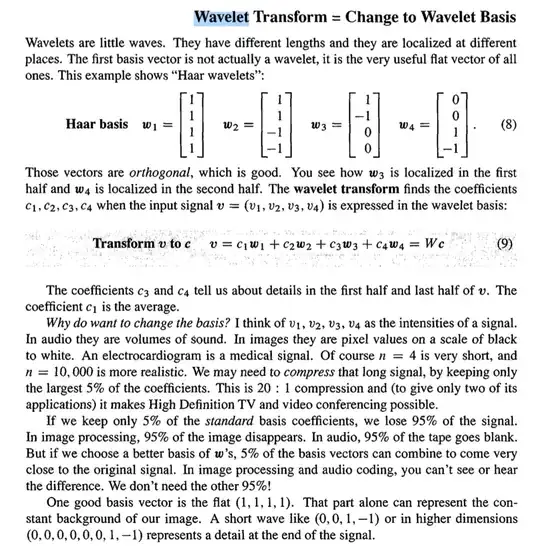
It talks about how to change a vector from one basis to another but it never rigorously defines what a wavelet is (by the way, I did understand that extract I included, just not the concept of "wavelet"). From my understanding, some special basis are called wavelets (for some special reason). But which basis are we allowed to call wavelets? I would assume that they have something to do with linear algebra and oscillation/sinusoidal functions but I don't really see what the relation between the two is.
To look for an alternative explanation I went to wikipedia and the initial paragraph starts as follows:
A wavelet is a wave-like oscillation with an amplitude that begins at zero, increases, and then decreases back to zero. It can typically be visualized as a "brief oscillation" like one might see recorded by a seismograph or heart monitor. Generally, wavelets are purposefully crafted to have specific properties that make them useful for signal processing. Wavelets can be combined, using a "reverse, shift, multiply and integrate" technique called convolution, with portions of a known signal to extract information from the unknown signal.
With that description it makes me feel that wavelets are actually functions. However, I've had difficulty understanding this precisely, specially when trying to relate it to linear algebra. I guess I am having a hard time connecting the three, wavelets, linear algebra and their relations to sinusoidal functions (if there is any relation to them).


