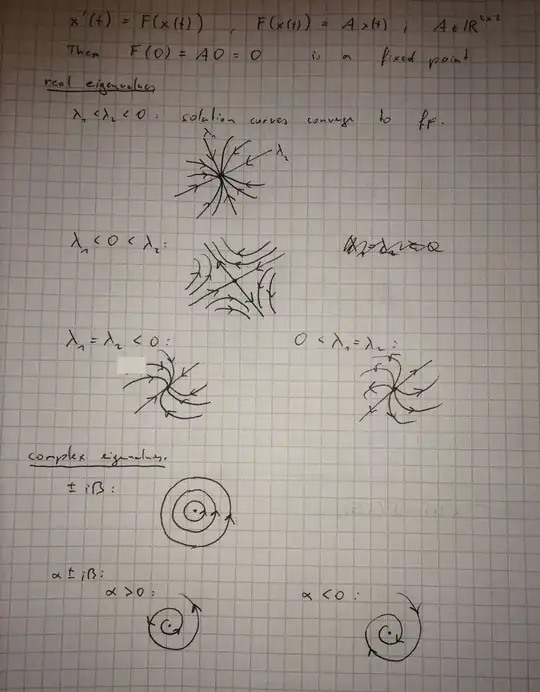
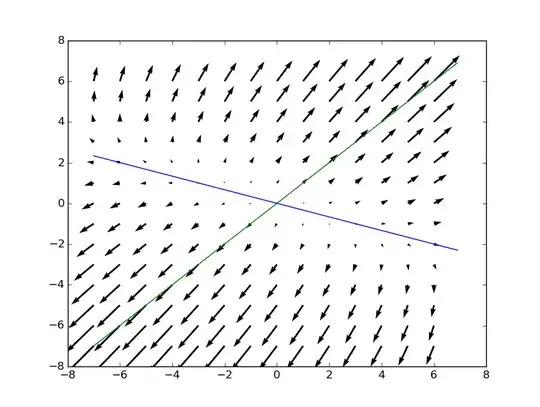
Consider a linear ODE system of the following form: $$ \frac {dx} {dt} = Ax $$ In case $A$ has real eigenvectors, I can interpret them as the directions in which the system will move, if the initial value is already a point on the eigenvector. The eigenvalues corresponding to each eigenvector would tell me whether the system approaches the fixed point (negative eigenvalue) or moves away from it (pos. eigenvalue). The plot below shows an example vectorfield for the case $ A = \left( \begin{array}{cc} 2 & 3\\ 1 & 4 \end{array} \right) $, in which the Jacobian $A$ has eigenvalues $1$ and $5$ and eigenvectors $\left( \begin{array}{c} -3 \\ 1 \end{array} \right)$ (blue) and $\left( \begin{array}{c} 1 \\ 1 \end{array} \right)$ (green).
Plot of real eigenvectors:
My question is how to interpret the eigenvectors in case they are complex? If the Jacobian has complex eigenvectors, this means the eigenvalues are also complex, so the system will oscillate. Do the complex eigenvectors tell me something about the rotational axis of these oscillations?
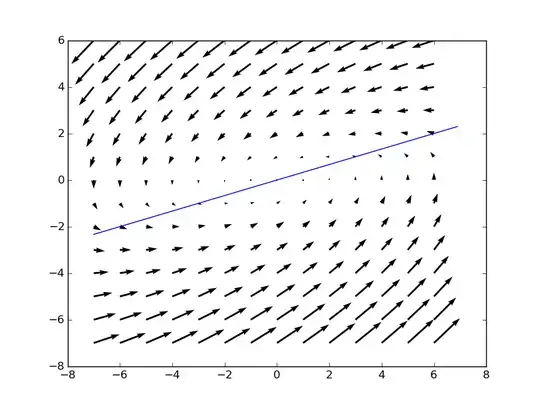
I have plotted the vectorfield of several linear oscillatory systems and to me it seems like the real part of eigenvector points in the direction of the ellipse in which the system oscillates. Here is the vectorfield plot for the system $$A = \left( \begin{array}{cc} 0 & -3\\ 1 & -2 \end{array} \right)$$ ( eigenvalues are $-1 \pm \sqrt{-2}$). The real part of the eigenvector is shown in blue.
Plot of complex eigenvectors:
If this is correct, how can I interpret the imaginary parts of the eigenvectors? Could you maybe point me out an article or a book in which this is explained?