9

Let $γ : I→R^3$ be a regular parametrization of a curve C. If asked what a vector field on C is I would perhaps answer like this:

1) "a smooth function $v$ associating to any point $γ(t)$ of C an element of the tangent space of $R^3$ at $γ(t)$".

An alternative answer: 2) "a smooth function $f$ associating to any t $∈$ I an element of the tangent space of $R^3$ at $γ(t)$".

My question: is the second answer technically wrong? Thanks.

1 Answers1

14

In fact, I'd prefer the second definition - it's what Lee uses in his Riemannian Manifolds book:

enter image description here

This allows a curve to intersect itself at a point in different directions while being able to record this fact in the velocity vector. I think if one takes seriously the idea that "curve" refers to the map $\gamma:I\to M$, and not its image $\gamma(I)\subset M$, then this is the right definition.

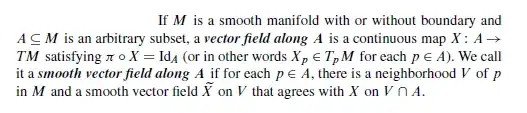
However, I'd say your first definition is appropriate if you're talking about vector fields on the subset $\gamma(I)$, having forgotten about $\gamma$. From Lee's Smooth Manifolds book:

enter image description here

Zev Chonoles
  • 132,937
  • 2
    The point about self intersections is a nice one! – John Hughes May 22 '15 at 16:04
  • 3
    Good answer. It really depends on whether you're thinking of "a curve" as a parametrized curve (i.e. a function from an interval into some space) or as a set of points (typically the image of some parametrized curve). To work with "vector fields along curves," it's usually most useful to work with the former interpretation, in which case the OP's second definition is the right one. – Jack Lee May 22 '15 at 16:25
  • @Jack Lee : And we use the differential structure of the tangent bundle of the manifold to determine smoothness of the assignment? – MSIS Feb 01 '22 at 00:14
  • 1
    @MSIS: Yes, that's right. – Jack Lee Feb 01 '22 at 00:17
  • @JackLee: Prof Lee, if I may please ignore otherwise. I'm trying to gain a better understanding of Covariant Differentiation. Is it the case that the Derivative Vector Field of a circle with the parametrization $(Cost, Sint)$ given by $(-Sint, Cost)$ is a Tangent Vector Field so that $(Cost, Sint)$ is the actual Covariant Derivative, since there are no non-tangential components to it? And the normal vector field N is never-tangent, so that it projects to the 0 vector on each tangent space, so that its Covariant Derivative is identically 0? – MSIS Feb 01 '22 at 00:26
  • @Jack Lee: If you prefer, I can write this as an actual question here, to make it easier, I hope, for you to answer. Hope I,m not too lost :). Can you think of a vector field on the circle whose derivative has non zero components of each? – MSIS Feb 01 '22 at 00:26
  • 1
    @MSIS: Yes, you should ask this as a separate question. – Jack Lee Feb 01 '22 at 00:29
  • Here it is, if you're available: https://math.stackexchange.com/questions/4371042/examples-of-covariant-differentiation. I hope I am not too lost :) – MSIS Feb 01 '22 at 00:42